
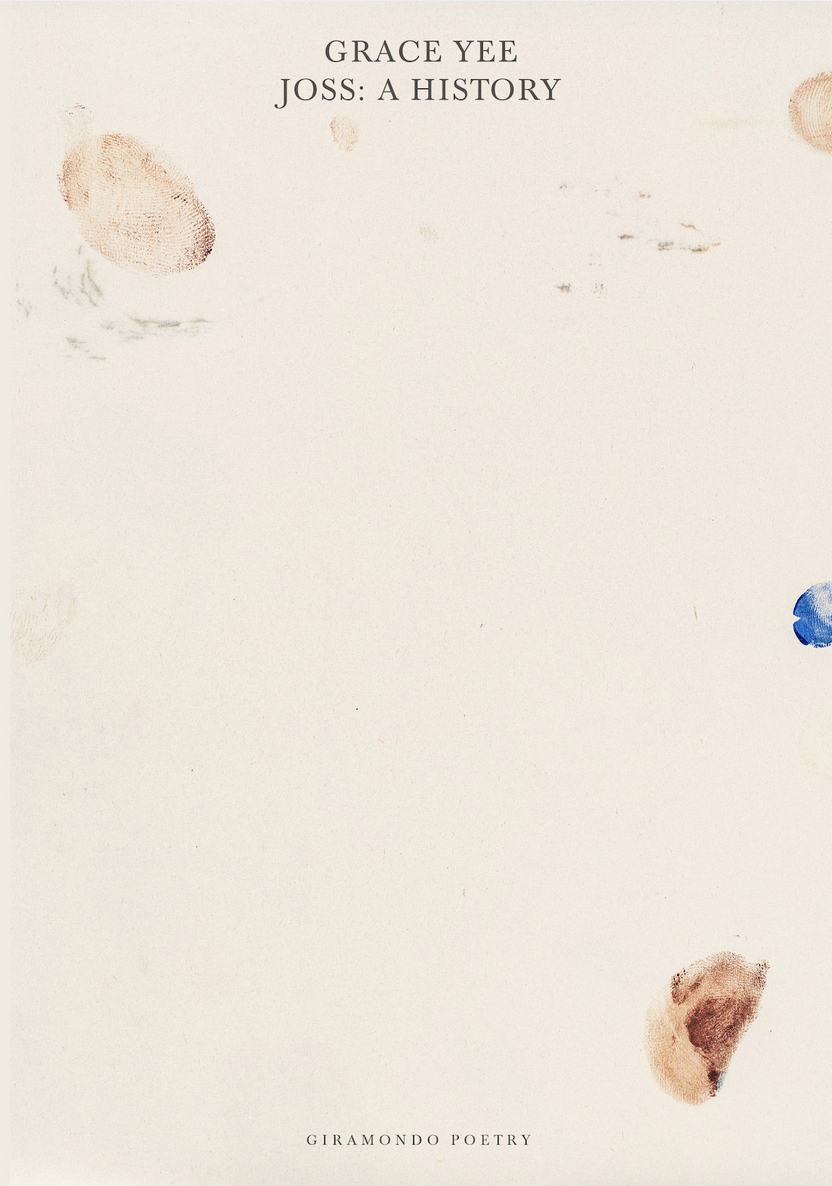
Joss: A History, Grace Yee
Giramondo Press, 2025
my father was not a gardener
but he was a handsome widespreading form descended from a
long-lived drought-resistant species.
every night he out-walked the doughnut boys ‘fuckin’ asians!’ out
in the street in their revved-up ford cortinas.
walking, he knew, was good for surveying the lie of the land and
building tolerance for life’s implacably white horizons.
in forty years, one hundred and twenty-five million steps graven
in the asphalt, relieving the pressure like a burr hole.
the woman he married was a graceful weeping habit (her beauties
severe and planed): a splendid courtyard specimen, unable to
grow in heavy soils.
nightly she waited for him: flashlight wedging the dark, bones
crumbling early, safe and dry.
discouraged by heavy staking and rectilinear boundaries, my
father, struck with leaves of variable light, was a legend among
biologists.
every evening he ventured into the wilderness, spade hands a
hundred feet deep in thought earth. the land he roamed was
densely populated:
sepia daughters, china, mother. heaving sea-plane, roiling ocean.
jock-the-border-collie flying in the rearview mirror. vauxhall viva.
blue.
dead brother. dead lover. whisky. codeine. lost keys a tilting door
nana mouskouri singing ‘you return to love’ carbon monoxide
filling his lungs like a lake in a bonsai forest.
rain hail sleet snow or interstellar dust, my father rode out to
orion’s belt in his sherlock hat, hohner harmonica + johnnie
walker + cat in tow. moths strumming the campfire.
when the embers fell, he’d pull up his collar and shuffle inside,
pausing a moment to gaze at the oak trees bathed in molasses on
the floors of the house.
Grace Yee
Early drafts of ‘my father was not a gardener’ were written in response to the word ‘solace’, a prompt I read somewhere – it might have been for a competition I ended up not entering.
The poem was inspired by my father, who suffered a stroke at the age of forty-four and during his rehabilitation, spent hours each day walking up and down the street. After he went back to work he continued walking, mostly in the evenings – it was a habit that kept him alive for decades, right up until the restrictions imposed by the pandemic in 2020 (he died in 2021).
He walked in all kinds of weather. In the winter, he would wear a thick scarf and the Sherlock hat with ear flaps that I bought for him in England. The stroke affected his balance: he had a wide-legged gait, more of a shuffle, slow but steady. Immediately after the stroke, he gave up cigarettes and took up chewing gum, so he’d walk and chew. Before the stroke, he’d been a whistler – after the stroke, he never whistled again.
At the time, it seemed to me that the stroke cleaved his life in two – before the stroke, he was young-ish and able-bodied and cheerful, and after, he became old and disabled and grumpy. I used to think the stroke was the most dramatic thing that ever happened to my father – but over the years, and after his passing at the age of 84, I came to realise that he had survived many upheavals, that the stroke was just one of them, and that even in the darkest underpasses of his life, there had been light.
My father was not a gardener: he had no patience for growing things for leisure or for work – he was never the stereotypical Chinese market gardener. But he did love poetry and philosophy and fiction and music and people and animals and nature. When I wrote that he was “struck by leaves of variable light, was a legend among biologists”, I meant that he was captivated by literature and trees, and the vast abstract and concrete worlds he lived in, and that despite his diminished capacity to engage, was in awe of it all.
Grace Yee
A Poetry Shelf review
Grace Yee’s multi-award winning debut poetry collection, Chinese Fish, adapted her collection from the Creative Writing and Cultural Studies PhD thesis that she completed at the University of Melbourne. The collection is rich in multiple voices, braided narratives, cultural inheritances. It is a probing reaction to immigration, hierarchies, overt and covert racism, and emerges from daily living, personal experience, feeling, reflection, research and a tremendous love of words. Her writing draws upon and borrows from diverse sources: New Zealand archives including newspapers; nonfiction works on gender and women; songs, radio documentary. Seven poem sequences gather the overlapping subject matter, the motifs, the linguistic melodies.
I return to this earlier collection because Joss: A History, equally acute and probing, steps off from the foundation stones in her debut book to shine further vital light on Chinese communities, present and past, in Australasia. I see this new collection standing in for the ‘joss’ stick held high, with its connotations of the divine, as a move both to respect and to honour. It’s a collection held high for us to see, hear and feel the chorus of assembled voices. Grace has sourced, borrowed and adapted text from multiple settings: museums, news media, diaries, novels and nonfiction books (see her comprehensive endnotes). From these precious fragments she is excavating, exhuming, exposing the heartbreaking gaps and cliches. Together the voices establish a matrix. It’s a throb. It’s a poetic finger on the pulse of ideas, circumstances, erasures, narratives that link past to present in myriad slippery ways.
We are taken to the White Hills Cemetery in Bendigo where a thousand plus ‘Chinamen’ are buried, many in unmarked graves, many with links back to south China’s Canton area. As Grace is discovering precious fragments in her reading and research, her discoveries – the buried, the eclipsed, the misrepresented, the exoticised – shift in the light and singe of her poetry. It’s poetry that is political, personal, shifting in form, layered with history yet never loosing touch with the present. And that is why this book matters so much. In these times. In these hard times where the past is a jagged edge in the gut and the heart of the present. And it needs to be. Grace reminds us the poem can be a vessel for thinking back, for carrying the pain of the world, for holding out possibilities for the paths forward. Poetry carries us beyond. Joss: A history carries us back and beyond, and that is a gift in this colonised world. Thank you.
Grace Yee was born in British Hong Kong, grew up in Ōtautahi, Aotearoa New Zealand and now lives in Melbourne, on Wurundjeri land. Her poetry has been widely published and anthologised in Australia and internationally. Her awards include the Patricia Hackett Prize, the Peter Steele Poetry Award, a Creative Fellowship at the State Library Victoria, and grants from Creative Victoria and the Australia Council for the Arts. She has taught in the creative writing programs at Deakin University, and at the University of Melbourne, where she completed a PhD on settler Chinese women’s storytelling in Aotearoa New Zealand. Her debut collection Chinese Fish won the 2024 Victorian Prize for Literature, the Victorian Premier’s Literary Award for Poetry, and the Mary and Peter Biggs Award for Poetry at the Ockham New Zealand Book Awards. Her second collection, Joss: A History, was published by Giramondo in June 2025 and longlisted for the Ockham New Zealand Book Award for Poetry.
Giramondo page
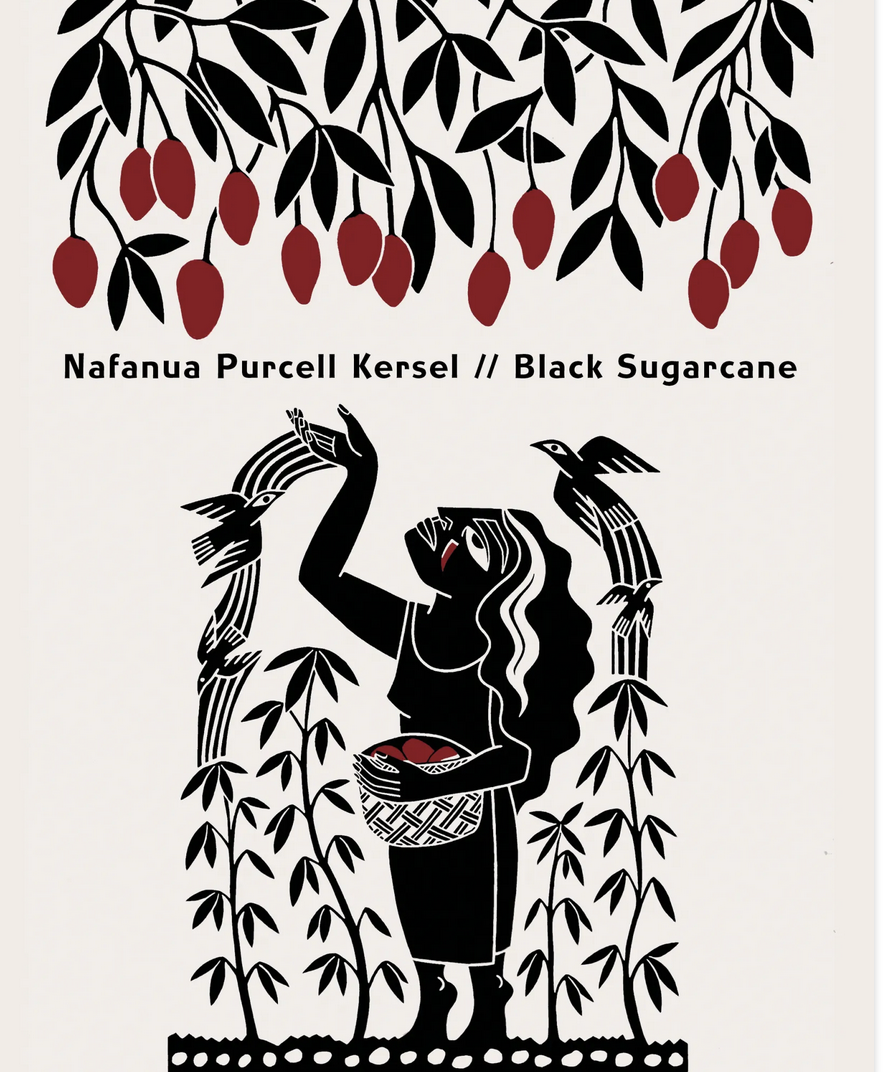
Black Sugarcane, Nafanua Purcell Kersel
Te Herenga Waka University Press, 2025
Moana Pōetics
We build a safe around our birth stones.
Craft it with a dream, a gourd, a drum-made
chant.
Pile it high with frigate bird bones,
song bones, bones of
cherished names.
We rub sinnet along our thighs and lash
our cache. Our stories kept sound, where words
and names and songs are not forgotten.
One day before, now, or beyond, something
with a heart drops a hank of its flesh
before us. It sounds like a drum and we know
it’s time
to undo the rope, iron-rock and bone-sand.
The stories, they tell us
that if we are the dark blue seas then we are
also the pillowed nights and days, soft with
clouds, spread half-open.
We are a tidal collection, hind-waters of the
forever we rally on, to break the staple
metaphors from the fringes.
Safe.
We sound together on a dance or
bark an intricate rhyme.
We, are the filaments of a devoted rope. We,
who contain a continuance and
call it poetry.
Nafanua Purcell Kersel
Nafanua Purcell Kersel’s debut poetry collection, Black Sugarcane is a book to savour slowly, with senses alert, ready to absorb the aroha, the myriad pathways, the songs, the prayers, the dance of living. The first line of the first poem, ‘Moana Pōetics’, is a precious talisman: ‘We build a safe around our birth stones.’ It is a found poem that uses terms from the glossary in Mauri Ola: Contemporary Polynesian Poems in English, edited by Albert Wendt, Reina Whaitiri and Robert Sullivan (Auckland University Press, 2010). The poem draws us deep into the power of stories, night and day, the ocean, safety, the power of rhythm. And that is exactly what the collection does.
The book is divided into five sections, each bearing a vowel as a title (ā, ē, ī, ō, ū), the macron drawing out the sound, as it does in so many languages like an extended breath. When I read of vowels in the poem, ‘To’ona’i’, the idea and presence of vowels lift a notch, and poetry itself becomes a ‘sweet refresh’, a warm aunty laugh: “Aunty Sia’s laugh is like a perfectly ripe pineapple / a sweet refresh of vowel sounds”.
Let me say this. There is no shortage of poetry books published in Aotearoa this year to love, to be enthralled and astonished by. We need this. We need these reading pathways. Sometimes I love a poetry book so much I transcend the everyday scene of reading (yes those bush tūī singing and the kererū fast-swooping) to a zone where I am beyond words. It is when reading is both nourishment and restoration, miracle and epiphany . . . and that is what I get with this book.
Begin with the physicality of a scene, a place, an island, a home. The scent of food being prepared and eaten will ignite your taste buds. Pies filled and savoured, luscious quince, the trickster fruit slowly simmered, a menu that is as much a set of meals as a pattern of life. Move into the warm embrace of whanau, the cousins, aunties, uncles, parents, grandparents, offspring. And especially, most especially, the grandmother and her lessons: ‘”If you want to learn by heart, / be still and watch my hands” (from ‘Grandma lessons (kitchen)’).
Find yourself in the rub of politics: the way you are never just a place name and that where you come from is a rich catalogue of markers, not a single word. The question itself so often misguided and racist. Enter the ripple effect of the dawn raids, or the Christchurch terrorist attack, or poverty, or climate change, crippling hierarchies. And find yourself in the expanding space of the personal; where things are sometimes explored and confessed, and sometimes hinted at. I am thinking pain. I am thinking therapist.
Find yourself in shifting poetic forms, akin to the shifting rhythms of life and living: a pantoum, a found poem, an erasure poem, long lines short lines, drifting lines. Find yourself in the company of other poets, direct and indirect lines to the nourishment Nafanua experiences as a writer: for example, Lyn Hejinian, Kaveh Akbar, Karlo Mila, Tusiata Avia, Selina Tusitala Marsh, Serie Barford, Konai Helu Thaman, Dan Taulapapa McMullin. So often I am reminded we don’t write within vacuums. We write towards, from and because of poetry that feeds us.
Bob Marley makes an appearance so I put his album, Exodus, on repeat as I write this. It makes me feel the poetry even more deeply. This coming together, this ‘One Love,’ this getting together and feeling alright, as we are still fighting, still uniting to make things better in a thousand and one ways.
I give thanks for this book.
Listen to Nafanua read here.
‘
Nafanua Purcell Kersel (Satupa‘itea, Faleālupo, Aleipata, Tuaefu) is a writer, poet and performer who was born in Sāmoa and raised in Te-Whanganui-a-Tara, Aotearoa. Her poetry has been widely published. She has an MA from the IIML at Te Herenga Waka—Victoria University of Wellington and won the 2022 Biggs Family Prize in Poetry for Black Sugarcane, her first book. She lives in Te Matau-a-Māui Hawke’s Bay.
Te Herenga Waka University Press page
 NZ Poetry Shelf