
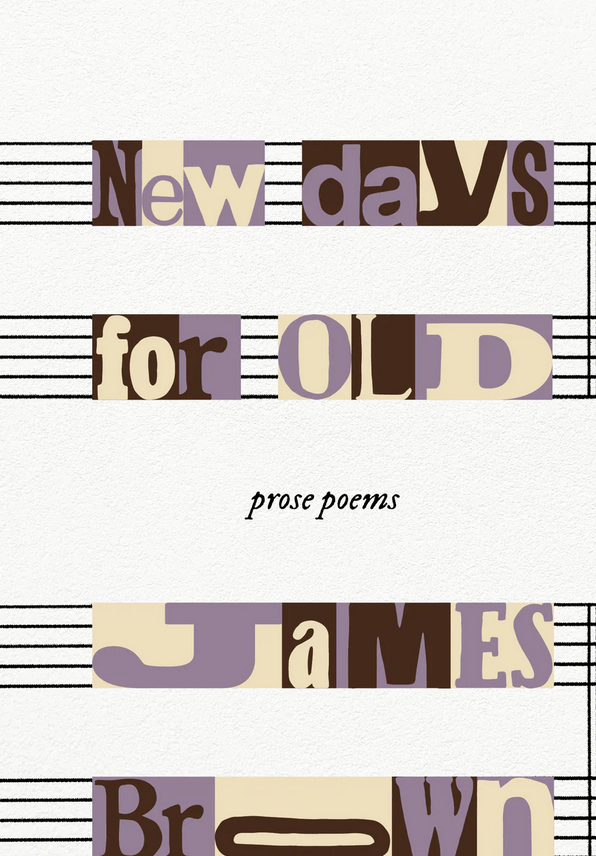
New Days for Old: prose poems, James Brown
Te Herenga Waka University Press, 2026
In my country of origin, far across the sea, the women
sweep the floors with what you would call broomsticks.
These are effective until their ends begin to fray and snap,
creating more debris than they clean away. This was also
the problem with our government, which is why my
father disguised us as suitcases and brought us here.
James Brown
from New Days for Old: prose poems
First up, I love the feel, shape and look of James Brown’s new poetry collection. Secondly, I love the title: New Days for Old. Thirdly, I love the choice of genre: a sequence of prose poems. And finally I love the opening quotation: “Much of the greatest art, I find, seeks to remind us of the obvious.” (Patrick Bringley, All the Beauty in the World: A Museum Guide’s Adventures in Life, Loss and Art).
I tip the quotation on its heels, borrow the word beauty, and get caught in a thinking whirlpool of beauty and wonder, the obvious and the ordinary. I was sidetrailed into musing on the small in the large as much as the large in the small.
Nothing like a glorious poetry eddy to get your senses tingling.
The opening prose poem is like a trinket box, like I’m entering a prose poem, a pocket narrative that is strange and unsettling all in one breath, that is finger tapping magic realism maybe, dystopian fiction, an arcing life story, the addictive openness of a Bill Manhire poem, and not to forget, never to forget, the brutal reality 2026.
On the back of the book Bill claims every poem in the book as his favourite, and I agree. It feels like I am in a unique treasure shop and I am agog with wonder, picking every prose poem up and holding it to the light to see it spin and shift and sparkle. Every poem is sense-catching. Think of the book as an unfolding life story, brimming with babies and childhood, delight and despair. It’s wit and it’s politics and its pocket narratives, it’s sonic fluency and it’s silence.
“We take lasagna round to John because ‘He’s fallen
through the cracks,’ says my mother. That must be why
it’s bad luck to step on them.'”
James’s metaphors resemble surprise packages the rural courier has just delivered – each is a receptacle of narrative possibilities. Plump with behind-the-scenes anecdotes. I am not sure if this idea works but I was thinking of metaphors as little foundation stones – extraordinary and glorious – upon which I get to build imagine remember things. This is poetry at its interactive best. Reading between and under and above the lines.
“Every high tide, all our little chickens come home / to roost.”
A poetry collection can flourish as a whole, it can offer gold nugget lines sprinkled throughout, and sometimes as in the case of James, it can do both. Every poem, as you see in the pieces I have quoted, has lines that grip you. That fascinate.
The cover of the book has the title and the blurb laid on a musical staff, both bass and treble clef. How perfect when, as James says in his cafe reading, tone matters. It is tone, so exquisitely crafted, that transports us through the treasure shop. Picking up new and old, whether imagined or confessed. Picking up the curious, the ordinary, the satisfying.
Every review I write reconsiders my relationship with poetry, as both reader and writer. What interests me is the poetic effect on mind and heart, maybe skin, think the goosebump effect, or enhanced energy levels. I am gravitating to books that offer tilt and openness – that soothe and challenge and sing, and that is the gift of this new collection: I have experienced tilt, openness, balm, challenge, song. And that is altogether perfect when the weather outside is off-key.
“A woman with a red hat gets on the bus at a stop
nobody gets on at. Aah dee doo, ah dee doo dah day.
A woman and child exit the bus at a bookmark in the
middle of the middle volume of In Search of Lost Time.
Read Proust for soft focus. Aah dee doo, ah de daay dee.
A lamp post on a hillside recedes into gorse and
bedstraw.”
James Brown describes himself as ‘a Sunday poet who fell in with the wrong crowd’. His poetry collections are New Days for Old (2026), Slim Volume (2024), The Tip Shop (2022), Selected Poems (2020), Floods Another Chamber (2017), Warm Auditorium (2012), The Year of the Bicycle (2006), which was a finalist in the Montana New Zealand Book Awards 2007, Favourite Monsters (2002), Lemon (1999), and Go Round Power Please (1996), which won the Best First Book Award for Poetry.
James has been the recipient of several writing fellowships and residencies, including the 1994 Louis Johnson New Writers Bursary (1994) and a share of the 2000 Buddle Findlay Sargeson Fellowship, the Canterbury University Writer in Residence (2001). He edited The Nature of Things: Poems from the New Zealand Landscape (Craig Potton, 2005), the literary magazine Sport from 1993 to 2000, and Best New Zealand Poems 2008. In 2002, as Dr Ernest M. Bluespire, he published the useful booklet Instructions for Poetry Readings (Braunias University Press). In 2018, James created what he calls ‘a transcribed poem’ out of Herbert Morrison’s famous radio commentary of the Hindenburg disaster: ‘Hindenburg: A transcribed poem’, and also produced the small booklet Songs of the Humpback Whale. In 2019, Alan Gregg, formerly of the band the Mutton Birds, turned two of James’s poems (‘Shrinking Violet’ and ‘Peculiar Julia’) into songs.
James works as an editor and teaches the Poetry Workshop at the International Institute of Modern Letters at Te Herenga Waka—Victoria University of Wellington.
Te Herenga Waka University page
James reads from New Days for Old: prose poems
 NZ Poetry Shelf