
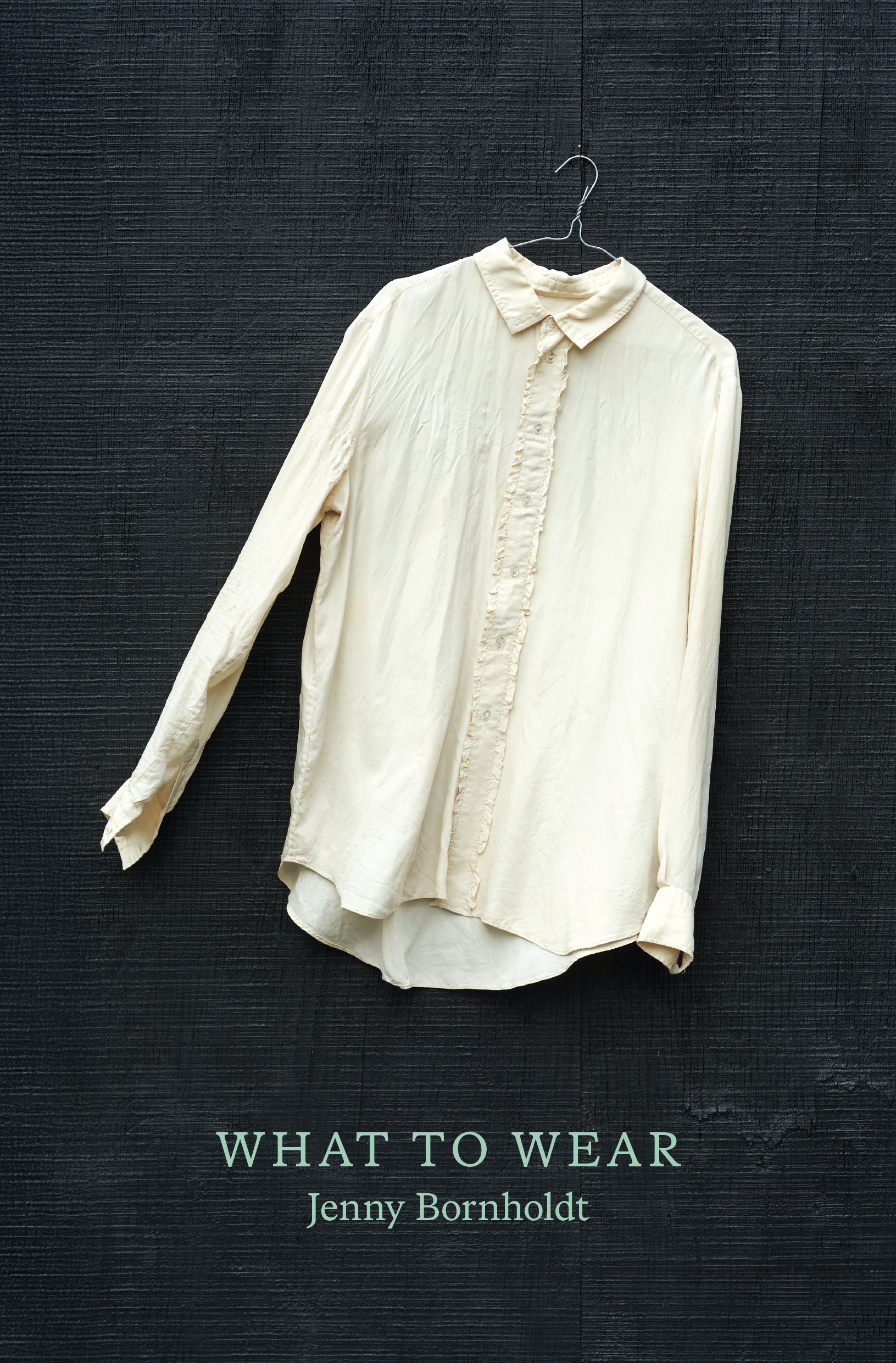
What to Wear, Jenny Bornholdt
Te Herenga Waka University Press, 2026
A woman stilled by light
then folded
into darkness.
Still, though, she’s there
by the window, still there
in the room.
Jenny Bornholdt
from ‘Ada in the Room’
What an absolute treat to lose and find myself within the paths and slipstreams of Jenny Bornholdt’s new writing. This book is a visual haunting, a soundtrack of grief, loss, illness, love, wonder. Enter this collection, and enter a poetic terrain that is both gloriously spare and captivatingly rich.
Poetry can do this. Poetry can offer subtlety within richness, and then in a sweet poetry swivel, offer richness within subtlety.
I found myself musing on the art of dressmaking – an irony when the cover and the title of the book signal clothing (more on this later). I got musing on the way slivers of life are hiding within the seams of the poems, in the nuance of a line, in the folds of a metaphor. Musing on the way tiny arrivals are signposts in the wide expanse of daily living, whether a word mantra repeated during an MRI, or how a mountain’s death zone brushes against the death zone in a cancer ward, or the throwing away of a mother’s maps, or the wearing of socks when days are numbered, or the drawing-breath sound of trees after rain.
‘What to wear’ is the final line in the final poem, ‘Illness’. Not a question, but a member of the checklist of daily choices. The poem — so heart-affecting when the woman we read of is “up, but just, just / hanging on” — returns me to the terrific cover image (photograph by Deborah Smith). The hanging shirt. Hanging in space. Hanging in the great unknown. And in my madcap musings, I am wondering if, in one or more senses, I am wearing the poems, these poems so exquisitely crafted, with piquant detail, with an under-and-overlay of personal experience, with a shimmering bridge between what is and what is not, between what is spoken and what is framed in silence. What is fascinating fable and surprising fiction. Ah. What to read in the seams? I am losing and finding the way a poem hangs in both the dark and light.
Sometimes I muse that what we bring to a poetry collection makes an electric and eclectic difference. Maybe that is why the book has sparked for me on many levels. Both personally and on how we might write a poem.
I read and love ‘Ada in the Room’. It’s an exquisite visual haunting, a poem that catches you as a sublime painting might, and then I discover the poem is a response to an actual painting, ‘Interior, Sunlight on the Floor’ in the Tate Gallery in London. Plus it has a fascinating anecdote. An owner had folded the painting so the artist’s wife Ada was no longer visible! But it is the poem that holds me. I am transported to the moment on the kitchen chair when I too watch the light streak the floor, and knowing I get folded into light and dark across the course of every single day.
Oh the joy of poems as miniatures to fold and unfold.
When I slow down to an extended reading pause, I am reminded of reading Bill Manhire’s new collection, Lyrical Ballads THWUP, 2026). How poetry can hint and whisper, sing and imagine, find humour and enigma, whether in everyday starting points or imagined flight, in both the strange and the unexpected. How the everyday prompts vital rewards for mind heart imagination senses. I loved the idea of listening to Bill read Lyrical Ballads from start to finish, and now I want Jenny to do the same.
Poetry, as my personalised review underlines, can offer delight along with self-nourishment. In What to Wear, the amalgam of reading delight and nourishment is there in broken things, sitting on the phone, the poem with the hole in it (ah what poem doesn’t have a hole in it), and the members of an extended family ‘declining like nouns’. I have had startle jabs of feeling, points of recognition, prolonged engagements with the chemistry of words. Take ‘Poem with a hole in it’. It juxtaposes word lists with stanzas. The laying of a path overlays/underlays the laying of a poem. The word lists epitomise how Jenny’s poems open out wider from their immediately visible pavings.
What to Wear is still on the table and I want to prolong my day in its nooks and crannies and spaces, in this magical poetry collection that folds and gently moves me to wonder and ache and absorb.
Plum
Why wear socks
when your days
are numbered.
Like plums falling
from trees, frequent
as minutes
Jenny Bornoldt
Jenny Bornholdt has published over a dozen books of poems, including Lost and Somewhere Else (2019), Selected Poems (2016) and The Rocky Shore (winner of the Montana New Zealand Book Award for Poetry, 2009). She has edited a number of anthologies, including Short Poems of New Zealand (2018), and has worked on numerous book and art projects with artists including Annemarie Hope-Cross, Pip Culbert, Mary McFarlane, Noel McKenna, Mari Mahr, Brendan O’Brien and Gregory O’Brien. In 2018 she was the co-recipient, with Gregory O’Brien, of the Henderson Arts Trust Residency and spent 12 months in Alexandra, Central Otago. She was New Zealand’s poet laureate in 2005–2007, and in the 2014 New Year Honours she was appointed a Member of the New Zealand Order of Merit for services as a poet.
Te Herenga Waka University Press page
 NZ Poetry Shelf