

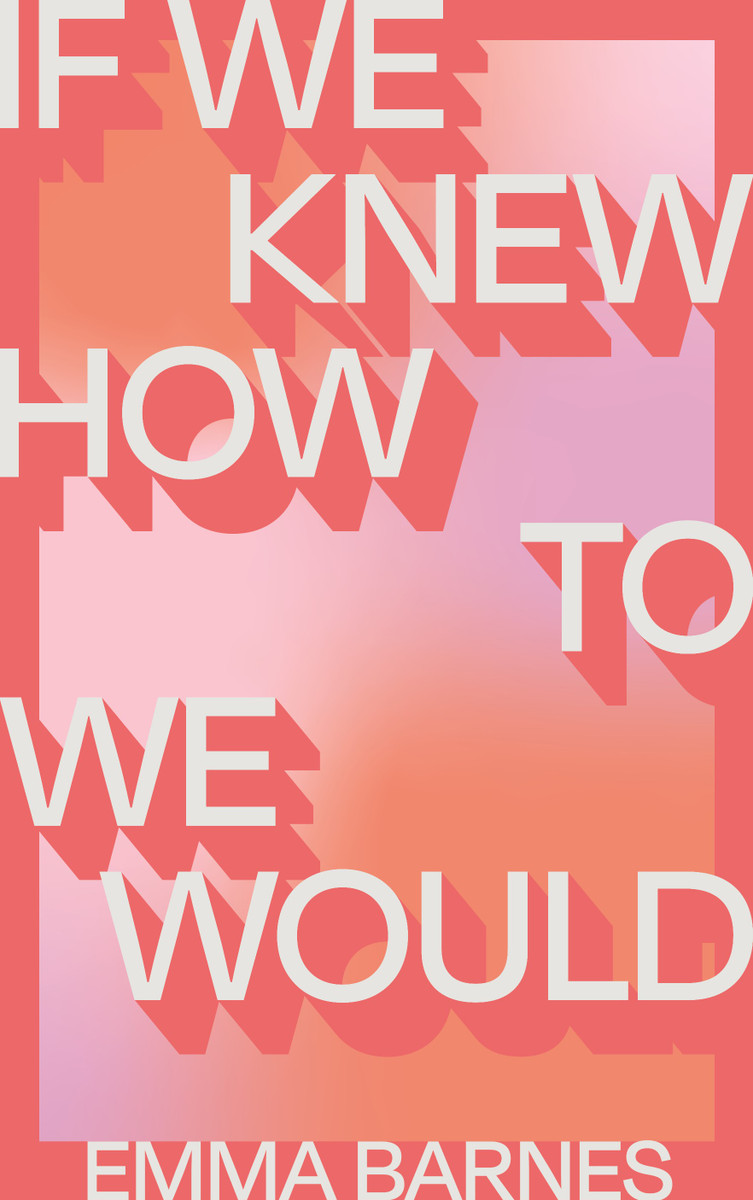
If We Knew How to We Would, Emma Barnes
Auckland University Press, 2025
Poetry Shelf review
Emma Barnes’ new collection comes with an advisory note as some parts deal with suicide, depression and grief. I utterly loved Emma’s debut collection,I Am in Bed with You (AUP, 2021), but in my patchwork year of light and dark, in 2025 I could not enter the pathways of If We Knew How We Could. Making choices like this is an important part of self care, yet this week, having steadily grown into my new normal, I felt ready to read it. And I absolutely love it.
I near the end of my madcap plan to celebrate every poetry book on the Ockham NZ Book Awards poetry longlist (within an uncharacteristic short space of time) and I know what an extraordinary set of books the judges have selected. And here is Emma’s book, one of the few collections I had not already read and reviewed, and it touches me so profoundly. It did not trigger the dark, it opened up a kaleidoscope of light on existence, on non-existence, on self love as much as self loathing.
The book is dedicated to “all the ad hoc mental health support teams who are out there doing their best in an underfunded, seemingly unloving world.’ How this resonates when our health system is rusting up and out, when our doctors and nurses are working against all our odds to heal and care.
Emma’s collection is divided into three sections, each prefaced with epigrams from authors who, as Emma writes in their endnote, are their “literary ancestors”: “As a writer I am descended from every author I’ve read and loved”. Again so resonant. I am reminded how I carry mantras in my heart and pockets, lines from poems that flicker and fertilise throughout each day. Try this for size:
“Love doesn’t just sit there, like a stone,
it has to be made, like bread;
remade all the time, made new.”
Ursula K. Le Guin, The Lathe of Heaven
I have filled a notebook with epigrams from If We Knew How We Could. Yet every prose poem is like an opening fan of epigrams, each line intricately woven into the “tilt” and “truth” of how we read the ones either side. This for example from ‘To knit is to code is to code is to knit’:
I am aware of the gaps within myself. I leave a little bit of openness for a
future though I knit around you, I knit around us. I knit into a future world
where thread and gap combine to wrap our history neatly of lopsided. The
gaps that made us then are not the gaps that make us now.
As much as the collection faces, negotiates, and indeed travels, with grief, it faces, negotiates and travels with life. I see the book as a form of embrace. Think self, think life, and also think form. The first and third sections are the warm arms around the middle section’s aching jagged heartwrenching core. In the opening section, the poems, both organic and mesmerising, at times erotic draw us close to a together and breaking “we”, to bodies that yearn and crave and desire, smudging and crossing borders between we and you and I. Of words, beyond words. Of self, beyond self. The middle section faces a suicide (the word too unbearable to be used by the poet) of someone close, with the pain of the what-if alternate paths and alleys, the toughness of the “unknown” and the “unknowable”, especially to self, even to self. The third section returns to the homeself, to the body, to the self as a solar system of possibilities, truths, recognitions. And yes, pain and desire and fragilities. Read this sample from one of my favourite poems, ‘I Am’:
I am an unmade bed. I am a single thing made up of many other things. I am a reason, a raising, a roof to be raised. I am a song you sing in your sleep. I am a collection of dots. I am a need you buried in the back garden. I am a literal spray of light across a wooden floor in a house where the sun has only just returned. I am a musical phrase. I am a lead light. I am a host. I am seven different names. I am all the fat in my body. I am the sky when it is early spring and I can’t believe I exist in this colour range. I am so blue.
What do I pull close from this extraordinary book, words to carry in my pockets and heart? I could point you to the way we are organic and multi-hued, maybe even multi-hulled. The way both world and self are full of gaps, how there is the known and the unknown, the knowable and the unknowable, recognition and misrecognition. I utterly love the unfolding slowness of the narrating voice, the rhythm intensifying thoughtfulness, the weave of “truth” and “tilt”, the complicated “knit” of how to live and co-exist, how to be, despite edges and wounds. I love the physical objects that feed into the self-narrative-knit: the Wi-Fi restarting, the egg cracked, the empty street, the tree roots and leaves, the pattern of feet, tender wall, soft bridge.
Extraordinary, this is my heart book of 2025, this book of human stutters and connections.
Emma Barnes (Pākehā, they/them) studied at the University of Canterbury and lives in Aro Valley, Te Whanganui-a-Tara, Wellington. Their poetry has been published in journals including Landfall, Turbine | Kapohau, Cordite and Best New Zealand Poems (2008, 2010, 2021). They performed in Show Ponies in 2022 and 2023. They are the author of the poetry collection I Am in Bed with You (AUP, 2021) and co-editor with Chris Tse of Out Here: An Anthology of Takatāpui and LGBTQIA+ Writers from Aotearoa (AUP, 2021). They work in tech and spend a lot of time picking up heavy things and putting them back down again.
Auckland University Press page
 NZ Poetry Shelf