
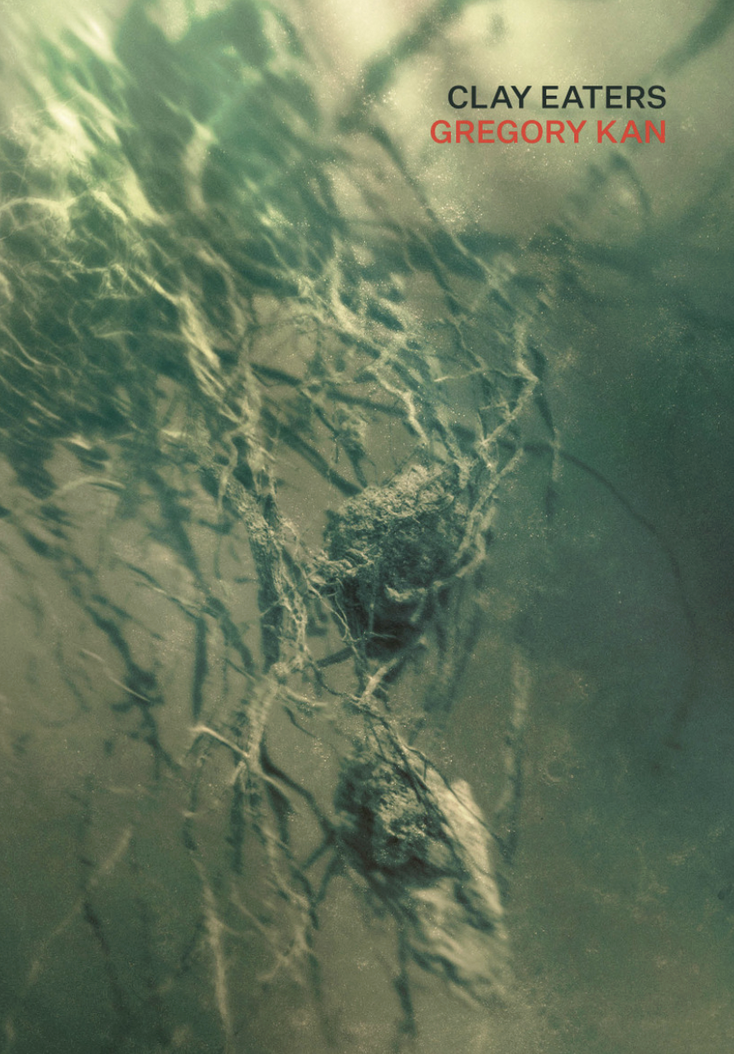
Clay Eaters, Gregory Kan
Auckland University Press, 2025
Not wanting to be bent
Over each and every loss
Divided my mind into multiple plots
Of land, with fences
Growing around each of them
Pretended
That there was nowhere else to go
That where I was
Was all that was left
And years went by
Like on television
Gregory Kan
from Clay Eaters
“I feel like I’ve written this poem many times, differently.” Gregory
From Paula Green’s review on Poetry Shelf:
I have just finished reading Gregory Kan’s Clay Eaters and I am caught in an eddy of multiple hauntings. How to translate this transcendental state of reading? How to share this poetry nourishment? I will begin with the notion that the collection resembles a landscape of braided rivers: a polyphonic source, the tributaries, the gentle currents and the torrents, the obstacle boulders and the jagged edges, the ripples and the calm. The beauty. The fierceness. The shifting waters. The place to stand and ponder. The place to stand and be. Poetry as braided river. Poetry as wonder.
Poetry that is personal and invented and incredibly moving.
Who were you, really
Outside of us, outside of me
Outside of all my
Useless bargaining
There are autobiographical braids. The family who moves from Singapore to Aotearoa. The poet who returns to Singapore six years later to do compulsory military service on Pulau Tekong. A father who suffers a stroke. A partner and a beloved cat who dies. Siblings and their offspring.
Poetry that is slowly unfolding as we traverse the braided currents. The visual layout offers shifting movement as we move amidst silence, the double spacing, the single spacing, the space to ponder, the spare and the dense, the jungle and the family room, the familiar and the unfamiliar.
Poetry as mapping. Maps are a recurring motif on an island that has a chequered history of cartography and naming, where orienteering is a key lesson for the military trainees. Yet I find myself viewing this as more than jungle mapping, because these poetic braids are a way of mapping self, of heart. There are the slippery currents of losing and finding one’s way in both past and present, the porous areas between here and there. There is no translation for a dish, kueh: ‘Neither cake nor jelly / Neither dumpling nor pudding / But somewhere between them all’. For me that signalled the inhabited space. Nothing set in concrete. Nothing static. The forever changed. Like the braided river flowing, the same but different.
This is poetry that navigates a tough experience, the poet’s military cadet years, those jungle ghosts, where spirits may dwell in trees: ‘The island didn’t seem like a place for people’. Where it’s the ‘Endless trees running deep into the red clay earth’. And it’s the weight of packs and mysterious stories and escape longings. The hammering weapons. Heart wrenching. This ache.
And then.
This is poetry that draws forward the father, there in his invalid wheelchair or his study, notebooks piling, books on shelves. The difficulty and ease of being with him, then and now. And the family, the mother, the siblings and the offspring, coming into view. And a scene, this together family scene, after the ‘archetypal family feast’, that is a catch in my throat, as the dreams accrue and connect.
Gregory Kan is a writer and developer based in Pōneke/Wellington. His first collection of poetry, This Paper Boat, was shortlisted for the Ockham New Zealand Book Awards for poetry in 2017. Under Glass, his second collection, was longlisted for the award in 2020. He was the 2017 Grimshaw Sargeson Fellow.
Auckland University Press page
Listen to Gregory read here
 NZ Poetry Shelf