

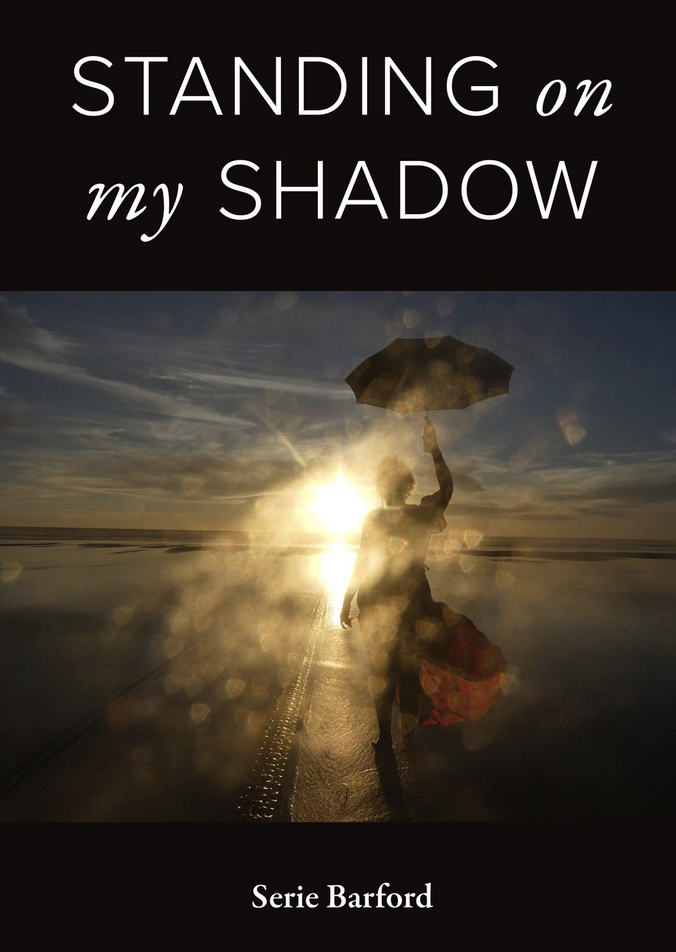
STANDING on my SHADOW by Serie Barford
Anahera Press, 2025
Waiting room triad
I face the door, eyes closed, wait for the kuia from my
moemoeā to arrive. She’ll step into this room like a feisty
maunga dismantling into an outgoing tide. Glow like
fading embers.
Flick. My eyes roller-blind open. Focus on a patient at
reception. She sees me. Seers me. Sails the mopped floor
of diagnosis and disease. We hongi. Kiss cheeks. Sit quietly
on cheapskate chairs opposite a television screwed to the wall.
Utu, she explains. A blood transfusion was the portal. An
enemy with mākutu flair slept within a donor’s toto. One
whiff of my whakapapa, he woke up – greedy to settle
old scores. Steered a waka taua through red tides infusing
my tinana. Ha! That sneaky bastard gave colonial troops
a runaround in his day. I was a sitting duck!
I’ve swallowed pills for five years. Hormone suppressors
to starve breast cancer. They took the wahine out of me.
Make me hōhā. Weak.
We admire the intricacies of utu. The enemy’s tenacity.
The way he patiently nursed a grudge through bloodlines.
Waited to strike.
At least it ends with me. Balance is restored. My whānau
safe. No way I can talk to doctors about this. Aue!
We laugh. Roll our eyes at how casually we censor truth.
Whitewash talk.
Hine-nui-te pō is waiting.
Not long now.
Serie Barford
Notes
kuia elderly woman, grandmother, female elder
moemoeā dream, vision
maunga mountain. Some west coast coast maunga – once volcano but also personified ancestors – are slowly eroding and being carried by the sea to beaches in this area
hongi sharing of breath by two people pressing noses together
utu concept of reciprocation or balance to retain mana; both friendly and unfriendly actions require an appropriate response
mākutu sorcery, the infliction of physical and psychological harm or death through spiritual powers
toto blood
whakapapa a line of descent from one’s ancestors, genealogy
waka taua canoe for war parties
tinana body, torso
wahine woman
hōhā annoyed, irritated
whānau extended family, family group
aūe! exclamation expressing an emotional reaction
Hine-nui-te-pō Māori goddess of night and death
I’ve chosen this poem because it explores the casualisation of blood in the Western medical system and how this affects some cancer patients’ behaviour, as well as relationships between patients and medical professionals.
I’m descended from a line of dreamers. Seers. I often dream who I’ll meet days, weeks or even years before we encounter each other. The night before a chemo infusion I met a woman in a dream. I could tell from the shape of a mountain that the kuia was from the Taranaki region. I also saw that she was eroding. Physically disintegrating. We introduced ourselves. Chatted.
The next day I sat in the oncology waiting room, closed my eyes, waited to feel her enter the room. We recognised each other and continued our
conversation. Some of our kōrero is written as italics within the poem.
One of her ancestors had an adversary who was unable to extract utu before he died. The ‘cost’ was in the ether – waiting to be paid. It’s an intergenerational debt that will eventually be paid by a person from the ‘wrongdoers’ bloodline. Both warriors were involved in the Taranaki land conflicts in the 1860s. The kuia was targeted by her ancestor’s enemy who wanted to address a perceived betrayal.
Over a century later this kuia needed a blood transfusion. The blood that saved her life contained the bloodline (DNA cellular memory) of her ancestor’s adversary. Blood recognises blood. Some people can even smell blood connections. I’ve walked into rooms and people have ‘scented’ me as being part of their ancestral line. Her ancestor’s adversary attacked her from within. Sailed her “red tides” on a waka taua – a war canoe.
We discussed hormone therapy that’s part of breast cancer adjuvant treatment. It wasn’t until I embarked on this treatment that I realised how vulnerable it makes women with certain wairua/spiritual gifts. I lost my ability to dream. I just couldn’t access this part of my life. I felt useless. My dreaming guided and protected me, connected me with ancestors and was something that helped my community. I was “blind” for six years.
So there were were, a woman who’d stopped hormone therapy and a woman who was yet to begin this treatment. We met in a space where we were able to dream and connect. I was still hopeful that I’d have many years ahead of me. The graceful kuia knew she’d paid the cost for her ancestor’s transgression. She was peaceful because the debt was paid. Her descendants were safe. She would soon pass into Hine-nui-te-pō’s realm.
It all made perfect sense to us. We understood the potency of blood and how it is casualised in the Western medical system. We know that we have to censor truth in order to be a “good patient”. I’ve been offered counselling and antidepressants when I’ve tried to talk to medical professionals about indigenous spiritual matters. I wrote this book to express and connect. And because I wanted to give voice to censored truth. To elevate disrupted narratives.
Serie Barford
An extract from Paula Green’s Poetry Shelf review:
The final word of the collection is ‘aroha’. The final image drawing us back to the infusion of toxicity and delight we picture at the start of the collection. Here I am, personally attached to this personal record of an utterly challenging time, and I am brimming with sadness and recognition, joy and connections. Read the final paragraph from ‘The grace of a stranger’, order this book, and gift it to a friend:
Yesterday I was miserable. Overwhelmed by side effects.
Lay on the floor, heart flailing, sunlight rippling through
French doors, guarded by anxious cats. Birds were singing.
Clocks ticking. I thought about Chornobyl, the Exclusion
Zone, the trumpeting angel memorial to lives lost. Waited
for ancestors to appear. Fetch me. But it wasn’t my time.
Today I’m visiting an oncologist in Building 8. Facing this
tricky business of living. Talking about celestial beings.
Feeling uplifted by the grace of a stranger.
Aroha.
Serie Barford was born in Aotearoa to a German-Samoan mother and a Palagi father. She is one of New Zealand’s leading voices in contemporary poetry and has been a pioneer for Pasifika women poets since the late 1970s. She has published five previous collections of poetry. Sleeping with Stones was shortlisted for the 2022 Ockham New Zealand Book Award for Poetry. She was a recipient of a 2018 Pasifika residency at the Michael King Writers Centre. Serie promoted a Ukrainian translation of her poetry collection Tapa Talk at an international book festival in Kiev in 2019.
Anahera Press page
Serie in conversation with Emile Donovan on RNZ
Serie selects some books at The Spin Off
Sophie van Waardenberg review at Aotearoa NZ Review of Books
Hebe Kearney review at Kete Books
 NZ Poetry Shelf