
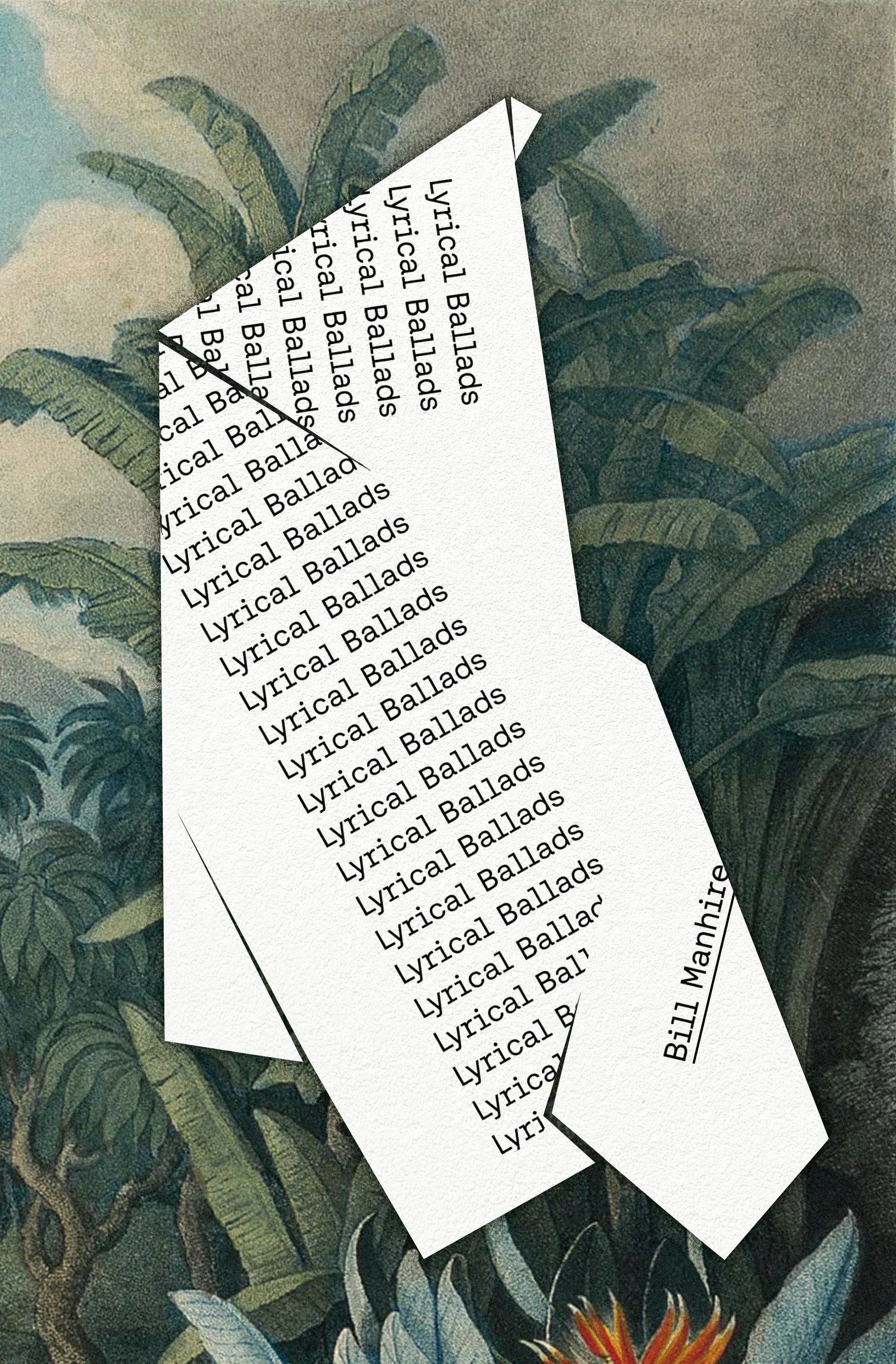
Lyrical Ballads, Bill Manhire
Te Herenga Waka University Press, 2026
Lyrical Ballad
I bought a bend in the river. It was a good,quiet bend.
You couldn’t see around the corner and after a few
steps you could. The water flowed round the bend, which
is essentially what you want. Everything else was doing its
thing. The Lost Hills were there in the distance. The river
was slow as it entered the bend, and maybe just a little
faster after that, I don’t know why. For a while I wondered
about getting a little boat, maybe a raft, but it was walking
around the bend that really made me happy. I liked the
reliable surprise. It’s gone now anyway, that bend, washed
away in the last big rains. Now it’s just a patch of land: a
channel and some structural damage. I suppose I should
sell it, but I can’t quite make myself. It was everything I
ever wanted.
Bill Manhire
In 2017, I chaired ‘Words and Melody’, a session with Bill Manhire and Norman Meehan at Going West. We discussed their collaboration, Tell Me My Name, and how they worked together to reach a place where, to quote Bill, “the music doesn’t overpower the words; but neither does it defer to them”. You can listen to the podcast here. And yes, there was music in the room. The best session I have chaired ever.
Bill has now written a collection of lyrical ballads dedicated to Norman. One part of me wants to hold the book out to you all, and simply say read this glorious collection, find a cosy reading nook and snuggle into the poetry to read in one slow and sweet sitting. Then put the book to one side for a few days before reading it again, even more slowly. I would stay on a hooked on poem, read it a number of times before turning the page.
But that said, I want to find a few words that will catch specks and glimmers of why I love this book so much. Last year I read all of Bill’s collections before writing a paragraph on his poetry to go in a new book and decided he was my Desert Island poet. His writing, over the course of decades, has offered everything I love about poetry, what makes me want to write poetry, read poetry, and yes review poetry. A word that has lifted to the surface in my week of roaming and reflecting within and beyond Lyrical Ballads, even above the beloved musicality and surprise arrivals, is “openness”. Poetry in Bill’s care, foregrounds the open poem. Dump prescriptions, formulae on the compost heap where they might transmute into open settings.
So here goes. The cicadas are at late summer screech. The west coat wind is nipping. The coffee is waiting. I want to write my way in and out of Bill’s glorious collection without closing windows and doors, paths and bridges for you, you the potential reader.
The first poem, ‘Come On In’, is an open invitation. We are invited into a room, “the kissing room”, and the four-couplet poem forms a labyrinth of possibilities. The poem (the room) might be a miniature narrative, anecdote, postcard from elsewhere or a home doorstep, an invention or a confession. A fable. A song. A lyrical ballad. It’s an open invitation to fill in detail with coloured pencils, if we so desire. Here is the room (the poem) that fills with talk and maybe heartbreak, braveness and maybe recitations.
When I roll the word “open” about in my mind, it picks up on ambiguity, the way a poem might swivel meaning, favour cloudy edges. The cast of characters feeds into this, relishing ambiguity and openness, along with Bill’s characteristic wit. We get to meet Mr Crimson from the Ministry of Health, Mr Doormat, Mungo, a girl called Daffodil Paddock (wow!!!) who wanted to be a character in a Margaret Mahy story, the recurring Alexander and Raewyn. This assembly of characters augments the ballad, advances the accumulation of story, the openness of story, as we get to picture and imagine, and add our own details. More than anything, the awkwardness, the ragged edges of existence, the difficulties (and ease) of fitting in and not fitting in, sing out.
Part of the joy of openness in poetry, is the way it promotes travel, and that is a significant and satisfying feature of the collection. We encounter roads and rivers and canals and bridges. We contemplate beyond, ins and outs, distance and proximity. It may be the known, it may be the unknown. It might be softening edges. Tough climbs. Watching the dawn or the dusk. Moving into older age. And wonder, yes above all wonder. I am reminded of the poetry of Vincent O’Sullivan where a poem infused with his ink might be an occasion of being there/here, or as one of Bill’s title says, “Getting There’.
After a time
After a time, my writing began to take a new direction.
Left after you cross the bridge, and then down what people
used to call the stumble-path – steps cut in the bank,
occasional big stones – to the water’s edge. You go down in
daylight and wait till it’s dark and there’s absolutely no one
there. After a while you aren’t there either. You feel truly
alone, fully neglected. I write all that down – you know,
in my head – then start on the difficult climb, no moon,
back up to the road. I need badly to return to the house,
even though it is empty now, windows open and curtains
billowing, still the place where everybody sits up waiting.
Ah. So many things to hold out to you in delight. I now want you to read the poem ‘Some Other Words They Sang’, where we are walking in the same direction as the insects when they sing in the night.
Some Other Words, I Think They Sang
Insects singing in the night.
We were all walking in the same direction.
Be careful. Be strong. Be kind.
That’s what they sang.
Sing when the world is worn away.
Some other words I think they sang.
Insects singing in the night.
We were all walking in the same direction.
Or read and re-read, and hold close Bill’s Gaza poem that has already moved us so deeply. Many of us are struggling with how to write within a matrix of global and local catastrophes, and abominable leaderships, climate change. How to live.
I am drawn to the talisman words and mantras I might carry in my pocket through the day (a bit like the words of the insects singing). I loved what the student took away from the History lecturer’s blackboard covered in difficult language: “‘It’s not the facts,’ he / said. ‘It’s what we do with the facts.'”
And of course there is the ink steeped in music, with rhyme and repetitions, loops, the exquisite lyricism that audio-marks each ballad. My dream is to sit in the Titirangi hall again and listen to Bill read us the whole book as we sit spell bound, before moving to the side room to the spread the locals have put on, to return with plates of food balancing on our knees, and to talk poetry and life until our voices are hoarse.
Is it possible to consider this collection in the light and possibilities of tracing paper, where each poem is a set of overlaid sheets, where story is overlaid upon song, which is overlaid upon the personal, which is overlaid upon philosophy and contemplation, and where every layer is embued with humanity, what it means to be human and humane, kind and caring, and every layer is shining through and adding myriad possibilities. What will the insects sing next? What will I hear in the kissing room? What do I picture when I picture the bend in the road?
In the acknowledgement page Bill thanks several people for their “encouragement, wisdom and rescue”. These words strike deep with me just as this book does. It feels like the poetry gives me encouragement, offers wisdom and rescues my frozen pen. There you go, I am holding this book out to you, so that you too may find your own gleams and shimmers.
Bill Manhire’s previous books include Wow (2020), Some Things to Place in a Coffin (2017), Tell Me My Name (with Hannah Griffin and Norman Meehan, 2017) and The Stories of Bill Manhire (2015). He has won the New Zealand Book Award for Poetry five times, and was New Zealand’s inaugural poet laureate. He founded and directed the International Institute of Modern Letters at Te Herenga Waka—Victoria University of Wellington. He has edited major anthologies of New Zealand literature, including, with Marion McLeod, the now classic Some Other Country: New Zealand’s Best Short Stories (1984). In 2018 Bill was awarded an Icon Award Whakamana Hiranga from the Arts Foundation.
Te Herenga Waka University Press page
 NZ Poetry Shelf
Pingback: Poetry Shelf review: What to Wear by Jenny Bornholdt | NZ Poetry Shelf