
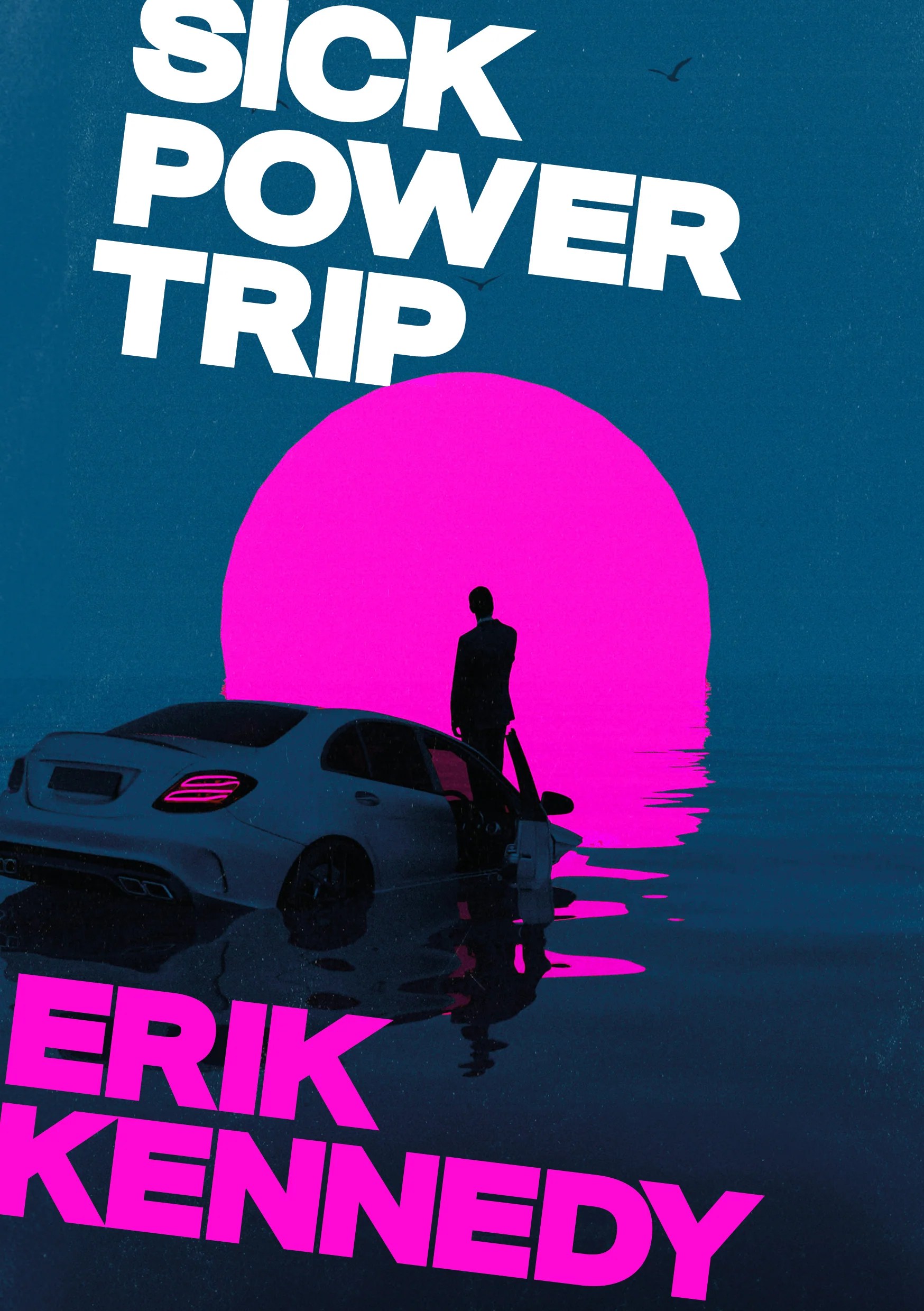
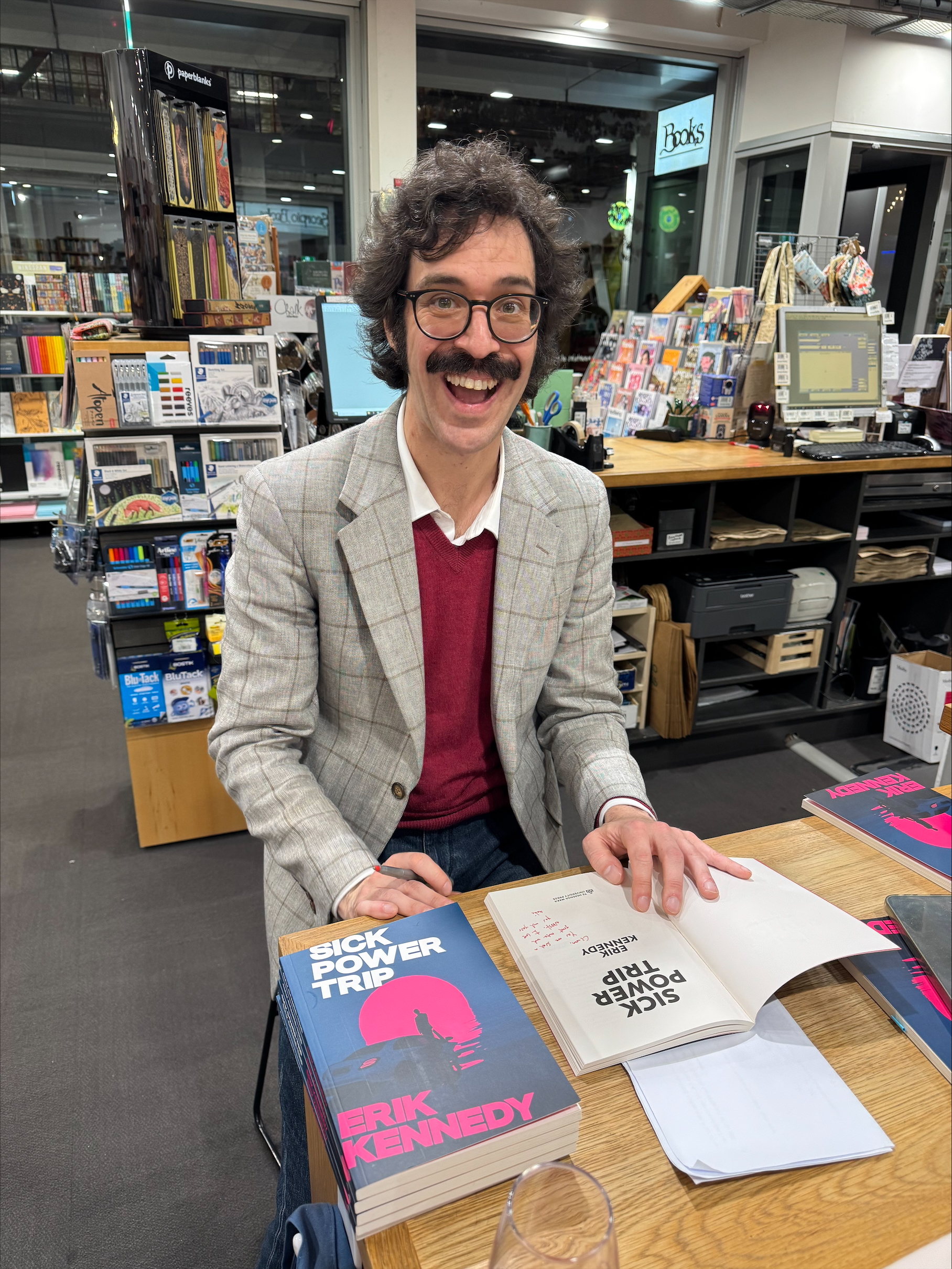
Sick Power Trip, Erik Kennedy, Te Herenga Waka University Press, 2025
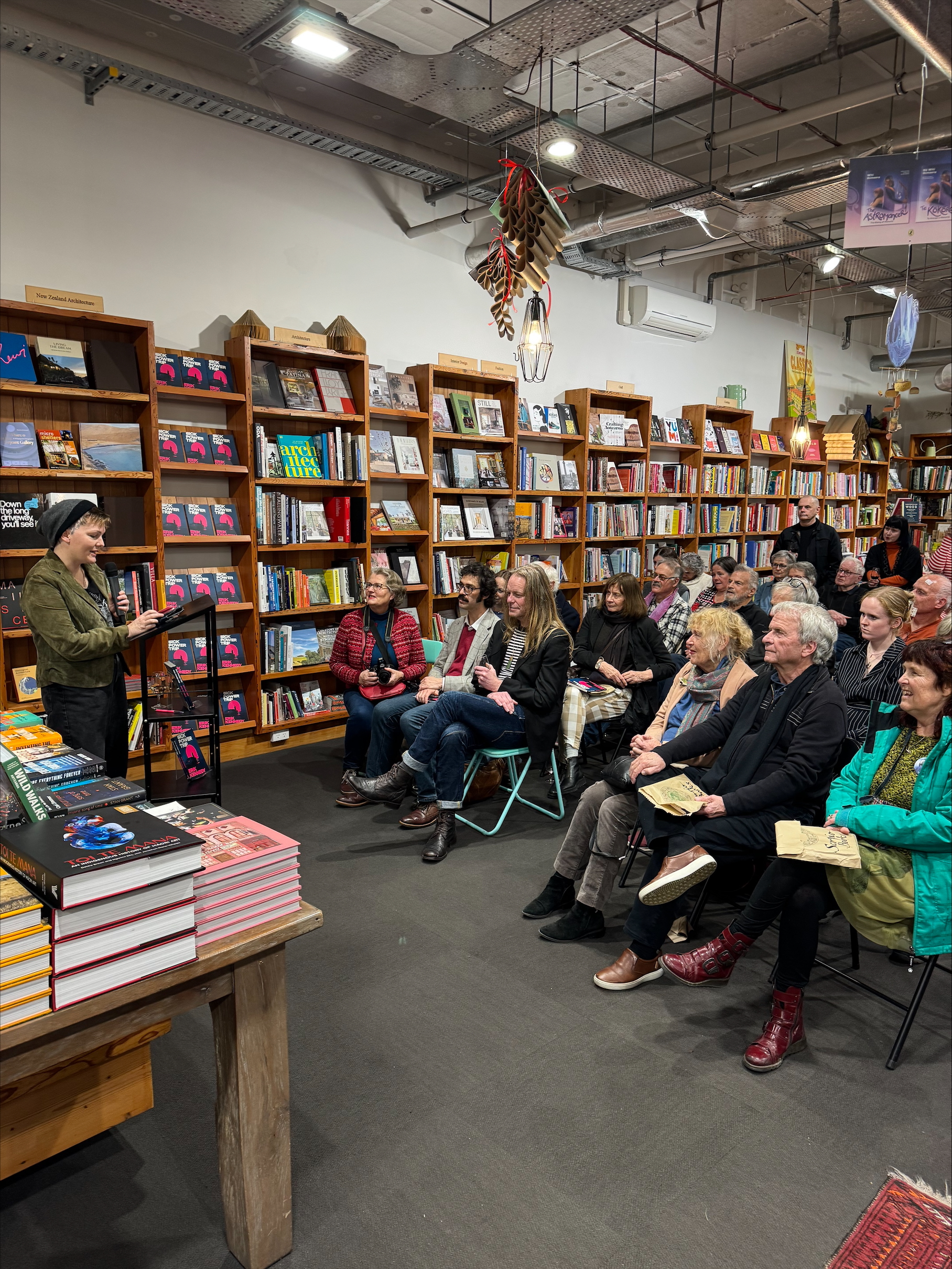
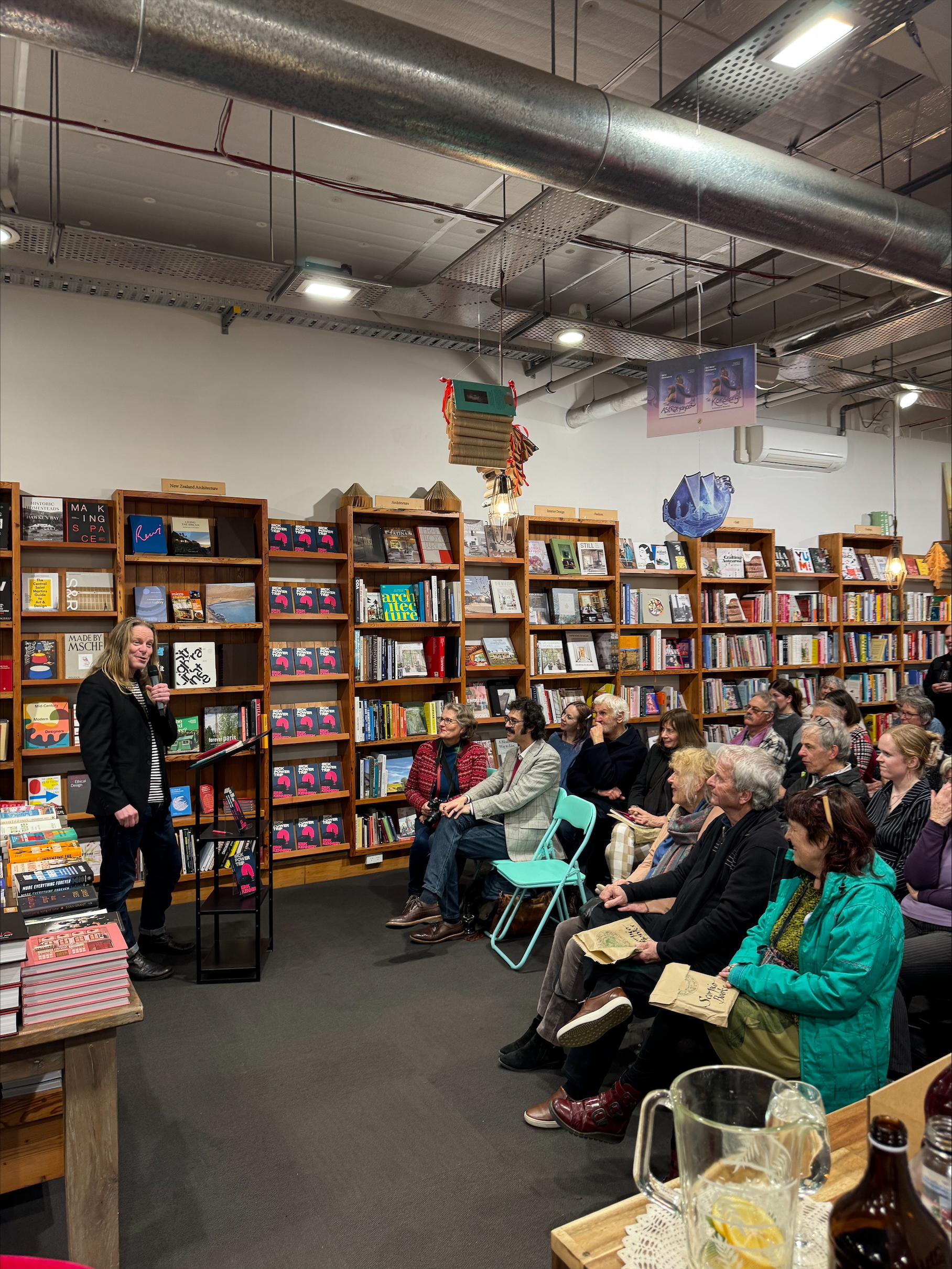
(photos courtesy of Scorpio Books)
Tēnā koutou katoa.
Ki ngā mate, haere, haere, haere atu rā.
E mihi ana ki te iwi e tau nei, Ngāi Tūāhuriri, tēnā koutou.
Ki a tātou e tau nei, kia ora koutou.
Nō Mīere me Ingarangi ōku tīpuna.
Kei te noho au ki Ōtautahi.
Kei kaituhituhi ahau e mahi ana.
Ko Claudia Herz Jardine tōku ingoa.
Tēnā koutou katoa.
Hello, everyone. Thank you for coming. A caveat that these things aren’t expressed so gracefully in reo Pākehā; with my opening remarks I acknowledge the deceased, notably the poet John Allison; I recognise Ngāi Tūāhuriri, our local iwi and tangata whenua; I welcome you all here, in Scorpio Books, to this celebration of Erik Kennedy’s pukapuka Sick Power Trip.
My name is Claudia Herz Jardine. My ancestors, like Erik’s, came from far away- and, also like Erik, I call Ōtautahi Christchurch home and am prepared to defend it from further environmental assault with my life, my poems and my needle-nose pliers.
The first image of Sick Power Trip that wedged itself in my head was the “absolute possibility engine”- a ferret on a leash as observed in the poem ‘Animals On Leads’. At the time, my brother-in-law had his girlfriend’s dearly beloved and deceased pet ferret in his freezer as they waited for the cost of taxidermy to go down – this going down in price could be enabled by free market conditions, or the death of another ferret i.e. taxidermy at a quantity discount. All the ferrets in my life were distinctly lacking in possibilities, and then Erik came along to our critical writing group with his poem. I didn’t have much critical feedback for Erik- I only recall scrawling, “love ‘the energy of a ten-man brawl in a two-man toilet’.” A phrase that feels like it has the same amount of plosive consonants as a ferret should have claws.
Many months later Erik mentioned he had a manuscript ready. He emailed it to me. I made approximately five suggestions. My email sign-off was: “It’s a stacked deck! A pack of heavyweights! An all-star team!!” This ratio of suggestions to compliments bodes well for Erik. I read it all in one sitting, and by standing before you all tonight, I declare that me and my poetic sensibilities were wholeheartedly entertained and intrigued by this book.
To make some hazy, summative stabs at the book now, Sick Power Trip is a sort of wealth redistribution weathervane. The poems in this book, together, seem to say- if you have THIS much money, can you please do the decent thing and use it to make THESE lives better? Though the poems are stacked with ‘I’ statements, the ‘I’ is always asking; why aren’t we kinder to each other? Why do the people with the most get away with caring about others the least?
We live in an age in which any possible friction in our daily lives is viewed by Big Tech Companies as a money-maker. We have computers in our hands, a supermarket monopoly willing to visit us at home, and apps that write small talk and argumentative rebuttals for us. The narrator of ‘Individualistic Societies’ (page 11) states: “I fixed every problem I ever had until I couldn’t, at which point I became the problem.” For as long as we are encouraged to remove friction from our lives by paying money, the environment and its indigenous populations will be exploited. Skip ahead to page 93, ‘Someone Put an Ancient Burial Ground Right Where a Hotel Needs to Go,’ and an archaeological worker has a vision of excavated bones filling the city- “One day this project will be done and the building that even / its designer’s mother doesn’t love will spend its seasons here… What is allowed to endure is sometimes a second-choice thing / and the ones choosing are as likely to be thinking about the weather / as the future. Is it going to rain? Is the smart oven set?”
Yes, these poems are fringed with scathing, cynical Erik-ness. They also serve as an untraditional curriculum vitae for why, in the end times, Erik Kennedy will be on the shortlist for holding the newly-designed flag while jumping up and down on top of the bunkers as we sweep through Central Otago, shelling billionaires from their boltholes. This will be a pointy time, and unlike the narrator of ‘Notes Towards a Theory of Fun’ (page 50), no one will be getting arrested for kidnapping fossil fuel executives and shouting (quote) “Imma rubber-band this motherfucker up like a bunch of kale.”
Some notes on craft; Erik knows when to end a line, use an adverb, when to turn up the dial on the presence of the narrator and how to get out of the way. Erik and I share a love of whittling the pointy end of the poem first and then making the grip as comfortable as we see fit. So, watch as he casually wraps serious themes in humour to make the weight a little easier to bear- you could “die in a hail of 5-inch shells / or mild social disapproval,” you were either “raised by scorpions,” or you can care about the people of Gaza, you can be sad and lonely, or you can get involved in your local dogging group- just get out there and network!
Importantly, these are poems about thinking and caring. Erik cares about us. Erik cares about all animals. Erik cares about the planet. And Erik, in his day-to-day ways, turns up for other poets and throws his support behind our scene. When Erik had long Covid and stayed home, we missed him, and it was nice of him to invent the word “wonkening” while he was away.
Thank you all for listening to my speech. Congratulations, Erik, on another fantastic volume of poems. Can we all give him a big round of applause?
A warm thank you to Te Herenga Waka University Press and our speakers for this evening – and please join me again in congratulating Erik Kennedy.
Claudia Herz Jardine, 10/07/25
Te Herenga Waka University Press page
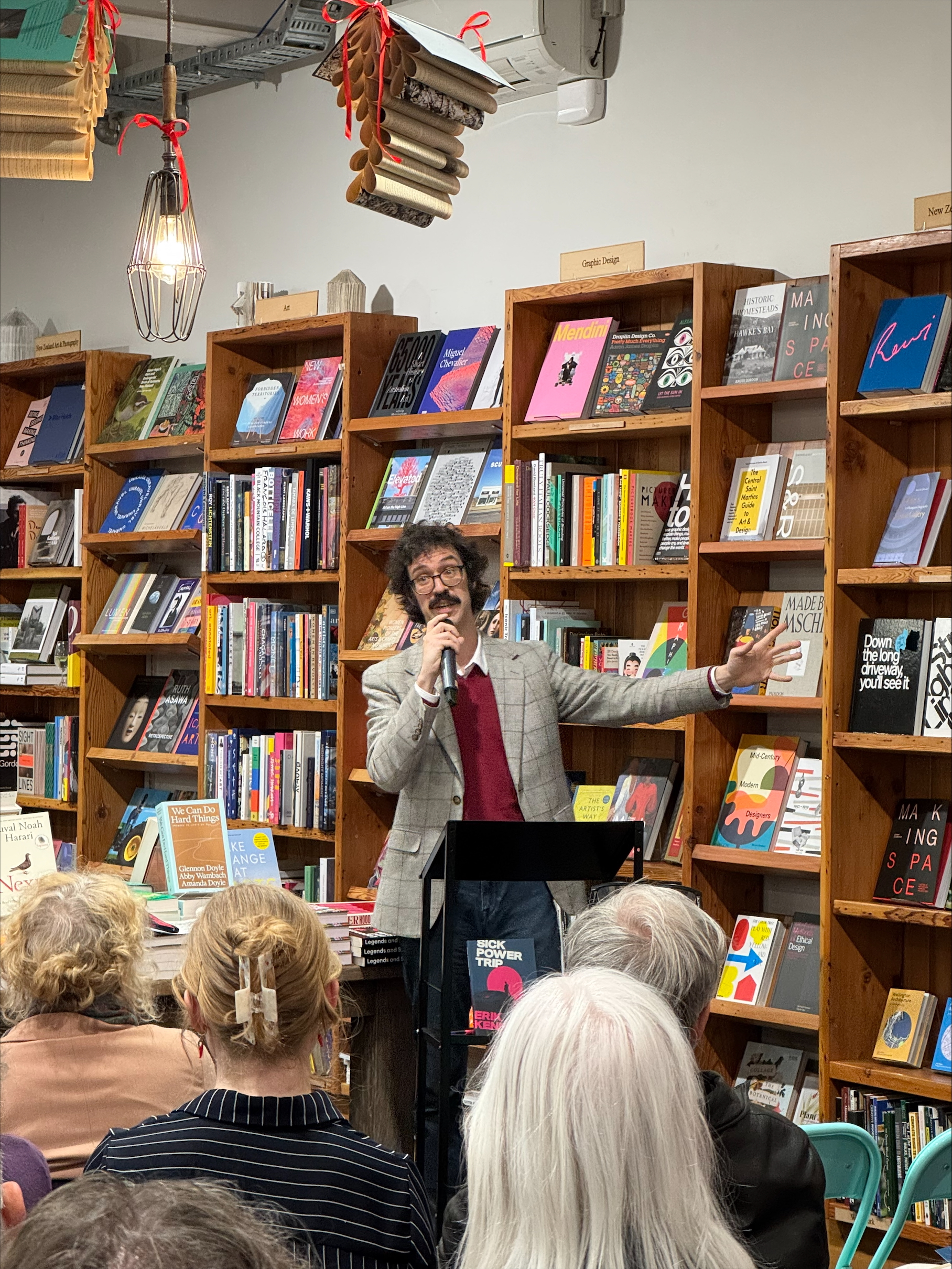
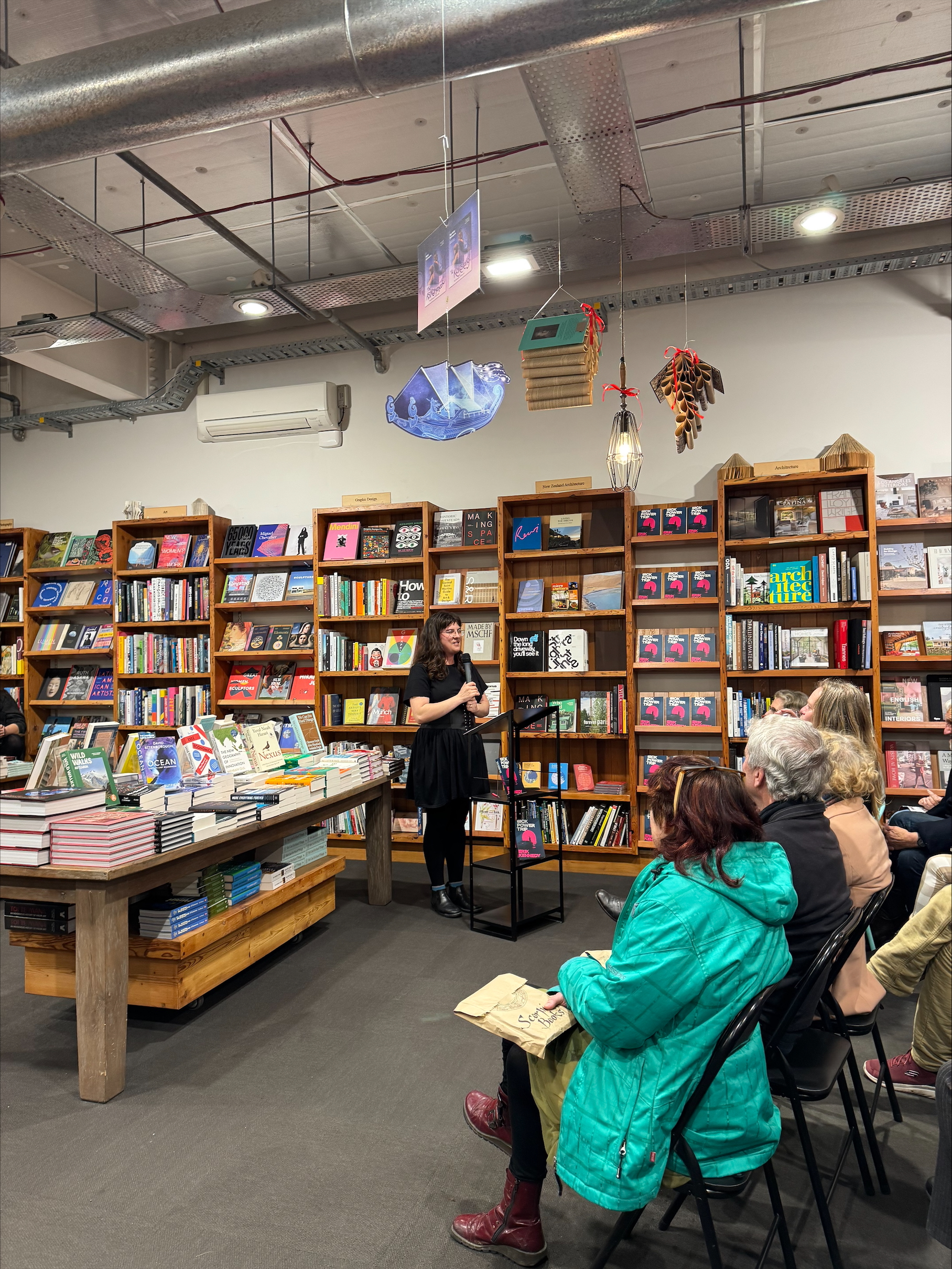
 NZ Poetry Shelf