
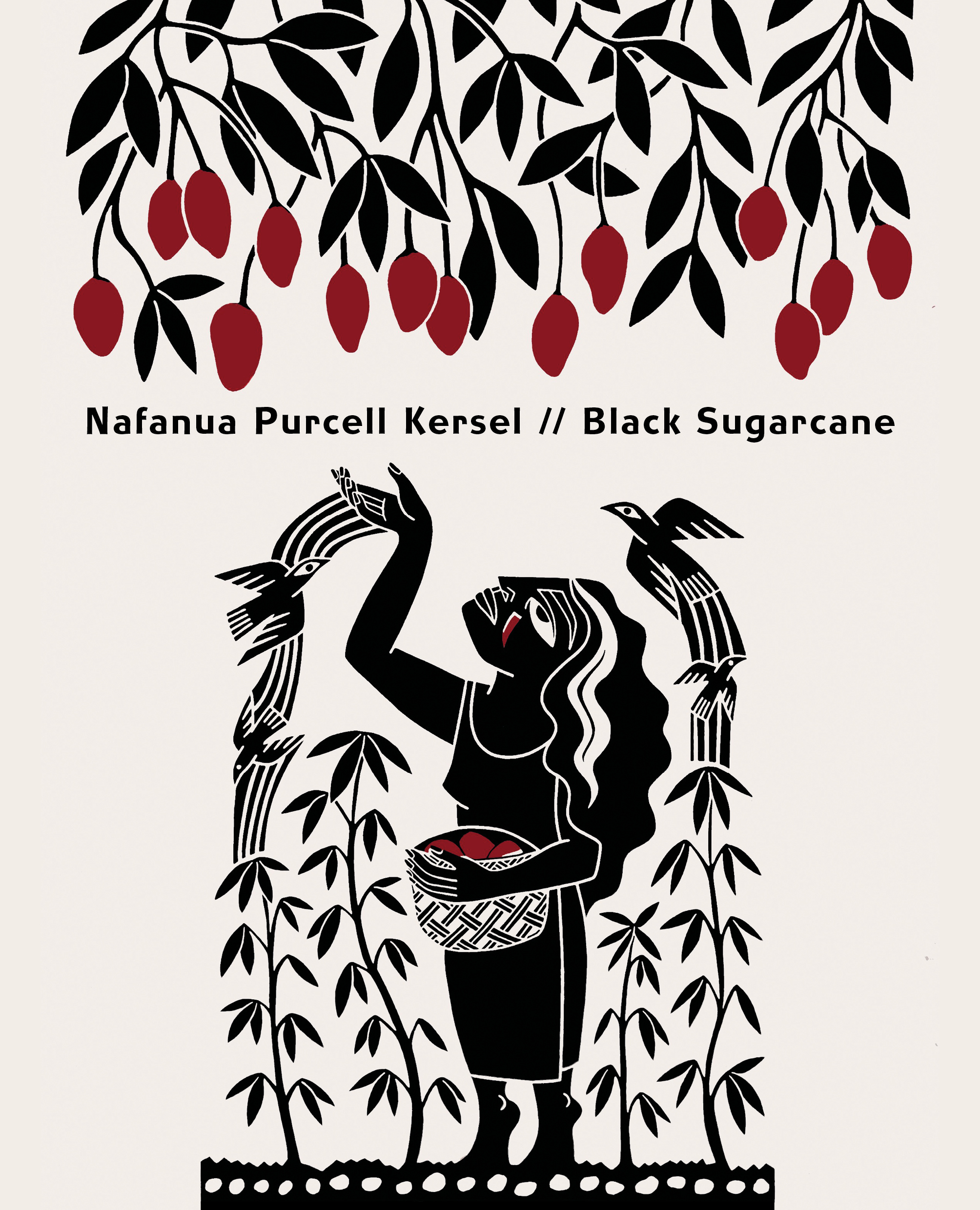
Black Sugarcane, Nafanua Purcell Kersel
Te Herenga Waka University Press, 2025
Moana Pōetics
We build a safe around our birth stones.
Craft it with a dream, a gourd, a drum-made
chant.
Pile it high with frigate bird bones,
song bones, bones of
cherished names.
We rub sinnet along our thighs and lash
our cache. Our stories kept sound, where words
and names and songs are not forgotten.
One day before, now, or beyond, something
with a heart drops a hank of its flesh
before us. It sounds like a drum and we know
it’s time
to undo the rope, iron-rock and bone-sand.
The stories, they tell us
that if we are the dark blue seas then we are
also the pillowed nights and days, soft with
clouds, spread half-open.
We are a tidal collection, hind-waters of the
forever we rally on, to break the staple
metaphors from the fringes.
Safe.
We sound together on a dance or
bark an intricate rhyme.
We, are the filaments of a devoted rope. We,
who contain a continuance and
call it poetry.
Nafanua Purcell Kersel
Nafanua Purcell Kersel’s debut poetry collection, Black Sugarcane is a book to savour slowly, with senses alert, ready to absorb the aroha, the myriad pathways, the songs, the prayers, the dance of living. The first line of the first poem, ‘Moana Pōetics’, is a precious talisman: ‘We build a safe around our birth stones.’ It is a found poem that uses terms from the glossary in Mauri Ola: Contemporary Polynesian Poems in English, edited by Albert Wendt, Reina Whaitiri and Robert Sullivan (Auckland University Press, 2010). The poem draws us deep into the power of stories, night and day, the ocean, safety, the power of rhythm. And that is exactly what the collection does.
The book is divided into five sections, each bearing a vowel as a title (ā, ē, ī, ō, ū), the macron drawing out the sound, as it does in so many languages like an extended breath. When I read of vowels in the poem, ‘To’ona’i’, the idea and presence of vowels lift a notch, and poetry itself becomes a ‘sweet refresh’, a warm aunty laugh: “Aunty Sia’s laugh is like a perfectly ripe pineapple / a sweet refresh of vowel sounds”.
Let me say this. There is no shortage of poetry books published in Aotearoa this year to love, to be enthralled and astonished by. We need this. We need these reading pathways. Sometimes I love a poetry book so much I transcend the everyday scene of reading (yes those bush tūī singing and the kererū fast-swooping) to a zone where I am beyond words. It is when reading is both nourishment and restoration, miracle and epiphany . . . and that is what I get with this book.
Begin with the physicality of a scene, a place, an island, a home. The scent of food being prepared and eaten will ignite your taste buds. Pies filled and savoured, luscious quince, the trickster fruit slowly simmered, a menu that is as much a set of meals as a pattern of life. Move into the warm embrace of whanau, the cousins, aunties, uncles, parents, grandparents, offspring. And especially, most especially, the grandmother and her lessons: ‘”If you want to learn by heart, / be still and watch my hands” (from ‘Grandma lessons (kitchen)’).
Find yourself in the rub of politics: the way you are never just a place name and that where you come from is a rich catalogue of markers, not a single word. The question itself so often misguided and racist. Enter the ripple effect of the dawn raids, or the Christchurch terrorist attack, or poverty, or climate change, crippling hierarchies. And find yourself in the expanding space of the personal; where things are sometimes explored and confessed, and sometimes hinted at. I am thinking pain. I am thinking therapist.
Find yourself in shifting poetic forms, akin to the shifting rhythms of life and living: a pantoum, a found poem, an erasure poem, long lines short lines, drifting lines. Find yourself in the company of other poets, direct and indirect lines to the nourishment Nafanua experiences as a writer: for example, Lyn Hejinian, Kaveh Akbar, Karlo Mila, Tusiata Avia, Selina Tusitala Marsh, Serie Barford, Konai Helu Thaman, Dan Taulapapa McMullin. So often I am reminded we don’t write within vacuums. We write towards, from and because of poetry that feeds us.
Bob Marley makes an appearance so I put his album, Exodus, on repeat as I write this. It makes me feel the poetry even more deeply. This coming together, this ‘One Love,’ this getting together and feeling alright, as we are still fighting, still uniting to make things better in a thousand and one ways.
I give thanks for this book.
a reading
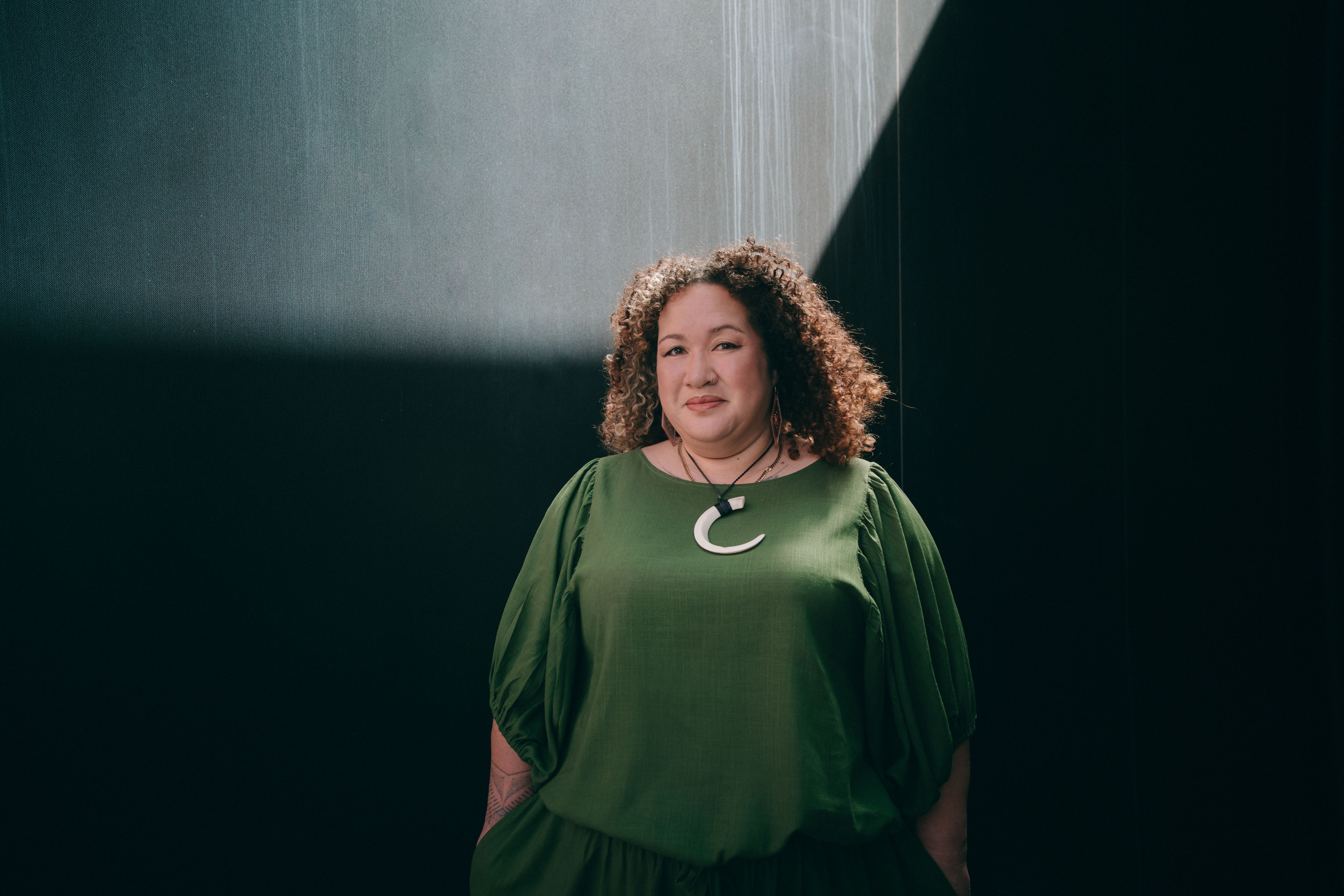
Author photo: Ebony Lamb
‘Moana Pōetics’
‘Grandma lessons (kitchen)’
a conversation
Were there any highlights, epiphanies, discoveries, challenges as you wrote this collection?
In a way, I guess the whole collection was a bit of a discovery process and the poems are little epiphanies. This is not the book I thought I would write at all. I had other ideas to really ‘brain’ my way through to a book but, in the MA workshop process I found that I needed to lead with heart and let the stories that have been waiting in my heart and family have the page. This sounds deep, and it was, but it was also faster so it’s one of the ways I coped with the pace of that year.
I had many challenges writing this collection, many physical and logistical but I had such incredible support which is why my acknowledgements page is so long! The whole process of showing up—to the page, to my workshop group, to my supervisor, to myself and my family expanded my potential, and so the collection. Creatively, the acceleration of the MA year intensified my decision making and focus, but the time I took afterwards to dial down the intensity, rest and discover what the collection needed to be in the long-run brought many epiphanies, one being the structure of the collection using the long vowel sounds ā ē ī ō ū.
What matters when you are writing a poem? Or to rephrase, what do you want your poetry to do or be?
I want my poetry to make me feel something. I started writing poetry in my youth to be able to explain or process my own feelings and observations. So my first draft is always to myself. Of course, I also want my poetry to make the reader feel something, as well as understand the words, concepts, perspectives. So that’s my wish at a macro level, feeling. When I write a poem, I feel a sense of play, and unfiltered curiosity which I hope comes across, even subtly as interesting or inviting to the reader.
Are there particular poets that have sustained you, as you navigate poetry as both reader and writer?
My Grandmas, obviously, and the poetry of their love and prayers. Also, I think almost every moana poet, storyteller, writer, playwright, orator whose words I’ve come across have kept me going in some way—as well as many more, moana or not, who I’ve not named in my acknowledgements! I will always, always be in awe of poetry and it will always fuel me.
We are living in hazardous and ruinous times. Can you name a few things that give you joy and hope?
Art, theatre, drag, music, old photographs, pets, karaoke, books, the Mana Moana concert (Signature Choir & NZSO), Tinā the movie.
Hang time with family, even if we’re not doing anything, being together is a blessing.
Working in community, I see joy and hope and potential every day in my mahi at Nevertheless NZ, a Māori, Pasifika and Rainbow mental health organisation where I have the honour of helping people through these ruinous times with connection, creativity and poetry!
Rangatahi, I have three teens of my own and work with many young people so I’m kept engaged in the chaos and energy and ultimate blessing that is our youth. In April, I helped out at NYDS/Taiohi Whakaari-a-motu, a week-long performing arts programme for ages 14-19. Being with the students as they learned and lived through the arts for a whole week topped up my joy and hope tanks no end.
Nafanua Purcell Kersel (Satupa‘itea, Faleālupo, Aleipata, Tuaefu) is a writer, poet and performer who was born in Sāmoa and raised in Te-Whanganui-a-Tara, Aotearoa. Her poetry has been widely published. She has an MA from the IIML at Te Herenga Waka—Victoria University of Wellington and won the 2022 Biggs Family Prize in Poetry for Black Sugarcane, her first book. She lives in Te Matau-a-Māui Hawke’s Bay.
Te Herenga Waka University Press page
 NZ Poetry Shelf
Pingback: Poetry Shelf celebrates a birthday with 7 Beacons of Light | NZ Poetry Shelf
Pingback: Poetry Shelf celebrates the Ockham NZ Book Awards Poetry Long list: Nafanua Purcell Kersel | NZ Poetry Shelf