
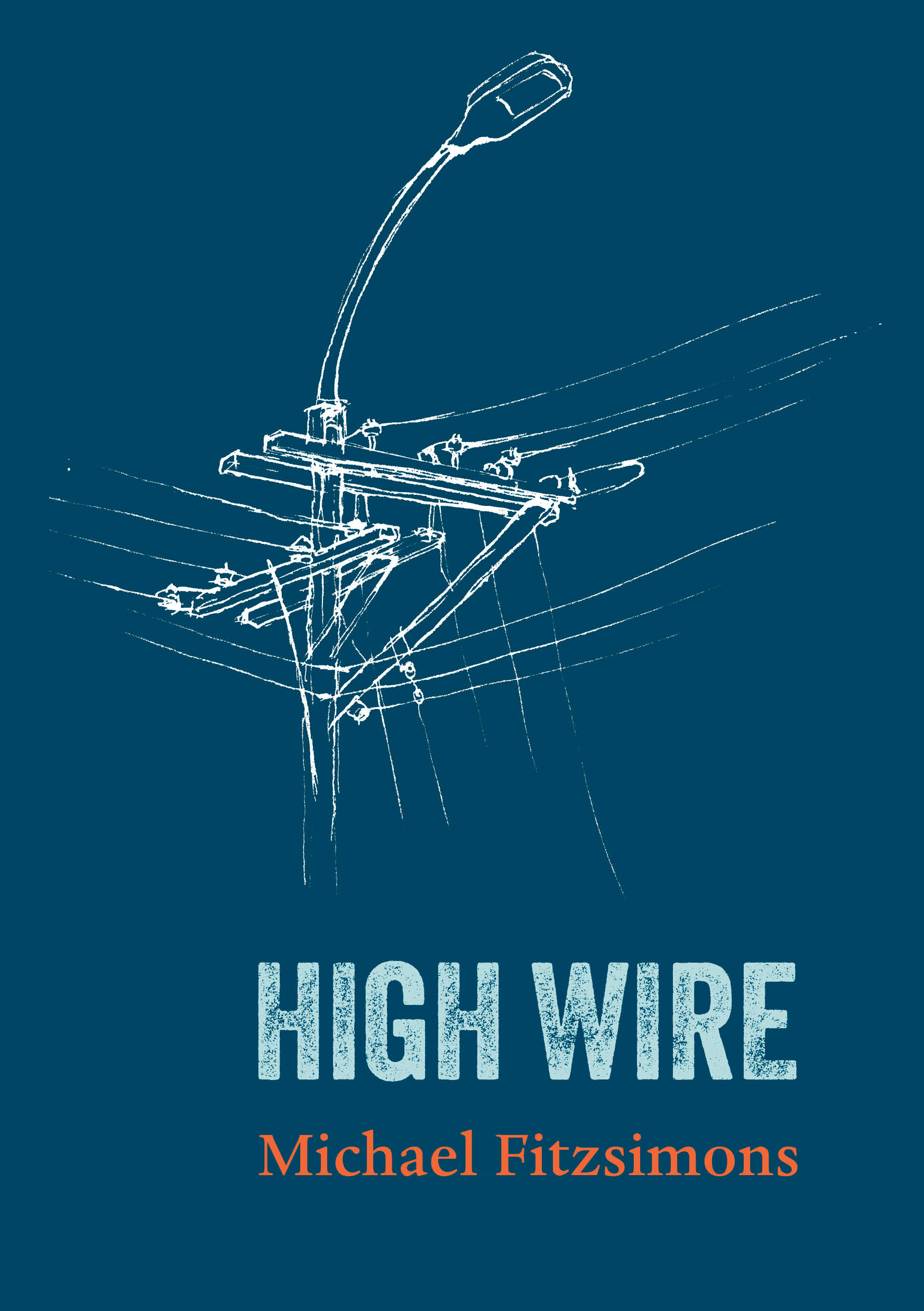
High Wire, Michael Fitzsimons, The Cuba Press, 2025
Now turn around
and see whitebaiters at the river mouth
and the puka leaf in the corner of the garden,
a rim of green brilliance,
and your home filled with homeliness,
noise and kids in every room,
and a woman with a voice like a bell,
singing a mountain hymn
right there in the kitchen.
And you far above the earth,
singing along.
Michael Fitzsimons
from ‘Remission’
Michael Fitzsimon’s new collection, High Wire, is a celebration of life: evocative, intimate, reflective. Home is a vital anchor as we absorb entwined threads of childhood, mythology, illness, recovery, reading, writing, routines and sidepaths.
The first section, a longish sequence entitled ‘All This’, offers the reader vital breathing space, a sweet slowness of arrival. In this current smash of global upheaval, when to pause and refresh feels like a necessity, Michael’s precious book is a gift. I am sitting here, in a zen-like state, the pīwakawaka dancing outside the bedroom window, a helicopter circling overhead, and I’m emptying my mind, falling into the sublime space of contemplation. Falling into this poetry uplift.
I slip into lines that are pinpricks upon the skin, sometimes pungent, sometimes tender, sometimes delicate: “Many are the things, she says, that can run a plough / through your heart.” The lines might expose a personal chord or the wider, collective wounds we face:
“If I don’t listen to Morning Report
it’s going to be a good day,
full of bounce and soft foliage.”
At one point, the poet lists the people in pain who surround him, at another times figures such as Bart Simpson, Henry VIII, Heraclitus, Parmenides, his yoga teacher, make an appearance. The circumstances of living and reading and writing are jagged and miraculous and everything in between. It’s high wire and it’s rejuvenating.
The second section, ‘And More’, comprises individual poems, a pocket-book suite of images and thoughts, and again, as with the first sequence, I am reminded of the exquisite breathing space, the spareness and physicality of Vincent O’Sullivan’s poetry. Again we are entering the varied rhythms of living, the acute epiphanies, the rewards of observation, the ebb and flow of memory.
When I put this precious book down, the pīwakawaka is now still, the helicopters now quiet, the missing dog walker found, and I feel like crying. It’s that curious and sublime mix of joy and wonder and delight. It’s intoxicating. It’s restoring. I am mindful how the rhythm of writing is so important, whatever the genre, because the rhythm of living is so very important. How words can sing and shine in our hearts when we most need them. And that moment is now.
I think about your struggle
to get it down,
your doggedness
in the quiet afternoon,
one more cup of coffee,
one more seagull drifting by the window,
your search for the hidden thing,
patient as an angler.
from ‘The writer’
A reading
‘Credo’
‘Four Square philosophy’
‘The fin’
A conversation
Were there any highlights, epiphanies, discoveries, challenges as you wrote this collection?
I wrote many of these poems in the long aftermath of a cancer diagnosis. As the months and years ticked by I felt increasingly over the moon for simply being here, for all the people around me and the beautiful natural world I inhabit on the edge of Wellington harbour. I hope the collection reflects an acute appreciation for the most simple things in life, and also an awareness of how precarious life is.
The first half of this collection is a series of short pieces / poetic fragments. This loose form gave me the freedom to try and capture poetically the rambling thoughts and feelings from that time of recovery. The mind is roaming widely but I think and hope there is a cohesion there.
What matters when you are writing a poem? Or to rephrase, what do you want your poetry to do?
I want my poetry to be honest to the thoughts and feelings I am having. I want there to be a core of emotional truth underlying the words which the reader might recognise in their own lives. To convey that truth in an interesting poetic form, in fresh images and story and metaphor, is always the challenge.
For me writing a poem is an interplay between the things I set out thinking I want to say and the things that arise unexpected in the writing of the poem. My best poems come as something of a surprise to myself.
I have found there are many different starting points for a poem. It might be an image or an idea, an object or a phrase, a memory or a strong emotion. It might be something someone said, it might be something I have read. The seeds of a new poem lie everywhere.
I value simplicity and accessibility in poetry. I would like my poetry to contain elements of surprise, gratitude and wonder.
Are there particular poets that have sustained you, as you navigate poetry as both reader and writer?
There are many poets I love. Particular favourites are Billy Collins, Mary Oliver, William Stafford, Charles Simic, Carol Ann Duffy and Wisława Szymborska. On the local scene I like Geoff Cochrane, Jenny Bornholdt, Peter Bland, Brian Turner, Elizabeth Smither and many others.
I am inspired by the work of other poets but I have learned not to try and copy them. I am always learning from them but the goal is to speak in my own voice, reflect my own experience of what it means to be human.
I am sustained by the dedication of other poets to the craft (I am not alone in this addiction to writing!) and I am sustained by so many knock-out poems that take my breath away.
We are living in hazardous and ruinous times. Can you name three things that give you joy and hope?
My friends and family – all three generations.
The beauty of the natural world that surrounds me. I live by the sea and walk the coastline most days.
The nourishment of the spirit – reading, singing, meditation, yoga.
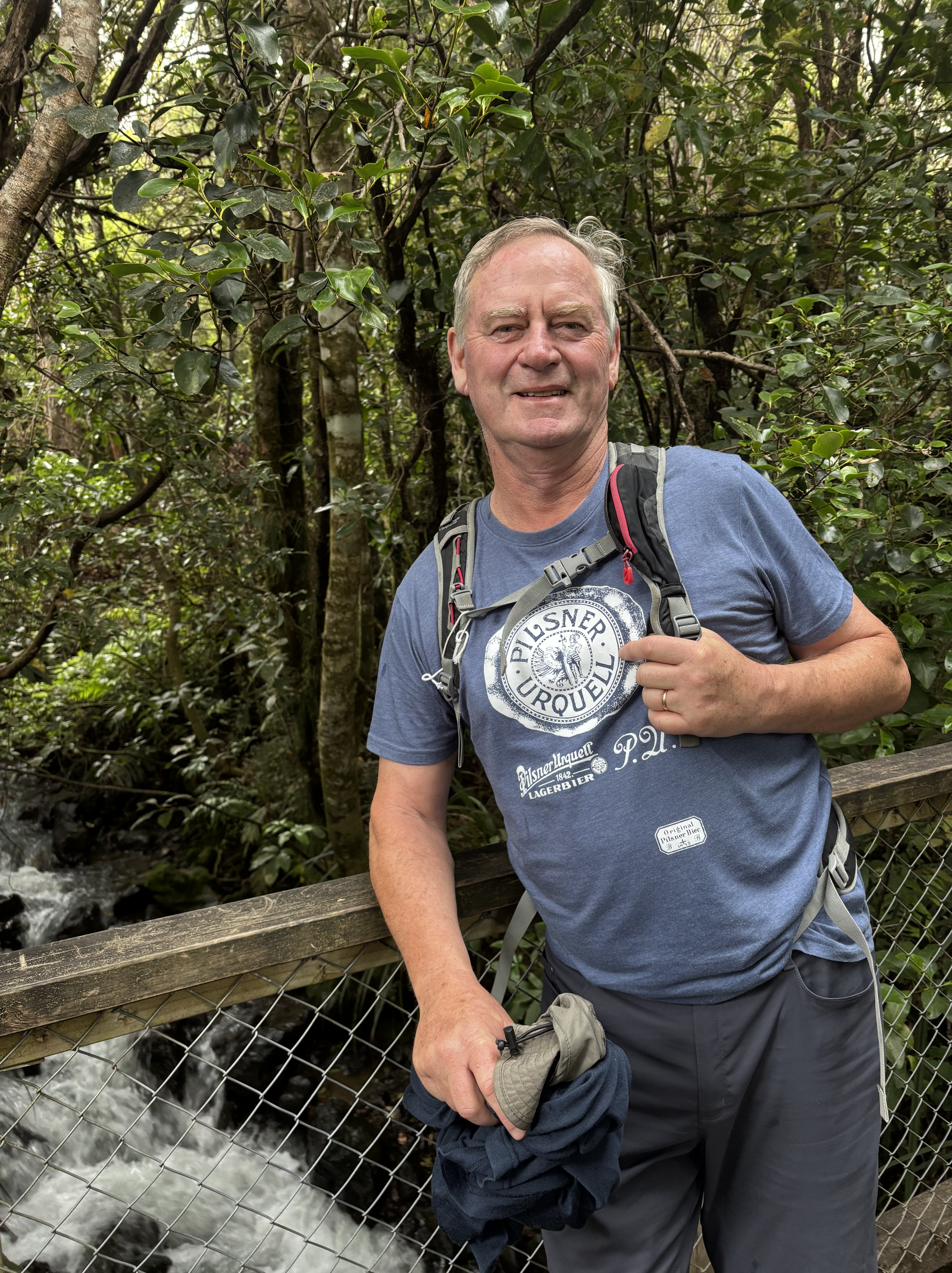
Michael Fitzsimons has published three books of poetry. His first collection Now You Know was recommended in RNZ’s annual poetry highlights. His second collection, Michael, I thought you were dead, dealt with a cancer diagnosis and was described by Joy Cowley as ‘a feast for the soul’. His third collection, High Wire, was published in February this year.
Michael is a professional writer and member of the three-person South Wellington Poetry Society. He was co-founder of the Wellington communications and publishing company, FitzBeck Creative. He has co-written two books with Nigel Beckford: With a Passion, the extraordinary passions of ordinary New Zealanders and You Don’t Take a Big Leap Without a Gulp – finding the courage to change careers and live again.
He lives with his wife Rose in Seatoun on a hill overlooking the harbour. They have three children spread from Wellington to Warsaw to upstate New York.
The Cuba Press page
 NZ Poetry Shelf