

To celebrate the Ockham NZ Book Award Poetry Shortlist I invited the four poets to answer a handful of questions, and to select a favourite poem from their book and one by another NZ poet.
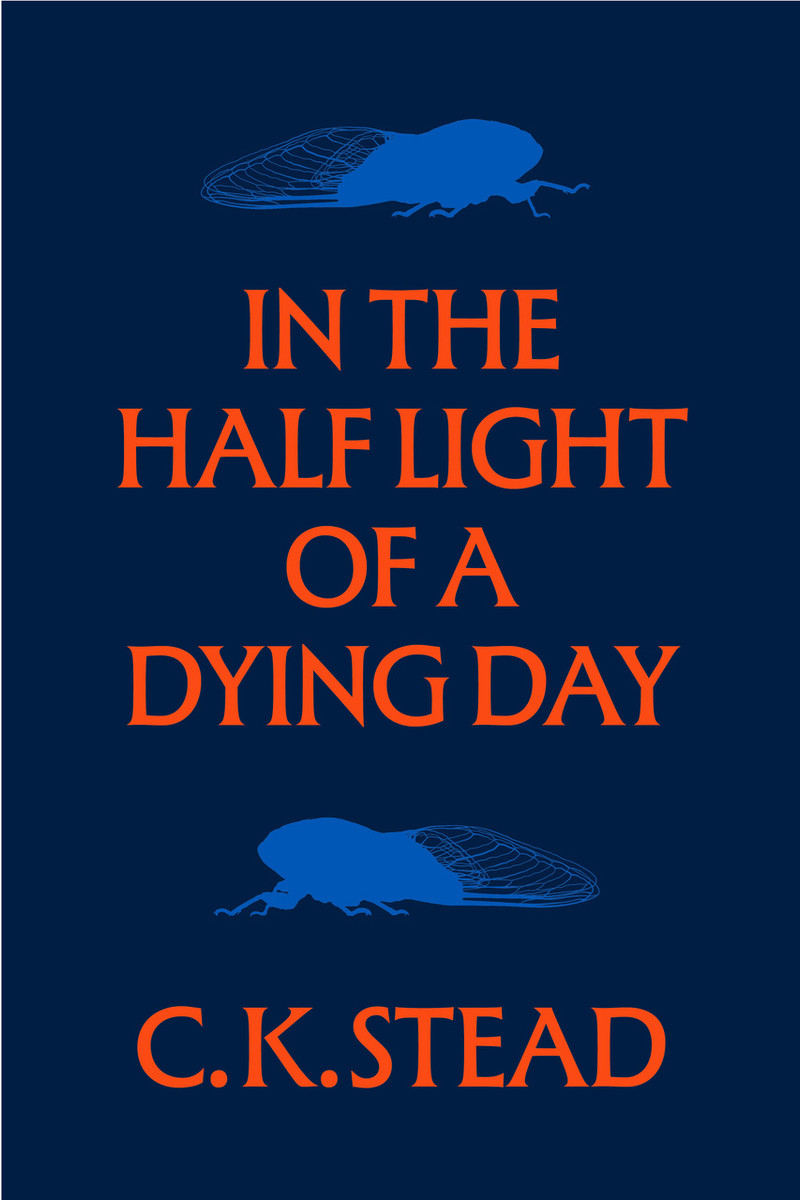
In the Half Light of a Dying Day, C. K. Stead
Auckland University Press, 2025
C. K. Stead has been writing versions of Catullus poems since 1979, also drawing upon Clodia, the woman believed to be the origin of Catullus’s Lesbia. Karl introduces a new figure, Kezia, borrowing the name from a child in Katherine Mansfield’s Burnell stories, a child believed to based on herself. Karl suggests his new collection, In the Half Light of a Dying Day, might be ‘read as a work of fiction’.
For me, this deeply affecting book, offers an album of bridges. I traverse the bridge from Caesar and his men away at war to ‘the lantern light / around the kitchen table / the women talking’. I cross the bridge between the farm up North with the calling morepork and another bloody battle. I am stalling on the bridge between Kevin and Karl sharing a wine or a poem and Catullus and Sappho penning verse. There is the bridge between our vulnerable world teetering on ruin and a world of hope and resourcefulness. I walk the bridge between the deeply personal and the imagined/documented past. More than anything, there is the bridge between love and grief, illness and death.
The poet is speaking in the ear of Catullus, the ear of Kezia, in the ear of the reader. He is speaking with heart on sleeve, sublime music rippling along the line, music that enhances the slow-paced revelations, the acute observations, poignant hypotheses, the building talk. In this lyrical unfolding, in this Calvinoesque city of bridges, poetry becomes a form of attentiveness, for both reader and writer.
There are many ways to travel through this extraordinary collection. To savour the contemporary references and locations along with those from the past. To see this as a personal navigation of loss, grief, love. To move from beloved to the wider reach of humanity. This is story. This fiction. This poetry. This is a book of love that I will carry with me for a long time.
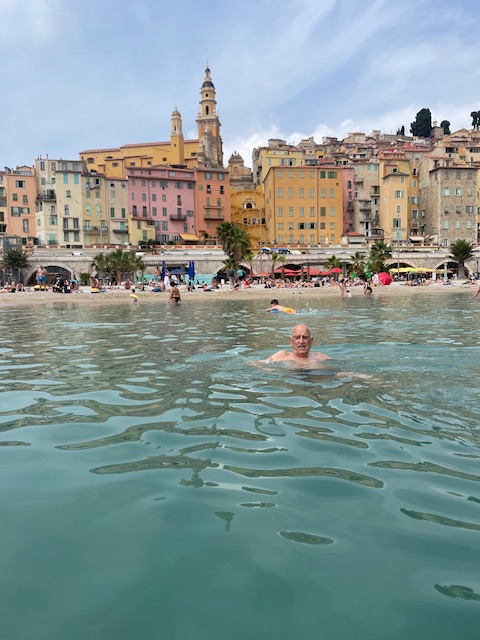
Swimming at Menton
Were there any highlights, epiphanies, discoveries, challenges as you wrote this collection?
They began just as a return to my old ‘poems in the manner of Catullus’ device, a way of using one’s own experience and half concealing its origin behind the persona of the Roman poet, so the reader could not be sure whether or not it was autobiography. But it was at just this time that my wife of 68 years, Kay, was diagnosed with cancer. The illness and her death occurred over several months so Catullus needed another lover than the ‘Clodia’ of my earlier poems. I gave her the name Kezia, and the poems became an account of her illness and death and of Catullus coping with the loss, the bereavement, the memories of their long past together, and the new reality of life alone. As in all my Catullus poems he never speaks in the first person – he is spoken to, or about, so these are not poems in the confessional manner, they keep a certain cool, a certain distance, the emotional demands on the reader are not heavy, which is why I think they work, if they do.
The poems seemed to write themselves, fluently. They were all written in one year, and then they stopped. I wrote the last one, and knew it was the end of the book and almost certainly the last poem I will ever write.
Is there a particular poem in the collection you have soft spot for?
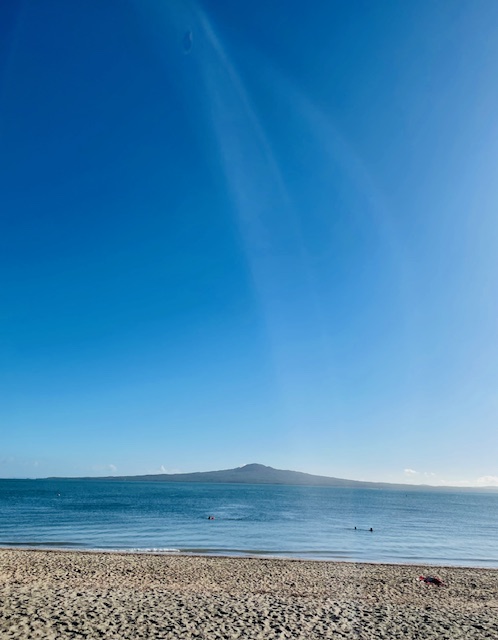
Possibly ‘Now more than ever seems it rich…’ which might be the longest single-sentence poem in New Zealand poetry. But I’m especially fond of ‘First light’, a swimming poem involving the yellow buoy at Kohi and the time when both Kezia and Catullus would swim all the way out to it in the early light.
‘Now more than ever seems it rich …’
Last night Kezia
Catullus called up
his ever-ready Keats
nightingale ode
and remembered how
in the same bed
when you were dying
you’d asked for the same poem
and he’d had to stop
at the sixth stanza
because you were weeping
at those lines that displayed
so poignantly
how the Muse could call forth
out of the nowhere
of a poet’s inner self
words so precisely placed
on the cliff-edge between
beauty and death
that poet and reader alike
must pause and weep.
First Light
Kezia’s funeral
Catullus
was yours too
no need for another.
Fine weather forecast
and an early tide
you are up at first light
to swim at Kohi
remembering days
when Kezia swam with you there
to the yellow buoy
in a sea that looked like glass
and felt like silk
and the vast beautiful harbour
under the enigma
of Rangitoto
felt like forever.
What matters more than ever when you are writing a poem? Or to rephrase, what do you want your poetry to do?
I can only reply to this by quoting what I wrote in the Foreword to my Collected Poems 1951-2006: ‘I think of writing a poem as putting oneself in the moment at the moment – an action more comprehensive, intuitive and mysterious than mere thinking, governed partly by history (the poet works in a tradition), but equally by individual temperament and voice, and by a feeling for what is harmonious, fresh, surprising and even, occasionally, wise.’
I would find this impossible to narrow to one example, but is there a poem by a poet in Aotearoa that has stuck with you?
There are so many of course but a good example would be Curnow’s ‘You will know when you get there’ which I quote in my final poem in the collection.
You Will Know When You Get There
Nobody comes up from the sea as late as this
in the day and the season, and nobody else goes down
the last steep kilometre, wet-metalled where
a shower passed shredding the light which keeps
pouring out of its tanks in the sky, through summits,
trees, vapours thickening and thinning. Too
credibly by half celestial, the dammed
reservoir up there keeps emptying while the light lasts
over the sea, where it ‘gathers the gold against
it’. The light is bits of crushed rock randomly
glinting underfoot, wetted by the short
shower, and down you go and so in its way does
the sun which gets there first. Boys, two of them,
turn campfirelit faces, a hesitancy to speak
is a hesitancy of the earth rolling back and away
behind this man going down to the sea with a bag
to pick mussels, having an arrangement with the tide,
the ocean to be shallowed three point seven metres,
one hour’s light to be left and there’s the excrescent
moon sponging off the last of it. A door
slams, a heavy wave, a door, the sea-floor shudders.
Down you go alone, so late, into the surge-black fissure.
Allen Curnow
From Collected Poems by Allen Curnow edited by Elizabeth Caffin and Terry Sturm, Auckland University Press 2017 permission courtesy of the copyright owner Tim Curnow, Sydney.
Are there particular poets that have sustained you, as you navigate poetry as both reader and writer?
Too many. I have always been a compulsive reader of poems and poetic drama, over the whole range, though in olde age I’m not good at ‘keeping up’ with what’s going on in the present.
We are living in hazardous and ruinous times. Can you name three things that give you joy and hope?
I could just reply ‘poetry’ – three times. But a better answer might be to refer to the poem ‘World’s End’ (p.22) where Catullus’s affirmative temperament acknowledges the terrible things ahead for the human race but seems to see better times beyond them, but then has to acknowledge ultimate extinction.
C. K. Stead is an award-winning novelist, literary critic, poet, essayist and emeritus professor of English at the University of Auckland. He was the New Zealand Poet Laureate from 2015–2017, has won the Prime Minister’s Award for Fiction and is a Member of the Order of New Zealand.
Auckland University Press page
 NZ Poetry Shelf