
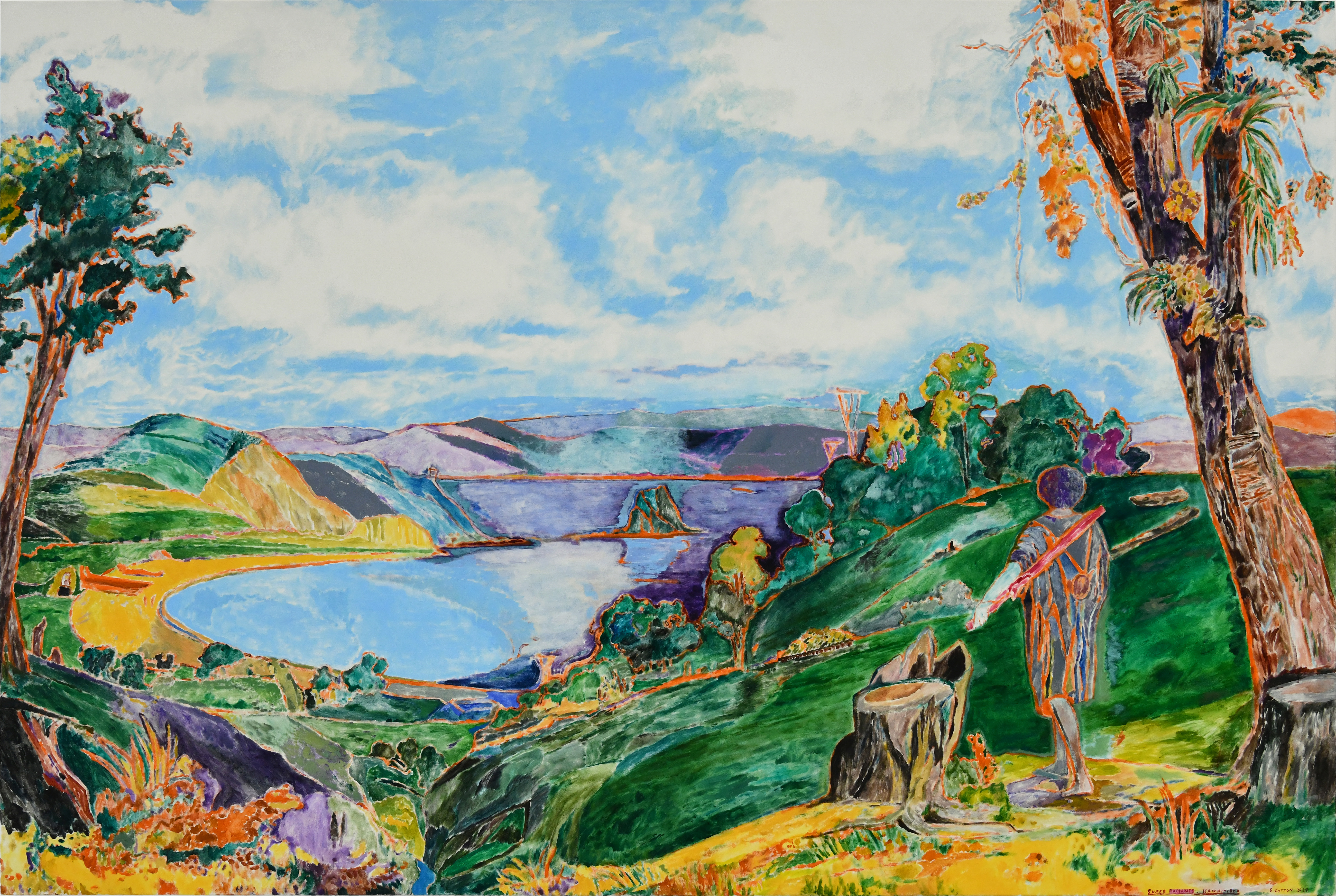
Super Radiance, 2024, Shane Cotton
New Paintings, Shane Cotton, 12 October to 16 November 202
Gow Langsford Gallery, Onehunga
For the first time in over two years, I stood in a gallery, masked up, and absorbed art. It was my first visit to the fabulous space Gow Langsford Gallery has created in Onehunga. They still have the gallery in Kitchener Street but their new creative venture includes exhibition spaces, studios for promising artists, and an extensive visual arts library.
I had spotted Shane Cotton’s new paintings on the gallery website and decided they were essential viewing. It was time to tag along with Michael as he dropped off work for his upcoming show and to view the new space.
In my bag, I had a book I am currently reading, Pictures and Tears by James Elkins (2001), a book that prompts travel to artworks that have profoundly moved me. I am, for example, back standing in the Rothko Room at the Tate Gallery, seeing the yellow pollen mountain of Wolfgang Laib at Musee d’Art Moderne Paris, and the Vincent Van Gogh Gallery in Amsterdam. More than anything I am returned to Renaissance Art in Italy where I was moved transfixed transported rebooted.
In Florence, I wrote a letter to the Uffizi Gallery requesting permission to view Artemisa Gentileschi’s paintings in storage, for my doctoral thesis. I was in the gallery two hours before the public, there in front of Botticelli’s ‘The Birth of Venus’, nobody else in the room bar a young ragazzo with his bunch of keys. I sat on the floor in the Gentileschi storage room, mesmerised. When I stood up, il ragazzo rattled his keys, saying, che altro?, and took me to the Caravaggio works in storage. I am almost weeping to be back in this moment. Postscript: that night the gallery was bombed, and those paintings were damaged.
Ah. How to experience art? Some people do a show, do a gallery, do a painting. Maybe that is an all encompassing word, because art is something we can see think feel memorise navigate. Both ethereal and physical. Surprising challenging intoxicating.
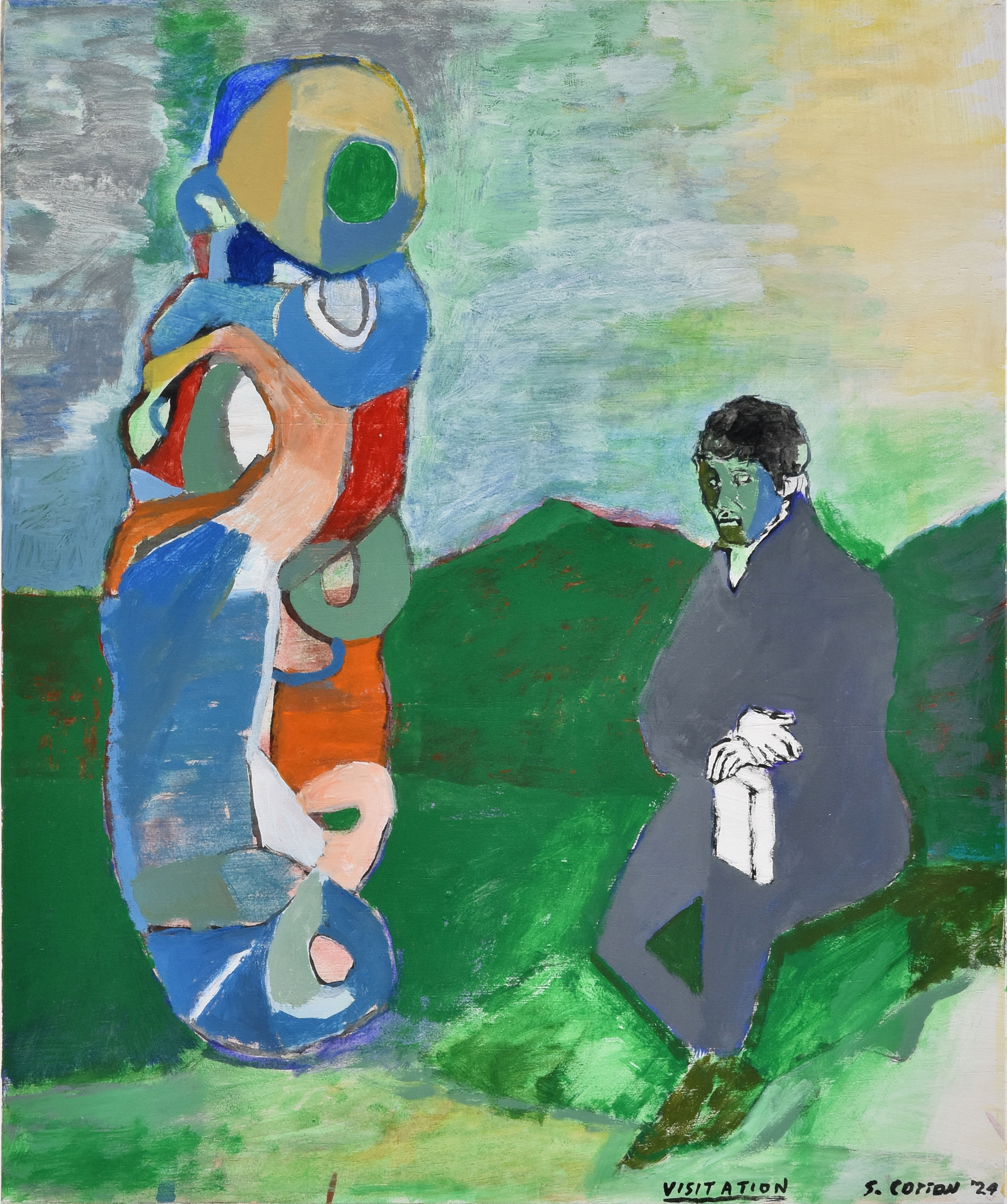
The Visitation, Shane Cotton, 2024
Tears. James Elkin’s book, as the title suggests, is a exploration of tears, on how art can prompt and promote feeling. Every now and then I walk up the hill to Michael’s studio and find myself in a state of awe, astonishment, wonder. I am not weeping but I am experiencing the electric fields of looking, contemplation, uplift.
Standing in Shane Cotton’s new show is a similar experience. I am not standing here as an art critic or reviewer, with my back catalogues of university studies, but as a poet. As a poet who sees writing as an open field of connections, possibilities, travels, techniques, innovations, traditions, conversations, challenges, protest, reverie, ideas, memory, experience, heart. I often ask poets which words matter as they write and, for me, the two I hold close, are connections and heart. I savour poetry that has heart, that forges myriad connections.
I also bring these two words, heart and connection, to art that catches me, and Shane’s sublime exhibition does exactly that. I feel these paintings like I feel a poem. The exhibition is a little different from his previous shows, but there are echoes, bridges, vital links. For me, this is art of entwinement; from personal traces to public narratives, intimate revelations to global concerns. Motifs, landscapes, people.
I begin with colour (Shane uses acrylic on board or linen), just as I might begin with the musicality of a poem. Not that there is ever a single formula for reading or viewing. Even on the website Shane’s use of colour strikes surprisingly, invigoratingly. It is scintillating, sheening, off-real, hyper-real. Think of how a piece of music might set you tingling, that is what colour can do. It generates colour hum, vibrations, psychological rhythms . . . let’s say vibes. A degree of word muteness, embedded in a moment of image trance. And Shane’s use of colour has edge, suspension, harmonics, it both elates and unsettles.
Narrative. After colour you might enter narrative. Each work carries story, close to the surface, deep set, woven, threaded, refracting, colliding, Indigenous, European, inhabited by ancestral figures. Personal. Intimate. The titles of the paintings underline the narrative scope. For example: ‘Up the Creek’, ‘Internal Visitor’, ‘The Will of the Devil’, The Laughing Tree’, ‘Sunset Gate’, ‘Rahiri’s Light’. I recommend reading Anthony Byrt’s terrific accompanying essay as it opens up the narrative richness, from colonial collisions, Ngāpuhi ancestors, the foregrounding of whakapapa, metaphorical possibilities, slippages, hybridity, visual and thematic chords. I see the exhibition as planting roots and tendrils in both new and old ground, navigating how and why we tell stories, have told stories, and must continue to tell stories in whatever form.
Movement. Shane’s art generates incredible movement. The figure painted in contemplation, walking or meditation renders me still, for an exquisite pause, until the prolonged moment slips and shifts into an acute awareness of body breath, heart beat, light, darkness, and again light.
On so many levels I am weeping. And in this catastrophic time, at home and abroad, with an inherited and ongoing smash of cruelty and greed, to breathe in strength and fragility, to spy anchor and exploration, is self fortification. It’s an aversion to explication. The way art and poetry can reside within and beyond framings. The way art and poetry are nourished by risk taking and by human care. And for me, there’s the vital impulse of never letting go of heart or a need to connect.
It feels like a miracle I could stand in the heart of this show, feel these paintings, take them home to view and revisit in my head gallery over the coming weeks.
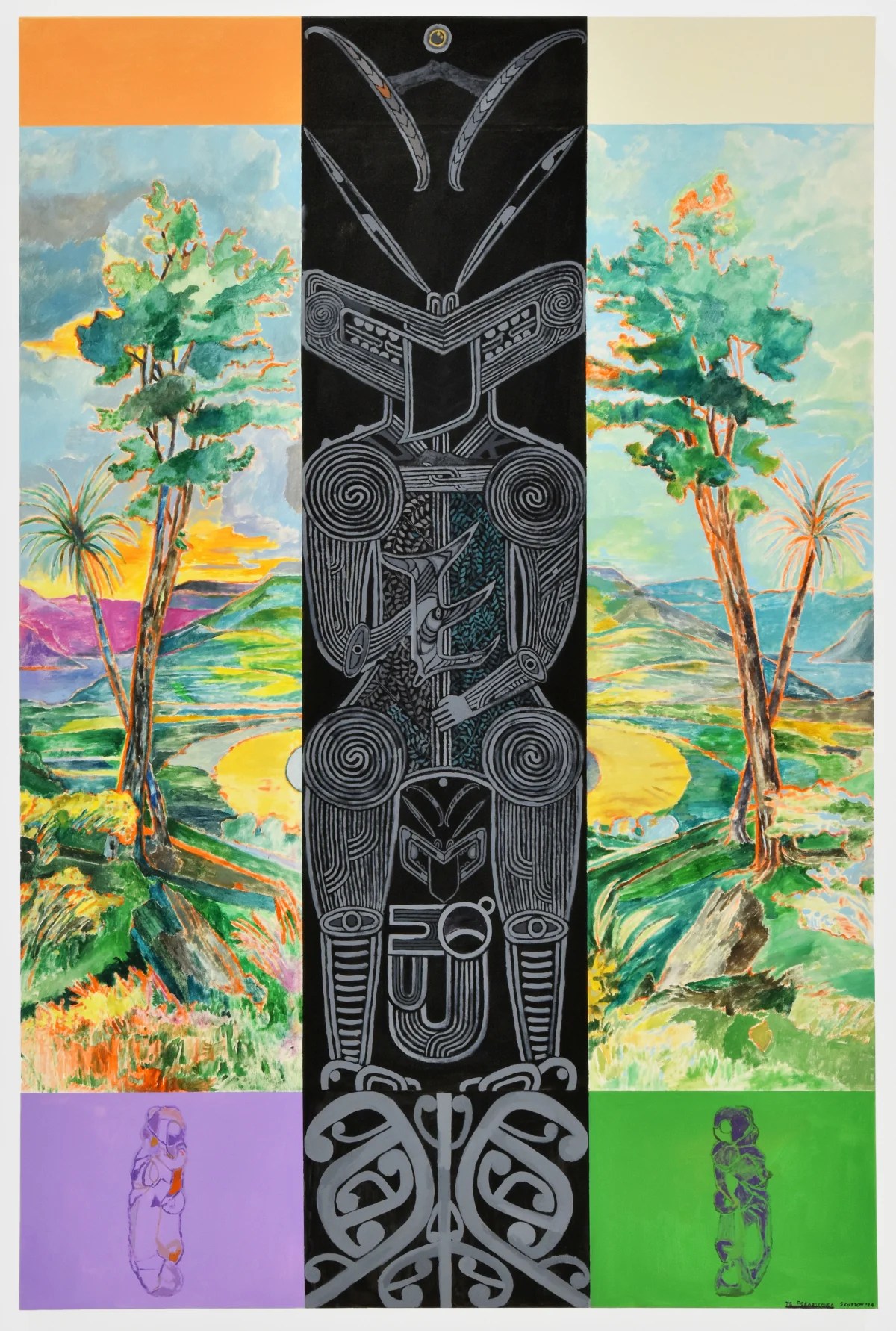
Te Pokatūpanga, Shane Cotton, 2024
Shane Cotton (Ngā Puhi, Ngāti Rangi, Ngāti Hine and Te Uri Taniwha) is as an internationally renowned New Zealand artist, who has exhibited extensively in New Zealand and abroad. In 2008, he received a Laureate Award from the New Zealand Arts Foundation and, in 2012 was made an Officer of the New Zealand Order of Merit for services to the visual arts. Lives in Kororāreka, Russell.
 NZ Poetry Shelf
Pingback: Poetry Shelf visits Michael Hight’s exhibition, Headwaters | NZ Poetry Shelf