Monthly Archives: October 2024

Poetry Shelf Noticeboard: South Asian Voices Event: Stories Beyond Borders

South Asian Voices Event, 24 October 2024: Curated by romesh dissanayake and Sudha Rao

Dinithi Nelum Bowatte is a Sinhala Sri Lankan New Zealander from Te Papaioea Palmerston North. She has written essays for various zines and the Pantograph Punch. Her short story ‘Three gigs’ is featured in ‘Visible Cities,’ a collection of writing published by the Cuba Press in 2023. 

Rajorshi Chakraborti was born in Kolkata and grew up there and in Mumbai, and now lives in Wellington with his family. He has published a collection of short fiction and six novels for adults. His latest book is The Bad Smell Hotel, a novel for children co-written with his daughter Leela.

romesh dissanayake is a Sri Lankan and Koryo Saram writer, poet and chef from Te Whanganui-a-Tara Wellington. His work explores ideas of identity, decolonisation and place. romesh’s poetry, fiction and essays have appeared in various print and online publications. His chapbook poetry collection, Favourite Flavour House, is featured in AUP New Poets 10 published by Auckland University Press. His first novel, When I open the shop, was the winner of the 2022 Modern Letters Fiction Prize and is published by Te Herenga Waka University Press.

Brannavan Gnanalingam is an award-winning novelist based in Pōneke. He is the author of Sprigs (winner of the Ngaio Marsh Award for Best Novel and shortlisted for the Jann Medlicott Acorn Foundation Prize for Fiction at the Ockham New Zealand Book Awards), Sodden Downstream (also shortlisted at the Ockham New Zealand Book Awards), and A Briefcase, Two Pies and a Penthouse (longlisted at the Ockham New Zealand Book Awards). He is also a former columnist for the Sunday-Star Times, and winner of a Qantas Media Award (as it was then known) as a film reviewer for The Lumière Reader. The Life and Opinions of Kartik Popat is his eighth novel.

Janaye Kirtikar is a Marathi Indian and Pākehā writer from Pōneke. She reads, she writes, and she stares at the ocean.

Rupa Maitra is a fiction writer born in New Zealand to Bengali parents. Her book of short stories, Prophecies, was published in 2019. 

Katya Mokha is a mixed Punjabi/English writer who grew up in various places, though she most closely identifies with Whanganui. While Katja feels new to the writing world, she has previously written short stories for personal enjoyment and, on a few occasions, for anthologies and competitions. Currently, she is an MA student at Te Herenga Waka and is just weeks away from submitting a full manuscript.

Nipuni Ranaweera is an academic and poet from Sri Lanka who is currently based in Wellington, New Zealand where she is reading for her PhD in English and Poetry at Massey University.

Nipuni has published two collections of poetry which were nominated for major awards in Sri Lanka.  Her work has also appeared in several local and international journals.

Sudha Rao is originally from Karnataka, South India, migrating to New Zealand. She trained in classical South Indian dance and established Dance Aotearoa New Zealand. Sudha completed an MA in Creative Writing at the International Institute of Modern Letters and published her first collection of poems On elephant’s shoulders, Cuba Press in 2022. Sudha’s poems other works have appeared in several anthologies including in Landfall and Best Poems New Zealand. Sudha was invited to participate in the International Bengaluru Poetry Festival.

Poetry Shelf Monday Poem: If I Go Back by Khadro Mohamed

If I Go Back

if I ‘go back to where I came from’
I will take everything with me.
my mason jars with fireflies, my golden bangles,
my morning coffee.
I will take my earth, my horned melons
and stories of Cleopatra.
I will take that rug, the one you love so much,
with the golden tassels and delicately picked
butterfly wings. I will take my turmeric
my henna, my lemongrass and acacia leaves.

I will take my language, heavy and
soft in the palms of my hands.
I will tuck my afrobeats and hip-hop in my back pocket.
I will carry the moon in my bindle,
my chocolate in a zip-lock bag.
I will carry my baobab and the cash
you owe me in my back pack.

and then you’ll left with naked
kings and queens with concave
bellies and hollow, scooped out eyes
because their fancy fabric, thin
sclera and jewelled crowns belong to me too.

Ama Ata Adioo once said ‘what would the world
be without Africa?’ and I think I know now.
It would no longer grow roses, it would be
void of lyrical words and sweet orange pulp
that melts on my tongue.
the earth would be scaly and dry,
the wind would not whistle.

there would be a dent in the air every time
you took a breath. there
would be no myriad of reds and purples
dancing across the sky.

Khadro Mohamed
from We’re All Made of Lightning, Tender Press (We are Babies), 2022

Over the coming months, Poetry Shelf Monday Poem spot will include poems that have stuck to me over time, poems that I’ve loved for all kinds of reasons. Poems that comfort or delight or challenge. Poems that strike the eye, ear or heart. This poem by Khadro Mohamed aches and connects and speaks heart. It is a poem I keep returning to, with its lattice of pain and love and wisdom, so perfect to read in these turbulent times. I hold this poem close to my heart. Today, in this relentless smash of malignant news, I hold poetry close to my heart.

Khadro Mohamed is a writer and poet from Pōneke, her debut poetry collection We’re All Made of Lightning won an Ockham NZ Book award in 2023. She’s currently working on a fiction novel. 

Poetry Shelf pays tribute to Fleur Adcock (1934 – 2024)

Over the past days I have been moved by the breadth and depth of tributes paid to Fleur Adcock (1934 – 2024); on social media, on the airwaves, in the press. At a time when we are saddened by news of Fleur’s death, I find myself drawing her poetry close, reflecting on what her poetry means to me, on certain poems that have resonated deeply. I heard publisher Fergus Barrowman sharing memories and poems with Emile Donovan (listen here Nights RNZ), read Dougal McNeill’s wee tribute to her poetry on Facebook – and that coincidentally, his students had been responding to Fleur’s Wellington poems in poems of their own. That matters so very much.

The effects of Fleur’s poetry are wide ranging; she wrote from a sustained history of reading and inquiry, from personal experience and sharp observation, from measured craft to conversational tones. Her poetry is poignant, witty, serious, physical, abstract, humane, cool, warm, personal. She assembled family and she looked back at New Zealand as she widened definitions of home.

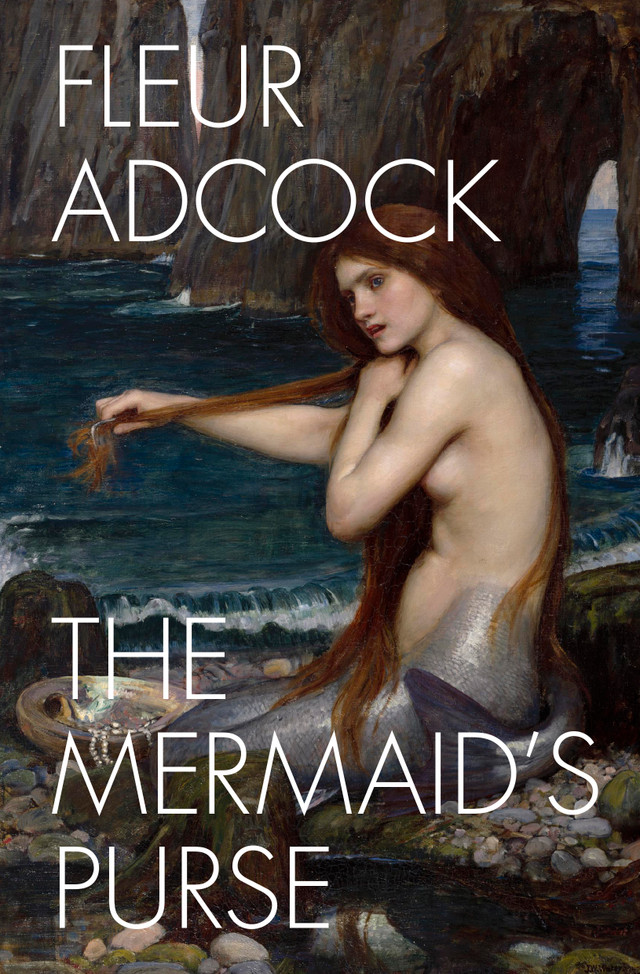
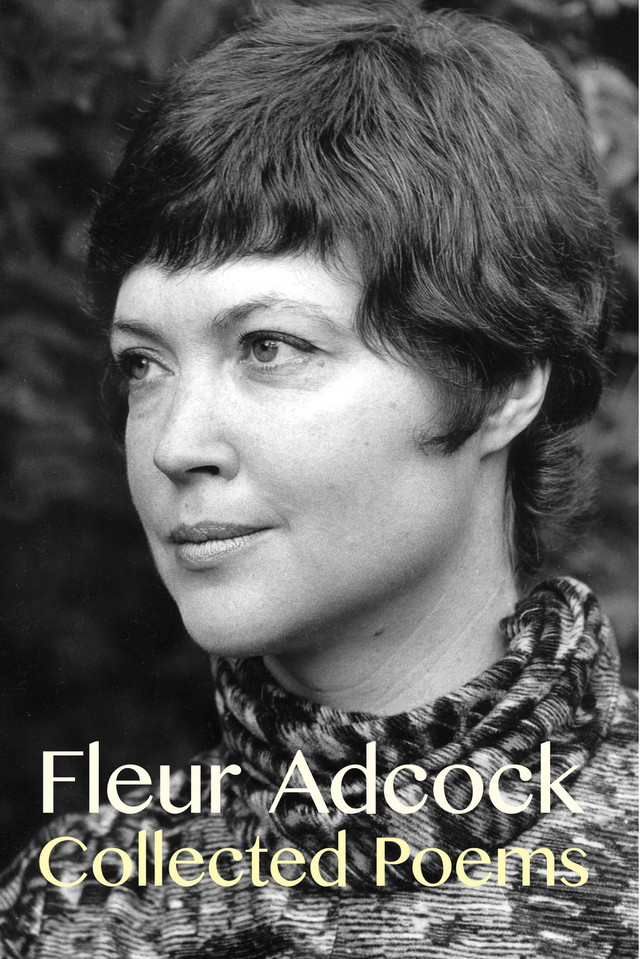
One of the many joys in researching and writing Wild Honey, my book on women poets, was reading Fleur Adcock’s poetry books – from The Eye of the Hurricane (1964) to Hoard (2017). Since then Victoria University Press/ Te Herenga Waka University Press has published The Mermaid Purse (2021) and Fleur’s Collected Poems. The anthology is a sumptuous, substantial tribute to a much loved poet: the book is beautifully designed, keenly edited and a perfect way to enjoy the scope of her poetry. I would like to gift a copy of this to one reader. Please leave a comment here or on my social media pages by Oct 15th if you would like a copy. I will put names in a hat and choose someone on 16th.

In May 2020, Fleur sent me a poem to post when we were in the thick of Covid, lockdowns and uncertainty. She included a note to go with it. I love the poem and I love the comment. I am reminded how precious memories and particular places are, how being in the garden or the woods or at the beach can furnish joy and balm in difficult times.

Island Bay

Bright specks of neverlastingness
float at me out of the blue air,
perhaps constructed by my retina

which these days constructs so much else,
or by the air itself, the limpid sky,
the sea drenched in its turquoise liquors

like the paua shells we used to pick up
seventy years ago, two bays
along from here, under the whale’s great jaw.

Fleur Adcock
from The Mermaid’s Purse, Te Herenga Waka University Press, 2021

Fleur: I wrote this poem when I was in New Zealand late last year. It feels unbelievable that I should have been able to walk freely along the coast of Island Bay basking in the sunshine and the wind, just because I felt like it; things are not like that here, and may never be again for someone of my age. But at least it’s spring, and I have my garden, and am allowed to go for walks in the local woods as long as I don’t travel on a bus to get there, or risk doing anything so audacious as my own shopping.

A conversation

To celebrate the arrival of Collected Poems (2019), Fleur and I embarked on a slow email conversation. The poems cited are included in the anthology, but I have added the original source here. This was a special and generous conversation, slowly unfolding over weeks not an hour.

At school I used to read, mostly,
and hide in the shed at dinnertime,
writing poems in my notebook.
‘Little fairies dancing,’ I wrote,
and ‘Peter and I, we watch the birds fly,
high in the sky, in the evening’.

from ‘Outwood’
(originally published in The Incident Book, Oxford University Press, 1986)

Paula: Can you paint a small snapshot of yourself as a young girl? Did books and writing feature?

Fleur:  From the age of six I was always a passionate reader, somewhat to the annoyance of my mother as the years went by. One of my favourite childhood photographs of myself (there were very few, because photographic films were almost unobtainable during the war) is of me lying on my stomach on the grass in our garden when I was eight or nine, reading a book. When I was nearly seven I was given a book called Jerry of St Winifred’s, about a girl who wanted to be a vet and who when trying to rescue a puppy from a rabbit hole accidentally discovered an ancient manuscript. This was when Marilyn and I were living in the country, as unofficial evacuees on the farm of our father’s cousins George and Eva Carter. Auntie Eva told me reading was bad for the eyesight, and restricted me to one chapter a day. If she had wanted to encourage me this would have been the best thing she could have done – in these days of reluctant readers, parents are told that if reading were forbidden more children would want to do it. In my case there was absolutely no need.

At that time we were away from our parents, and therefore writing letters and little stories for them, or at least I was – Marilyn was still at the stage of sending pictures, but it was all useful practice in communication.

The following year, 1940, we were living in Salfords, Surrey, with our mother, just across the road from the small tin-roofed public library. I used to go and browse in it alone, to borrow books. Titles I remember are Fairies and Chimneys, by Rose Fyleman, and Tales of Sir Benjamin Bulbous, Bart, which involved naiads, water sprites, etc. You will observe a fairy theme.

In what seems no time at all we were settled in a house of our own and I was reading whatever I could lay my hands on: library books, books from school, occasional books I was given as presents. Because of the wartime paper shortage these were in rather short supply. I liked adventure stories: Dr Doolittle, books by Arthur Ransome, Robert Louis Stevenson, and inevitably Enid Blyton. When I was 10 my mother lent me her copy of Gone with the Wind, and the following year gave me a rather beautiful ex-library copy of  Pride and Prejudice, which I read over and over again and still treasure.

I was also writing poems. When I was seven, at Outwood School in the Surrey countryside, I had a little notebook in which I wrote my compositions at lunchtimes. I was there for only three months, from early June to early September 1941, and had no friends. Marilyn was away for the first few weeks, with whooping cough. Poetry was my refuge.

(…) I was impatient
for Jerry of St Winifred’s
my Sunday School prize, my first real book
that wasn’t babyish with pictures –

to curl up with it in the armchair
beside the range, for my evening ration:
‘Only a chapter a day,’ said Auntie.
‘Too much reading’s bad for your eyes.’

I stuck my tongue out (not at her –
in a trance of concentration), tasting
the thrilling syllables: ‘veterinary
surgeon’, ‘papyrus’, ‘manuscript’.

from ‘Tongue Sandwiches’
(originally published in Looking Back, Oxford University Press, 1997)

At my next school, St John’s, I won a gold star (see my poem ‘The Pilgrim Fathers’, and also the previous one, ‘Tongue Sandwiches’, re the earlier experience). I graduated to a slightly larger notebook and my subject matter expanded slightly, although one of my principal influences was still Enid Blyton – our mother thought her little magazine “Sunny Stories” was suitable reading matter for children, rather than the comics we swapped with our friends from school. I also liked ballads and melodrama. There were three more schools before the end of the war. At one we studied ‘The Lady of Shalott’: just my cup of tea, with its Tennysonian sound-effects and melancholy ending.

When I was 13 we went back to New Zealand, and I began writing nostalgic poems about such topics as “Spring in a Surrey wood”. The poems were rather fewer in my teens; some of them were carefully made, with rhymes and proper scansion, suitable for the school magazine, in which I won prizes for ‘The Bay’ and a poem about a seagull. My more private poems came under the influence of TS Eliot, whose work we studied when I was 15. World-weary disillusionment set in, together with free verse; I’ve just found one that ends with the two lines: “But what the hell does it matter? / Let’s go out and shoot ourselves.” The Waste Land has a lot to answer for.

But I’m afraid this is not a small snapshot but a sprawling album! I’ll stop.

Paula: I got goose bumps picturing the power of words and books for the young child making her way from girlhood to adolescence. Has poetry writing always been a refuge for you? Or has it developed other functions?

Fleur: Writing poetry has many functions for me; more than I can identify. It’s art, it’s therapy, companionship, a challenge, an indicator of health – I’ve always been aware that when I’m healthy I’m writing, and when I’m writing I’m healthy. It’s that much despised thing self-expression, as resorted to by generations of teenagers. It’s also, to some extent, my bread and butter. When I had a proper job, as a librarian in the civil service, time to write poetry was the unattainable ideal. Now that I’m retired I have a small pension from that ‘proper job’, but for a long time while I was freelance most of the work I did, in the form of poetry readings, broadcasting, book reviewing, translating, teaching on writing courses, going to festivals, writing libretti, etc, arose out of the fact that I wrote poetry. There’s less of that now – you don’t get quite so many commissions in your 80s – but still a certain amount. And I’m still writing the poems.

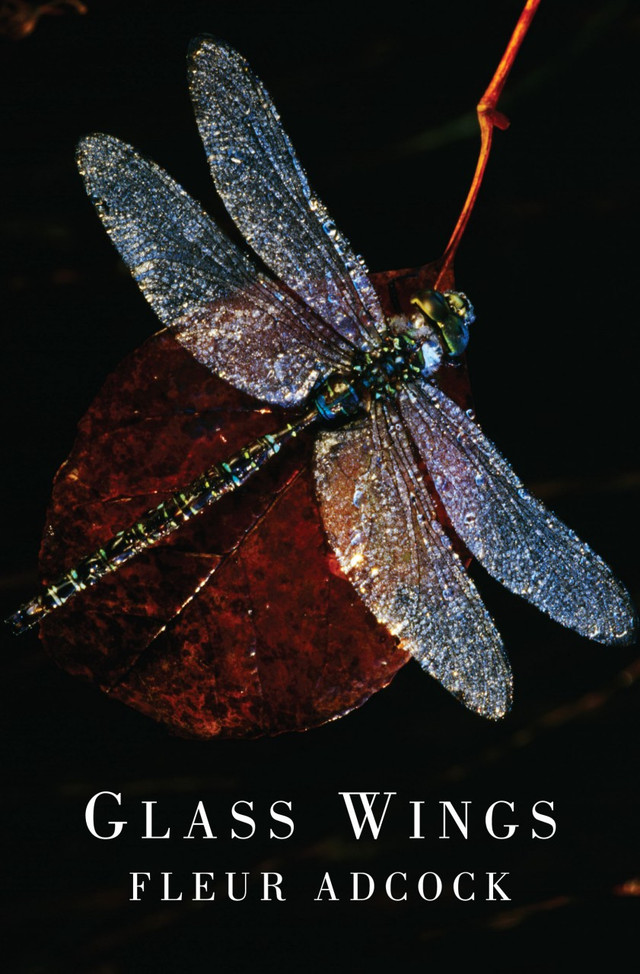
Poetry also has a social function. Some 18th century poets used to call their books ‘Poems upon Several Occasions’. I’ve written a number of those, too: poems for other people, for specific occasions or on topics that I hope they will be able to identify with. My poem ‘The Chiffonier’ about a particular habit of my mother’s (marking out special items for her children to inherit, long before she died) turned out to be common to a whole troop of mothers, I was pleased to learn from fan letters. I write a number of family poems: for birthdays, for Greg’s wedding to Angie, for the birth of my great-grandson Seth (a rare male among my hosts of female descendants), also elegies – for my parents and various ancestors, and one for Alistair that I managed to produce in time for Marilyn to read it at his funeral. There are elegies for friends, too, and increasing numbers of laments for doomed or extinct inhabitants of the natural world: birds, butterflies, insects of all kinds (my book Glass Wings contains examples), bats… It would be depressing to go on.

But now I see you in your Indian skirt
and casual cornflower-blue linen shirt
in the garden, under your feijoa tree,
looking about as old or as young as me.
Dear little Mother! Naturally I’m glad
you found a piece of furniture that had
happy associations with your youth;
and yes, I do admire it – that’s the truth:
its polished wood and touch of Art Nouveau
appeal to me. But surely you must know
I value this or any other treasure
of yours chiefly because it gives you pleasure.
I have to write this now, while you’re still here:
I want my mother, not her chiffonier.

from ‘The Chiffonier’
(originally published in The Incident Book, Oxford University Press, 1986)

Art: one of the enormous satisfactions of writing is constructing a beautiful or at least memorable and satisfying artefact. I believe that one of the essential elements of being human is wanting to create some kind of art. I remember having an argument with a friend about this, or perhaps just a misunderstanding – when I say “art” I include large areas of human creative endeavour such as gardening, growing plants, making clothes, furniture, jewellery, or anything that gives satisfaction to its creator. Some people (I’m not among them) find artistic pleasure in cooking. When my grandchildren Cait and Ella were small they spent hours of ingenuity constructing miniature items of furniture for their Sylvanian toys out of scraps of cardboard, Sellotape, fabric or whatever was around; that was art. So, I suppose, were the elaborate cakes their mother made for their birthdays; I remember one in the form of a swimming pool with blue jelly for water. For me the primary art-form is poetry. Very few things make me happier than finishing a poem I’ve been struggling with.

Paula: I love the way poetry emerges from the nooks and crannies of your life and thinking, the way it feeds and spurs. Your Collected Poems demonstrates this so clearly. Rereading the first two collections – The Eye of the Hurricane (1964) and Tigers (1967) – I am reminded how these early poems have travelled so well across the decades. Take the much-loved and anthologised ‘For a Five-Year-Old’ for example.  What were your early preoccupations as a poet in view of both style and subject matter?

I see, then, that a kind of faith prevails:
your gentleness is moulded still by words
from me, who have trapped mice and shot wild birds,
from me, who drowned your kittens, who betrayed
your closest relatives, and who purveyed
the harshest kind of truth to many another.
But that is how things are: I am your mother,
and we are kind to snails.

from ‘For a Five-Year-old’
(originally published in The Eye of the Hurricane, AW Reed, 1964 and then in  Tigers, Oxford University Press, 1967)

Fleur: I don’t think I can answer this in any meaningful way. I could look back through the early collections to see what I was writing about, but so could anyone; it’s not the same as being inside my feelings at the time, which I find it impossible to recall. I wasn’t setting out with any aim or objective; I just wrote about whatever topics suggested themselves, and my chief emotion was “Oh, good, I’m writing a poem!”

One of my first preoccupations, even as an adolescent, was my ‘exile’ from England. I wrote about this in my early teens, and also in the poem I called ‘The Lover’, in which I imagined a male persona trying to adapt to living in a new country. This ridiculous enterprise naturally misfired: everybody thought I was writing about Alistair. Serves me right, for not having had the confidence to write as a female.

Looking at The Eye of the Hurricane, I see that a number of the poems were about relationships with various men, one in particular – a natural preoccupation of a person in her 20s. One person they were definitely not about is Alistair. I was very surprised, in later years, to find that some people imagined he was the character represented in such poems as ‘Knifeplay’, when he was not at all like that.  Most of those poems were written in the nearly five years between my divorce from him and my marriage to Barry Crump in 1962. I never wrote about Alistair while I was married to him. Most of my very few poems about him were written while he was dying or after his death in 2009 – my elegy for him was modelled stylistically on his famous Elegy in Mine eyes dazzle.  My own early “battle of the sexes” poems (to use a Baxter phrase) were about my then current preoccupations. By 1959, Alistair was history.

As for the style, in those days I wrote in traditional verse forms, often rhymed, because it was easier to be convinced that I’d got a poem right if the rhymes and metre were correct. Free verse is far more difficult to judge (I don’t mean blank verse – unrhymed iambic pentameter, as in Shakespeare’s plays – which is another kettle of fish. I certainly used that from time to time.)

When it came to my next collection, Tigers, a new subject presented itself: culture shock. I was suddenly living in a wider society, in England, exposed to the harsh realities outside insular little cosy New Zealand. ‘Regression’ is a reflection of my new political anxieties, although I had also written about the nuclear threat earlier, in NZ. We were all convinced the world could end at any time, as seemed quite likely. But on the whole I rather cringe to open these two earliest collections. I think of what Katherine Mansfield wrote to JMM when he urged her to allow In a German Pension to be reissued: “It is far too immature, and I don’t even acknowledge it today. I mean I don’t ‘hold’ by it. I can’t go foisting that kind of stuff on the public” (quoted in his introduction to the Penguin Modern Classics edition).

All the flowers have gone back into the ground.
We fell on them, and they did not lie
crushed and crumpled, waiting to die
on the earth’s surface. (..)

from ‘Regression’
(originally published in Tigers, Oxford University Press, 1967)

Paula: You touch upon the way autobiography can both corrupt and enhance a reader’s pathways through a poem and the danger of making assumptions about both the speaker and subject of a poem. Some things in a poem stay secret and some are exquisitely open.  As I read my way through your collections I relish the shifting tones, sharpness, admissions, contemplations. The way poems are both oblique and transparent. Two collections have particularly affected me, but before sharing these, are there one or two books that have been especially important in the making and published result?

Fleur: Once again, impossible to answer. For quite some time The Incident Book gave me particular pleasure to look back on, but inevitably it was overtaken by others.  Every published collection that appears between covers and looks like a complete and separate entity is in fact just a bundle of individual poems. When my youngest granddaughter saw the size of my Collected Poems in New Zealand, she said to her father, “Wow! How could she write so many poems?” The answer is, one at a time. Each new poem is a world in itself, something to plunge into and be absorbed by for as long as the writing of it lasts. Only much later does it become part of a published book, if I decide to include it in one. Not every poem is chosen.

21

The fountain in her heart informs her
she needn’t try to sleep tonight –
rush, gush: the sleep-extinguisher
frothing in her chest like a dishwasher.

She sits at the window with a blanket
to track the turning stars. A comet
might add some point. The moon ignores her;
but dawn may come. She’d settle for that.

from ‘Meeting the Comet’
(originally published in Time-Zones, Oxford University Press, 1991)

My feelings about the various collections tend to be influenced by my memories of the circumstances and places in which they were written. For example, Time-Zones received its title from the travelling I was doing during that time I was working on it. It contains poems from my three months in Australia as writer in residence at the University of Adelaide in 1984, including the two long sequences at the end, ‘Mrs Fraser’s Frenzy’ (written for music, originally for Gillian Whitehead, but she decided it didn’t suit the commission she had in mind and it was subsequently set by the English composer George Newson instead), and ‘Meeting the Comet’, which I wrote in bits and pieces during my journey to and from the southern hemisphere, as a way of staying sane and having something to work on while I was in transition from one place to another. (The girl in the poem is fictional, but was originally inspired by the child of friends in Newcastle, who had the same disability although not the same history as the one in the poem.) The collection also includes poems about Adelaide, where I was living for a time, and Romania, which I had visited and where I had made good friends and had my eyes opened to a new political landscape. Altogether a bit of a ragbag – I was crossing time zones as the poems came to me.

How complicated these things are to explain.

Then there was Looking Back, which was short-listed for the T.S. Eliot prize in 1997. It gave me great pleasure to write, or at least the poems about my ancestors did, because of my obsession with genealogy, but shortly afterwards, oddly enough, I lost interest in writing poems for some years, and devoted myself to the ancestors in a big way.

Dragon Talk was important, by virtue of the fact that it marked my return to writing poetry after a gap of several years. However, I certainly wouldn’t call it my best collection; it was a necessary one, to get the wheels turning again, but afterwards I moved on in different directions.

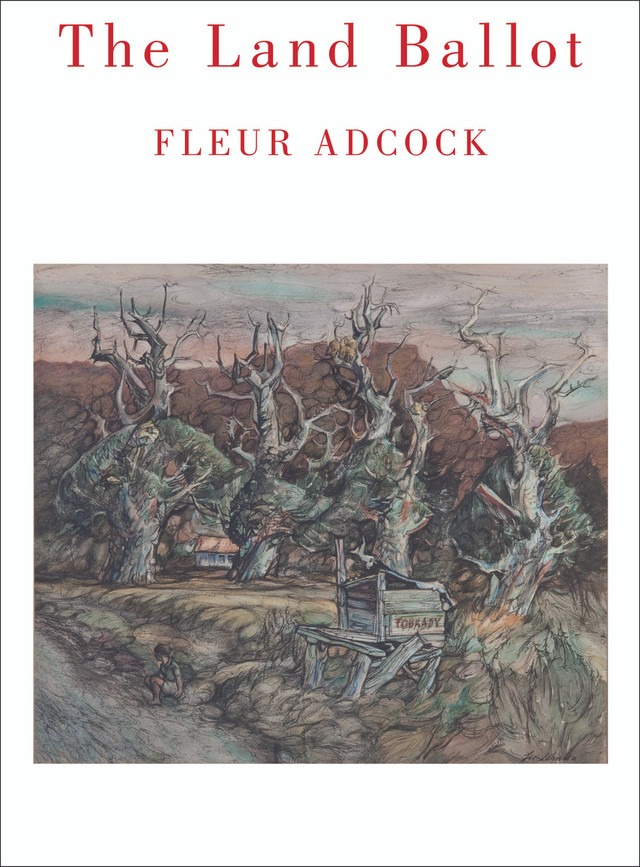
The only book I actually conceived and embarked on as a single entity, in the way you might embark on a novel, was The Land Ballot. I wrote three or four poems about my father’s childhood, and then it dawned on me that  I might be able to produce enough for a book. I did enormous amounts of research for this, over a period of two years, 2012-2013, building up a picture of this remote community and its inhabitants, and was totally immersed in it. Two of the happiest years of my life as a writer. On the other hand, one of the happiest years of my life as a person was 1977-8 (September-June), living in the Lake District as writer in residence at Charlotte Mason College in Ambleside, surrounded by amazing scenery, with time to walk and explore and make discoveries, as well as making a quantity of new friends and spending more time than usual with many of the old ones: if you live in a famously beautiful place and have a spare bedroom you suddenly become very popular. But the poems that emerged from this time are scattered between more than one published collection.

As there was only one lamp
they had to spend the winter evenings
at the table, close enough to share
its kerosene–perfumed radiance –

his mother sewing, and he
reading aloud to her the books
he borrowed from Mr Honoré
or the Daysh boys on the next farm

from ‘Evenings with Mother’
(originally published in The Land Ballot, Bloodaxe Books and VUP, 2014)

Paula: I love the way a poem becomes a miniature absorbing world for both reader and writer, and the way the context of its making is important for the poet. Reading a book is akin to listening to a symphony; you absorb the composition as a whole with certain notes and melodies standing out. I also loved The Incident Book with its fertile movement, physical beacons and emotional underlay. I keep going back to ‘The Chiffonier’, both a conversation with and portrait of your mother. The ending never fails to move me.

But I also loved Looking Back and The Land Ballot, two collections that consider ancestors, the past and the present, an attachment (and detachment) to two places, the UK and New Zealand. I guess it gets personal; the fact I am drawn to the gaping hole of my ancestors with insistent curiosity and the fact your exquisite writing satisfies my interest as a poet. Heart and mind are both engaged. Questions might arise, I feel and think multiple things, the music holds me, the intimacy is breathtaking.

What attracts you in poetry you admire?

Fleur: Another impossible question. The simple answer is simply expressed in the last line of my poem ‘The Prize-Winning Poem’: “it’s got to be good.”  Of course you will ask what is the nature of that ‘goodness’, or excellence? I could talk about the tone, the rhythms, the emotional resonances, the sense of mystery or wonder that poems sometimes induce, but what I always want a poem to do is surprise me. The only full answer would be a list of poems I have admired over the years, which would be impractical.

This afternoon I was listening to a performance of Britten’s Serenade for tenor, horn and strings, which includes the setting of Blake’s little gem ‘O rose thou art sick’, which I’ve known and admired since childhood, but because the musical setting (also familiar to me) slows the words down I was listening to them more carefully than usual, and particularly struck by them. A perfect poem. But then yesterday I picked up the latest copy of the TLS and found a poem by Helen Farish that was totally new to me, and found it striking in a different way, possibly because of its strangeness: it makes you want to know more about the situation she describes, although on the other hand knowing too much might spoil it.

Poems serve different functions in our lives, and how we respond to them is affected by the circumstances in which we read or hear them.

Paula: Indeed. Can you name three poetry collections you have admired in the last few years?

Fleur: The answer is that no, I can’t make any such choices. I don’t do “favourite poets” or “favourite books”. To do so would not constitute a considered judgement. Enthusiasms come and go; they are things of the moment. It takes me a long time to make up my mind about the value of any particular writer. For example, many of my friends have published books that were important to me, but that would be a judgement about friendship, not necessarily about literary worth. I’d rather pass on this question.

Paula: What activities complement your love of poetry?

Fleur: Walking (in our local woods or wherever I happen to be), watching plants grow, watching birds and other living creatures in my garden or elsewhere. The greater the destruction of our natural environment, the more important these things become. When I first bought my house in London, in 1967, huge crowds of birds came to the neighbours’ bird table; miniature froglets hopped around the grass verges when I tried to mow the lawn; the buddleia tree was smothered in butterflies; we used to hear owls in the night. Now that I have my own birdfeeders, and more time to watch and observe the population, I’m more and more aware of the sad losses. On the other hand, I’m grateful for my health and continued ability to look after my garden and get out and about.

Now that my eyesight is so much worse I find myself reading less and listening to music a lot more, but that doesn’t really belong in this interview – music is a completely different medium from literature.

Paula: Thank you Fleur, especially as I posed such difficult questions. I have loved this slowly unfolding conversation that has kept me returning to the joy and richness of your poetry. Thank you for your generous and engaging responses – it is now time for you to get back to what you love – writing poems!

Paths

I am the dotted lines on the map:
footpaths exist only when they are walked on.
I am gravel tracks through woodland; I am
field paths, the muddy ledge by the stream,
the stepping-stones. I am the grassy lane
open between waist-high bracken where sheep
fidget. I am the track to the top
skirting and scaling ricks. I am the cairn.

Here on the brow of the world I stop,
set my stone face to the wind, and turn
to each wide quarter. I am that I am.

Fleur Adcock
(originally published in Below Loughrigg, Bloodaxe Books, 1979)

Born in New Zealand in 1934, Fleur Adock lived part of her childhood and adolescence here, had two children and two marriages before returning to live permanently in England in 1963. She spent most of her writing life in Britain; she was an editor, a translator and above all a poet. She published many poetry collections, including Glass Wings (2013), The Land Ballot (2014), Hoard (2017) and The Mermaid’s Purse (2021), along with several other Selected Poems and her Collected Poems (2019, 2024). She edited The Oxford Book of Contemporary New Zealand Poetry (1982); The Faber Book of Twentieth-Century Women’s Poetry (1987); The Oxford Book of Creatures, with Jacqueline Simms (1995). Her multiple awards include the Jessie Mackay Prize in 1968 and 1972, the Buckland Award in 1968 and 1979, a New Zealand Book Award in 1984. She received an OBE in 1986, the Queen’s Gold Medal for Poetry in 2006, was made a CNZM for services to literature in 2008, and The Prime Minister’s Award for Poetry in 2019.

Te Herenga Waka University Press page

Poetry Shelf themes: Shirts, dresses, overalls

At first I went hunting for fancy dress poems for my fifth theme, but the more I read, the more the theme widened. I was captivated by the wide array of clothing items that make an appearance in poems, whether fleeting or as a central focus, whether physical or metaphorical. How a jersey might lead to a grandmother’s knitting needles and bedtime stories, or a shirt might lead to a trattoria in Rome, or a pair of tramping socks to a cruel argument, or a warm sweater to the love of your life. Ah.

I love bringing a suite of voices together, singing different notes, in different keys, activating senses, allowing ideas to drift and settle, and drift again. Every time I assemble a theme, I muse on what poetry does, on why I am so drawn to it, on how it is such an open field, so rich in connections and melodies.

Move from the shadows and denim coat worn by the girl in the park moon-gazing (Hone Tuwhare) to a mother’s wedding dress and haunting spaces (Majella Cullinane), to spikes and nibbles, ice and calm (Rachel McAlpine) and Rebecca Hawkes’ mesmerising ‘Technicolour dreamcake’, an ekphrasis poem after a painting by Adrian Cox, “Border Creatures with Secret Life”. I move through the suite wondering if a poem is both a dressing and an undressing, a comfort sweater (like my daughter’s new range featuring her artwork), a swaddling, or a secondhand clothes shop brimming with dust and allure and hand-me-down stories.

One more theme to go . . . but I’m so enjoying this daily poem meandering, I’ve invented a second series! Thanks to all the poets and publishers who gave permission to post today’s poems.

the poems

The Girl in the Park

The girl in the park
             saw a nonchalant blue sky
             shrug into a blue-dark
             denim coat.

             The girl in the park
             did not reach up to touch
             the cold steel buttons.

The girl in the park
             saw the moon glide
             into a dead tree’s arms
             and felt the vast night
             pressing.
             How huge it seems,
             and the trees are big she said.

             The stars heard her
             and swooped down perching
             on tree-top and branch
             owl-like and unblinking.

The grave trees,
             as muscular as her lover
             leaned darkly down to catch
             the moonrise and madness
             in her eyes :
             the moon is big, it is very big
             she said with velvet in her throat.

             An owl hooted.
             The trees scraped and nudged
              each other and the stars
              carried the helpless
              one-ribbed moon away. . . .

The girl in the park
              does not care : her body swaying
              to the dark-edged chant
              of storms.

Hone Tuwhare
from No Ordinary Sun, Blackwood & Janet Paul, 1964

Technicolour dreamcake

well now I must admit to painting you
in an unsayably saturated light

pre-raphaelite nymphknave incendiary
knelt among wildflowers

bulging with significance
souped from the loam

swaddled in kerosene fragrance
I yield to pheromone and accident

between our fluorescent camo and exposed roots
we can only guess what moths might flock to us

Rebecca Hawkes
from AUP New Poets 5, Auckland University Press, 2019

Wedding day

You gaze at your wedding day photograph,
tell me you don’t remember.

Thirty-four years old, you’re standing next to my father,
the two of you smiling. Two years later, I was born.

Your hair turned grey, you lost most of your teeth. I don’t say this.
There are other things I could say, things you wouldn’t like me to mention,

about second choices, other lives left behind. I have no right.
I offer the few details you’ve told me down the years.

The date: April 28th, 1972. I give you a grand, soft day
with a hint of rain. The air warm, the bees buzzing as the photographer

tells you to hold still. I don’t mention your niece, the dark-haired
flower girl in your wedding album at home, how she’s middle-aged

and white-haired now, or the puckered face of your long-dead aunt
in an elegant navy suit and hat, who disapproved of my father.

You wore a size 8 dress. You left the convent skin and bone. All right,
I know I’m teetering; I won’t mention that either, or that your father

didn’t walk you down the aisle. Your eldest sister bought the garish
bridesmaids’ dresses. Another sister sewed

your nightgowns together as a joke. You didn’t marry in your parish church;
it was closed for repairs. When I was a child I asked you why

I wasn’t there. Your attention drifts. Is some part
of you remembering as you stare at that image, or is the chasm

between the things I tell you insurmountable? The shadows
in the cave are quivering, the flames dying down. The story’s

coming to an end. One more thing I’ve only just remembered
the day after, you placed your wedding bouquet on your mother’s grave.

Majella Cullinane
from Meantime, Otago University Press, 2024

Fancy Dress

I always dressed in style
an apron, lace and
lipstick, a mortar-board and
cassock of wholesome black

but you with your small blunt words
have nibbled it all away

I crouch on the frozen clay
growing my pointed fur

I say lover, lover, lover
we both know that’s a lie

you grow younger and younger
cover me with mirrors
cover me with calm

Rachel McAlpine
from Fancy Dress, Cicada Press, 1979

Have you gone out at night in your favourite dress and then
felt like shit?

got all my delusions
worked up about the party
the shed
the lap dance
the silver bowls
left in the garden the golden frogs on the lawn
someone wants to put fire on my stomach
i push my my mouth onto small things
fingernails you clipped and left on the sill
fake lashes on the kitchen table
got all my delusions thinking that i won’t become a statistic
because this gender is a death trap or something

essa may ranapiri
from ransack, Te Herenga Waka Univeristy Press, 2019

Sa taille svelte de jeune fill

‘You’ve got it back.’ Sa taille svelte de jeune fille
the obstetrician said. The baby in her crib
swathed and hardly figuring.

The dress for leaving had been put on
the belt adjusted, the gloves and hat
(gloves and hat were worn that year).

Underneath the flesh felt soft and pupa-like
inside a chrysalis of stripes
black and white. The belt was red.

How did he know French and why practise it
on that occasion: a young mother leaving
the maternity ward, complete with triumph

and two kinds of flesh: her own
she would never again regard as svelte
and her new jeune fille in her basket.

Elizabeth Smither
(4th Floor Literary Journal, Whitireia NZ Writing Programme, 2011)

When mama made herself a cardboard suit

… and said she was going for a long walk in the forest, and I followed, hiding behind one tree, then another, when I heard her, the cardboard flapping, her muttered breath, when she stopped in a clearing and pulled out a smoke,  her arm  resting on her  stiff cardboard legs, when I wanted to sit beside her, picking at the corrugated folds of her knees, when every anniversary something would happen —  when she swam far out to sea and no calling would bring her back, when one  Christmas no one could get near her, when she began collecting cardboard boxes from the supermarket, from the backs of refrigerator warehouses , when she began cutting and stapling cardboard until the kitchen was piled high, when she stopped talking, when her voice became papery thin, when she pinned a photo of my dead brother  on her cardboard suit, was when she walked out of the door of her house and into the company of trees, that didn’t ask anything of her but just kept giving the way trees do.

Frankie McMillan

She walks

ahead of me to a rhythm set
     by the buds in her ears and I follow
the swing of her hips in short shorts
    hoping to guess

the tune from her sway.
     Her black cheesecloth shirt matches
her black Chuck Taylor shoes and I think
    how beautiful,

in this slight rain, the shirt will turn
     translucent soon, her legs will sheen
and her hair, already wet, will drip 
    dark snakes down her back.

Claire Orchard
from Cold Water Cure, THWUP/VUP, 2016

Permission to Hate

I stole your perfect shirt. I hate that it has no holes in it.
Like I hate ownership             and I hate money            and I hate colonisation.

I used to be afraid to play piano for my family.
But I learnt to deal with it.               I learnt
an easy song to fill a room with performative joy and to do what I was asked.
I was awful and I wanted to die when they clapped.

I used to be neat and tidy like I was at a Swiss finishing school
              and I hated it.
The silence and order sewed me so tight.
I wore a tie to prove my shirts were in order
              when really they were all over my floor.

Now I’m holey and hating everything. See:
colonisation,            money,             ownership.
I own my own hatred. The fire burns full circles out of your fabric.

Tell me, for the sake of my own voyeuristic interests.
When I give it back to you, will you ever rip up your shirt and hate?

I don’t care if it will be
for the sake of fashion or              for the sake of holes or
                                                           for the sake of growth.
You are allowed to hate the way it is.

Tessa Keenan
from AUP New Poets 10, Auckland University Press, 2024

Julia at Tai Tapu

Whenas in silks my Julia goes,
Then, then, methinks how sweetly flows
That liquefaction of her clothes.

Now when I cast mine eyes and see
That brave vibration each way free;
O how that glittering taketh me!

Robert Herrick

The paddock too is clad in silt.
Fine-grained, it falls as white as milk.
Like rain it shimmers, falling over
ryegrass, cocksfoot, sweet white clover.

Swamp and rivers we’d thought dead
rise, torchlit, clad in glittering thread.
And, sibilant, high fountains play
where Holsteins browse in naked day.

And Julia glides about her park,
a strange vibration in the dark.

Fiona Farrell
from Nouns, verbs, etc. Otago University Press, 2020

Watching

As if they’d done it before, they want
to swim in the sea-shimmer
of fabric, but they watch
the play of her beach-ball
cheeks underneath her skirt
the bounce and rise, and
they nudge each other – those boys
down at the beach, so shy

make her forget for a moment
her red lipstick might be smudged
the force of sand between her toes

her earrings jingle, the feel
of her skirt washing her ankles
while she’s on show
she’s not concerned with hiding

her feelings strengthen, she knows
she’s as coy as an oyster
on the beach at low tide
– those hooded pearl eyes
she stares out from under.


Gail Ingram
from Some Bird, Sudden Valley Press, 2023

Sunday Afternoon

It is the eleventh of February 1973.
Einstein is sitting up the back on a picnic blanket.
He is wearing shorts and jandals as though
he is on holiday from the laws of physics.
Florence Nightingale has sunglasses on
her hair loose and she is reading The Female Eunuch.

There is a bright blue sky over Western Springs
and Mick Jagger is wearing pink lipstick
thick silver armbands and a tight jumpsuit to match
the cloudless day. The silver diamonds could mean
anything as he struts across the stage and
pushes his chest into Sweet Virginia.

I have my eyes shut just for one second.

I think I have the moment in me
that I want to last like the instant the light
catches the hills to make them sharp
or the guitarist picks out that sweet melody.
I think I’m going to drop my plans
and go on down to Texas or New Orleans
but I’m seventeen and I don’t know
what I want and I don’t know
what I need. Mick Jagger struts
across the stage in his jean jacket with his pink scarf
soaring and his midnight ramblings burning
the afternoon crowd.

The world is in razor focus.

‘As long as you’ve got a table and a chair
and a violin and a bowl of fruit you’ll be right,’
Alberts says, ‘that’s all you need.’
He grabs Florence by the hand
and they start to shimmy and sway
to the Jumping-Jack beat.

Mick Jagger eyeballs the Sunday sky with his blue
eyeshadow glowing and his knee kicking high.
Albert pulls me up off the grass and I let myself
fall into the whiff of the blues, country girl at heart.

Paula Green
from The Baker’s Thumbprint, Seraph Press, 2013


The poets

Claire Orchard (she/her) studied English and history at Massey University and completed an MA in Creative Writing at the International Institute of Modern Letters. She lives in Te Whanganui-a-Tara and is the author of two poetry collections: Cold Water Cure (VUP, 2016) and Liveability (THWUP, 2023).

Elizabeth Smither has written six novels, six collections of short stories and eighteen poetry collections. She has twice won the major award for New Zealand poetry and was the 2001–2003 Te Mata Poet Laureate. In 2004, she was awarded an honorary LittD from the University of Auckland for her contribution to literature and was made a Member of the New Zealand Order of Merit. She received the Prime Minister’s Award for Literary Achievement in 2008. Her most recent book, Night Horse (Auckland University Press, 2017), won the 2018 Ockham New Zealand Book Award for Poetry.

essa may ranapiri (Ngaati Raukawa, Te Arawa, Ngaati Puukeko, Clan Gunn) is a person who lives on Ngaati Wairere whenua. Author of ransack and ECHIDNA. PhD student looking at how poetry by taangata takataapui engages atuatanga. Co-editor of Kupu Toi Takataapui | Takataapui Literary Journal with Michelle Rahurahu. They have a great love for language, LAND BACK and hot chips. Thanks as always goes to their ancestors, who are everything. They will write until they’re dead.

Fiona Farrell has published poetry, fiction, drama and non-fiction. Uniquely among New Zealand writers, she has received awards in all genres. Her poetry has been shortlisted for the New Zealand Book Awards and has been widely anthologised. Her first novel, The Skinny Louie Book, won the New Zealand Book Award for Fiction. Three later novels have been shortlisted for that award, and five have been longlisted for the prestigious International Dublin IMPAC Award. In 2013 she received the Michael King Award to write twinned books prompted by the Christchurch earthquakes and the city’s reconstruction. The non-fiction work, The Villa at the Edge of the Empire, was shortlisted for the 2017 Ockham NZ Book Awards. In 2018 she edited Best New Zealand Poems for the International Institute of Modern Letters. Farrell has received numerous awards, including the Prime Minister’s Award for Fiction and the ONZM for Services to Literature. She made Dunedin home in 2018.

Frankie McMillan is a poet and short fiction writer. In 2016 her collection, My Mother and the Hungarians and other small fictions(Canterbury University Press) was long-listed for the Ockham New Zealand Book Awards. In 2019  The Father of Octopus Wrestling and other small fictions ( CUP) was listed by Spinoff as one of the ten best New Zealand fiction books of 2019, and was shortlisted for the NZSA Heritage awards. In 2013 and 2015 she was the winner of the New Zealand Flash Fiction Day competition. She has won numerous awards and creative writing residencies including the Ursula Bethell residency in Creative Writing at the University of Canterbury (2014) the Michael King writing residency at the University of Auckland  ( 2017) and the NZSA Peter and Dianne Beatson Fellowship (2019). Her latest book, The Wandering Nature of Us Girls ( CUP) was published in 2022.

Gail Ingram is an award-winning writer from Ōtautahi, author of anthology (n.) a collection of flowers (Pūkeko Publications 2024), Some Bird (SVP 2023) and Contents Under Pressure (Pūkeko Publications 2019). Winner of both Caselberg and NZPS International Poetry Competitions, her work has appeared widely across Aotearoa and internationally. She is a creative-writing teacher at Write On and managing editor for a fine line. Website 

Hone Tuwhare(1922 — 2008) was of Ngāpuhi descent, with connections to Ngāti Korokoro, Ngāti Tautahi, Te Uri-o-Hau, Te Popoto, Ngāti Hine and Ngāti Kurī hapū. He was born in Kaikohe and grew up near Auckland. He was the author of No Ordinary Sun (1964), Come Rain Hail (1970), Sap-wood & Milk (1970), Shape-Shifter (1997), and Piggy-Back Moon (2001), among other books. Hone organized the first Māori Writers and Artists Conference in 1973. He received multiple awards and honours including a Robert Burns Fellowship at the University of Otago, a Montana New Zealand Book Award, was our second Poet Laureate of New Zealand from 1999 to 2001 and received the inaugural Prime Minister’s Award for Literary Achievement in 2003. That year, The Arts Foundation named him one of 10 living icons of the New Zealand arts.

Majella Cullinane writes poetry, fiction and essays. Her second collection Whisper of a Crow’s Wing (Otago University Press and Salmon Poetry, Ireland) was chosen as The Listener’s Top Ten Poetry Books of 2018. Her writing has been published internationally, and she has held residencies and fellowships in Ireland, Scotland and New Zealand. She was awarded a Copyright Licensing New Zealand Grant (2019) and a Creative New Zealand Arts Grant (2021) to complete Meantime. She graduated with a PhD in Creative Practice from the University of Otago in 2020. She lives in Kōpūtai Port Chalmers with her family.

Rachel McAlpine is 84, and all her current work relates in some way to the experience of aging. She hosts New Zealand’s only podcast on the topic: Learning How To Be Old. Her last collection of poems was How To Be Old (Cuba Press, 2020). She was a pioneer in digital content, and for fun she sings, dances, swims, blogs, and scribbles.

Rebecca Hawkes, poet and painter, debuted in AUP New Poets 5. Her collection Meat Lovers won Best First International Collection in the Laurel Prize and was a finalist in the Lambda Literary Awards. She edits the journal Sweet Mammalian and co-curated the Antipodean climate poetry anthology No Other Place to Stand. She is a founding member of popstar poets’ performance posse Show Ponies. She is currently doing an MFA in poetry at the University of Michigan as a Fulbright grantee.

Tessa Keenan (Te Ātiawa) is from Taranaki and is now based in Te Whanganui-a-Tara. Her debut chapbook ‘Pukapuka mapi / Atlas’ was published earlier this year as part of AUP New Poets 10. You can also find her writing in various Aotearoa publications including Starling, Poetry Aotearoa Yearbook and The Spinoff.

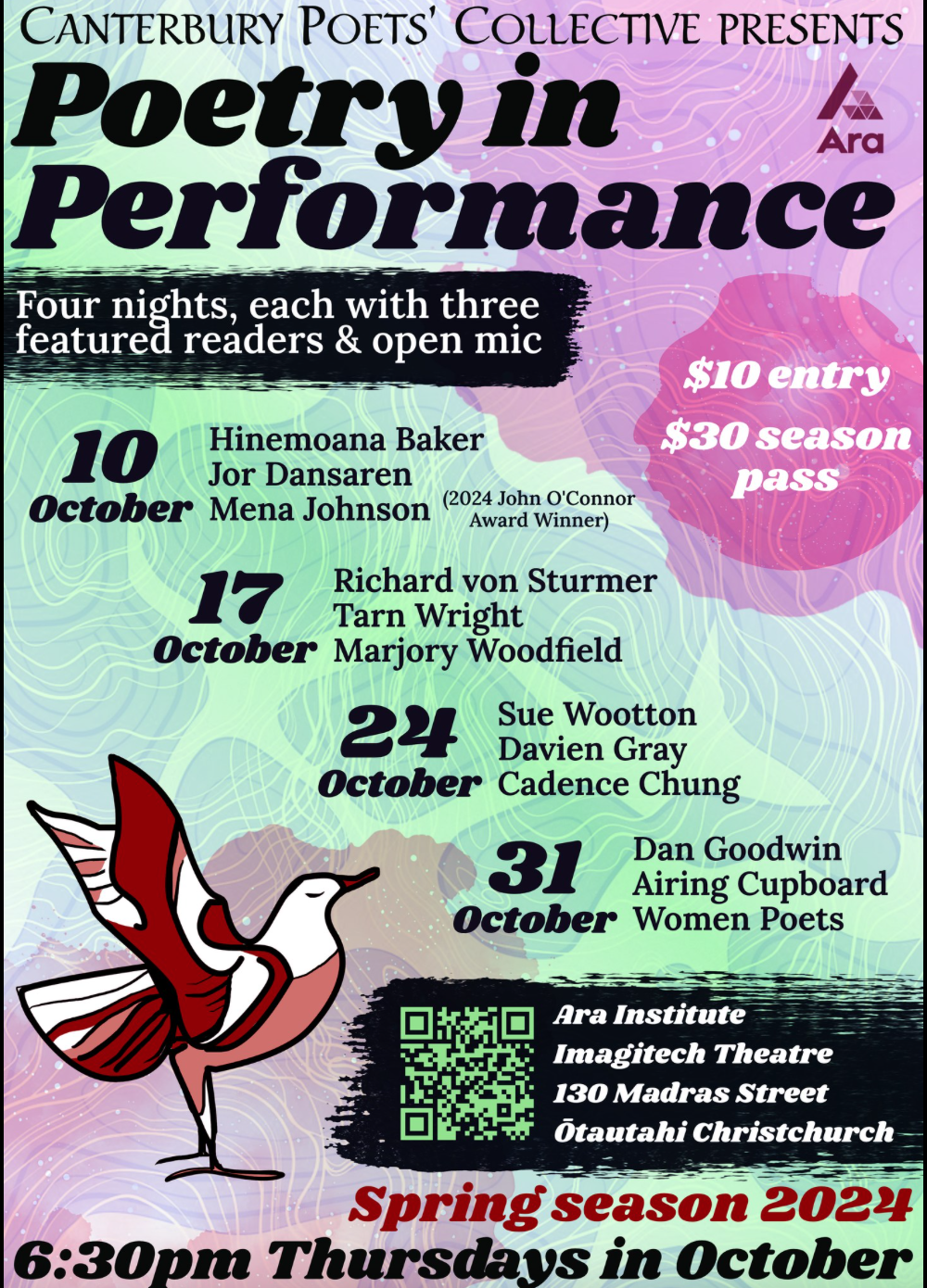
Poetry Shelf noticeboard: the 2024 Poetry in Performance spring season

The spring season of the 2024 Poetry in Performance season starts this Thursday 10 October with guest poets HINEMOANA BAKER, JOR DANSAREN, and PHILOMENA JOHNSON. 

Poet and performer HINEMOANA BAKER (Ngāti Raukawa, Ngāti Toa Rangatira, Te Āti Awa, Ngāi Tahu, Ngāi Kiritea) is the author of four collections of poetry. Her latest, Funkhaus (THWP 2020), was a finalist for the 2021 Ockham Book Awards. Funkhaus has also just been released as a bilingual edition (German and English, tr. Ulrike Almut Sandig) by Voland & Quist AZUR Edition in Berlin (2023). Hinemoana is spending the coming months in Wellington as the 2024 Randell Cottage Writer in Residence. (Photo credit: Ashley Clarke, 2019) [top left in photo]

JOR DANSAREN is a pagan, pansexual, powerlifting, poetry powerhouse. She is a multiple regional poetry slam finalist and host of the popular 6pm Speakeasy series in Ōtautahi/Christchurch. Her work is themed largely around nature, Nordic deities, neurodivergent experience, and the inevitable chaos of life. [too right in photo]

PHILOMENA JOHNSON graduated from The Hagley Writers’ Institute in 2017 where her portfolio was short-listed for the Margaret Mahy Award. Her poetry has appeared in The Quick Brown Dog, The London Grip, takahē, Fuego, a fine line; in the anthologies broken lines / in charcoal and Voiceprints 4; and forthcoming in the New Zealand Poetry Society Anthology 2024. Mena is a tutor at WRITE ON: School for Young Writers and she won The John O’Connor First Book Award in 2024 for her manuscript not everything turns away which was launched on August 23rd, National Poetry Day. [bottom left in photo]

Tickets are $10 for the night or $30 for a season/supporter ticket which gives you all 4 nights for the price of 3 plus the option to join via Zoom (perfect if you suddenly can’t make it in person one night but you don’t want to miss out!).  Two hours of poetry including our warm and friendly open mic! Arrive early to add your name to the open mic list, mix and mingle, and grab a good seat before we get started at 6.30 pm sharp.

All funds raised go to support future CPC events and poetry in Canterbury. Door sales with eftpos available or buy online: https://canterburypoets.org.nz/tickets/

Big thanks to our venue sponsor Ara Institute of Canterbury for use of their Imagitech Theatre.

Coming up next…
17 October: Richard von Sturmer, Marjory Woodfield, and Tarn Wright
24 October: Sue Wootton, Cadence Chung, and Davien Gray
31 October: Dan Goodwin and the Airing Cupboard Women Poets

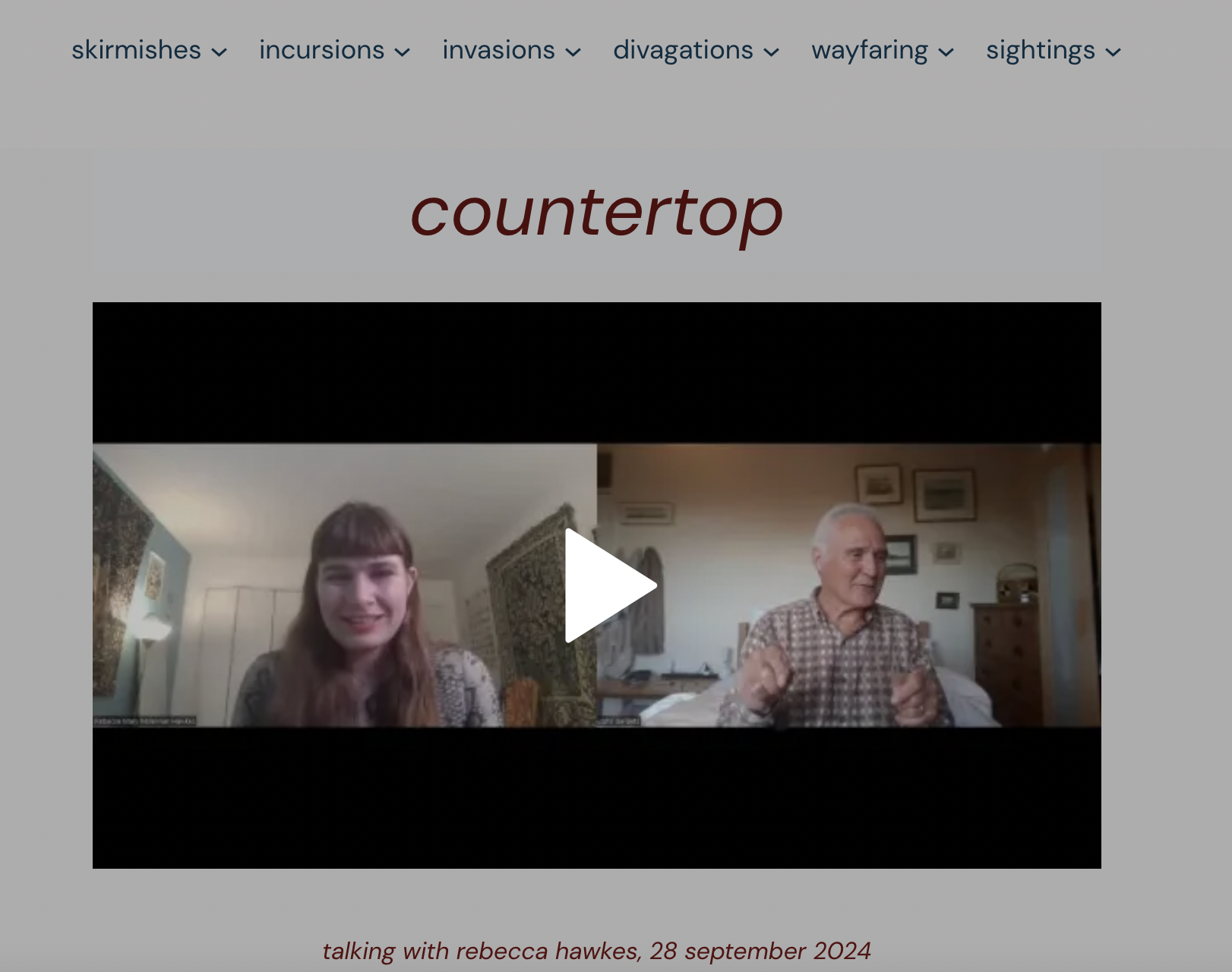
Poetry Shelf noticeboard: Poetry conversations on Countertop – Rebecca Hawkes

John Geraets has been running Countertop for awhile now, nurturing a terrific celebration of poetry. The site includes book reviews, recorded interviews with poets, his own poetry musings, poems. He includes essays that were published in ka mate ka ora: a new zealand journal of poetry and poetics. To date, the conversations are with Chris Tse, Stephen Bambury, Janet Charman, Richard von Sturmer, Lisa Samuels, Vaughan Rapatahana, Orchid Tierney, Kim Pieters, Bob Orr, Mark Young, Ian Wedde, Emma Neale, Michael Harlow.

The latest conversation is with Rebecca Hawkes and it’s a treat getting to hear a poet whose work I love, muse on writing, her origins, predilections, the questions that surface, the impulse to move to USA. She reads an extract from, as she says, “a poem in sentences or a very brisk lyric essay” that she is currently working on.

You can listen here.

Counterpoint is a treasure trove to explore indeed.

John Geraets lives in Whangārei, Aotearoa-New Zealand. His Everything’s Something in Place appeared from Titus Books in 2019. He has published a number of poetry collections and edited A Brief Description of the Whole World (1999 -2002). He curates the online magazine remake, the latest issue of which is available here.

Rebecca Hawkes, poet and painter, debuted in AUP New Poets 5. Her collection Meat Lovers won Best First International Collection in the Laurel Prize and was a finalist in the Lambda Literary Awards. She edits the journal Sweet Mammalian and co-curated the Antipodean climate poetry anthology No Other Place to Stand. She is a founding member of popstar poets’ performance posse Show Ponies. She is currently doing an MFA in poetry at the University of Michigan as a Fulbright grantee.

Poetry Shelf Monday Poem: How to Live by Helen Rickerby

How to live through this

We will make sure we get a good night’s sleep. We will eat a
decent breakfast, probably involving eggs and bacon. We will
make sure we drink enough water. We will go for a walk,
preferably in the sunshine. We will gently inhale lungsful of
air. We will try not to gulp in the lungsful of air. We will go to
the sea. We will watch the waves. We will phone our mothers.
We will phone our fathers. We will phone our friends. We will
sit on the couch with our friends. We will hold hands with our
friends while sitting on the couch. We will cry on the couch
with our friends. We will watch movies without tension –
comedies or concert movies – on the couch with our friends
while holding hands and crying. We will think about running
away and hiding. We will think about fighting, both
metaphorically and actually. We will consider bricks. We will
buy a sturdy padlock. We will lock the gate with the sturdy
padlock, even though the gate isn’t really high enough. We
will lock our doors. We will screen our calls. We will unlist our
phone numbers. We will wait. We will make appointments
with our doctors. We will make sure to eat our vegetables.
We will read comforting books before bedtime. We will make
sure our sheets are clean. We will make sure our room is aired.
We will make plans. We will talk around it and talk through it
and talk it out. We will try to be grateful. We will be grateful.
We will make sure we get a good night’s sleep.

Helen Rickerby
from How to Live, Auckland University Press, 2019

Over the coming months, Poetry Shelf Monday Poem spot will include poems that have stuck to me over time, poems that I’ve loved for all kinds of reasons. Poems that comfort or delight or challenge. Poems that strike the eye, ear or heart. This poem by Helen Rickerby resonates on so many levels, so perfect to read in these turbulent times, when a good night’s sleep can be elusive, when friendship is so important, when finding something precious is important. Something precious like this poem.

Helen Rickerby lives in a cliff-top tower in Aro Valley, Wellington. She’s the author of four collections, most recently How to Live (AUP 2019), which won the Mary and Peter Biggs Award for Poetry at the 2020 Ockham Book Awards. In 2004 she started boutique publishing company Seraph Press, which mainly published poetry. She’s having a break from that for the foreseeable future, and is focusing on her themes of the year: play and journal – which is resulting in a new poetry project. She works as a freelance editor and writer.

Poetry Shelf noticeboard: Jeffrey Paparoa Holman launch

Scorpio Books and Canterbury University Press warmly welcome you to the launch of Lily, Oh Lily: Searching for a Nazi ghost by Jeffrey Paparoa Holman. All welcome, refreshments provided. Please send in your RSVP and pre-order your book today.

Lily Hasenburg was just such a figure in Holman’s growing years. She was whispered into his ear by grandmother Eunice – in memorable stories of her older sister, who married and moved to Germany at the turn of the 20th century, and was later caught up in the Nazi web spun by Adolf Hitler. Unable to shake loose this story, Holman pursued her to Berlin, Hamburg and Dresden. Here, we have an account of his pilgrimage; the kind of family history we might bury, and forget – to our loss.


ABOUT THE AUTHOR

Jeffrey Paparoa Holman is an acclaimed poet, historian and memoirist. His poetry has been shortlisted for the New Zealand Book Awards; his family memoir The Lost Pilot (Penguin, 2013) was warmly received in Aotearoa and overseas. Best of Both Worlds: The story of Elsdon Best and Tutakangahau (Penguin, 2010) was short-listed for the Ernest Scott Prize (History) in Australia. Since retirement from his role as senior adjunct fellow at the University of Canterbury, he has taught creative writing in both primary and high school programmes.

Poetry Shelf noticeboard: Damien Wilkins launch

Kia ora e te whānau,

Please join us for the launch of Delirious, the new novel by Damien Wilkins. Novelist Elizabeth Knox will be launching the book for us.

Thursday 17 October
6pm
Unity Books Wellington
View more info on our Facebook page.

Te Herenga Waka University Press

‘A New Zealand novel of grace and humanity. How does Wilkins do it? These are flawed and immensely satisfying characters – you close your eyes at the faulty, circuitous routes they take. Delirious is a marvel of a book.’ —Witi Ihimaera

‘This is just a beautifully powerful, wonderful book.’ —Pip Adam, RNZ

‘Funny, sharp, sad and profound, Delirious made me laugh, think, weep and actually beat my breast. A masterpiece.’ —Elizabeth Knox, The Conversation

It’s time. Mary, an ex cop, and her husband, retired librarian Pete, have decided to move into a retirement village. They aren’t falling apart, but they’re watching each other – Pete with his tachcychardia and bad hip, Mary with her ankle and knee.

Selling their beloved house should be a clean break, but it’s as if the people they have lost keep returning to ask new things of them. A local detective calls with new information about the case of their son, Will, who was killed in an accident forty years before. Mary finds herself drawn to consider her older sister’s shortened life. Pete is increasingly haunted by memories of his late mother, who developed delirium and never recovered.

An emotionally powerful novel about families and ageing, Delirious dramatises the questions we will all face, if we’re lucky, or unlucky, enough. How to care for others? How to meet the new versions of ourselves who might arrive? How to cope? Delirious is also about the surprising ways second chances come around.