
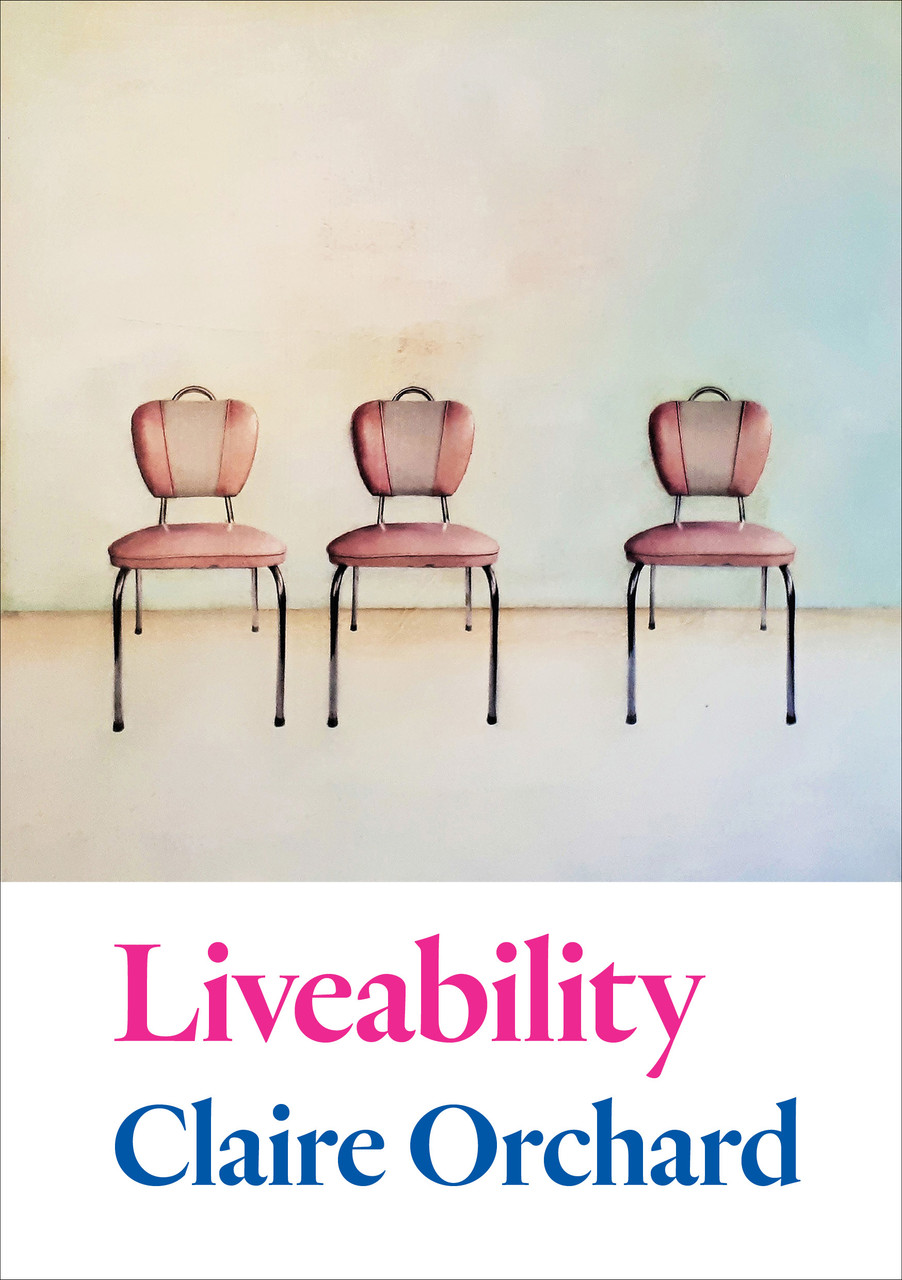
Liveability, Claire Orchard
Te Herenga Waka University Press, 2023
Liveability came out in 2023, and joined a wee pile of poetry collections I read and loved last year, but ran out of energy to review. Claire Orchard’s collection stuck with me, certain poems in particular, and I am posting one of them in my Monday Poem spot on November 4th. I am currently selecting poems that I have especially loved over a period of time, along with occasional new ones.
You can hear Claire read here.
Today, the sun is shining, the wind is on leave, the power is on, and in this rare miracle moment, I am sitting on the side of my recovery mountain at an intersection of equilibrium, beauty and peace. The perfect time to return to a book that resembles an ode to life, to the intricate lacework of being.
Claire writes with sublime fluency: the sweet aural currents carry physical detail, multiple voices, epiphanies, observations, declarations, tenderness and edge. Think of a collection with multiple notes, myriad bridges to the world outside, whether a world experienced or a world imagined, a world read or a world remembered. I find myself crossing footbridges into my own memory, my own ambulations, liveability.
Ah, the cover. I love the marriage between the title of the book and the cover image, a painting by Deb Fuller of three empty chairs, so carefully positioned, so haunting ot the degree of the uncanny. It struck a chord, not just as an entry point into the collection, but in terms of my own writing and what I have been thinking about poetry. Let’s say the making of a poem. Let’s say the poem as empty chair. Let’s say the poem with its physical detail and careful placements, wear and tear, relationships with other chairs, attached and detached memories. This week I was writing poems as empty chairs for the reader to sit in and make their own. An oxymoron because, of course a poem, is never empty.
And yes, Claire’s poetry achieves a satisfying fullness of effect. She might begin with a winged chair or Main Street, an aging mother, a family choosing pizza, feeding the pigeons, entries in a dictionary, the window display in a china shop. It is writing slowing down, a heavenly slowing down to retrieve memory, absorb what is seen through the window, in the street, what is read. Detail and mood are carefully gathered and assembled to the point they become pulse on the page. Throb. Vibration. Movement. That empty chair is rich in layers. In ‘Charms’, I get to drive Main Street in the car of the poet, a nostalgic trigger of past and present. The childhood bedroom in the family flat, in ‘Furnace’, is an equally nostalgic tripwire to a chipped tooth and chipped memories, imbued with the undulations and slippage of recall. Then there is swivel memory in “Xanadu summer album’:
Remember the derelict, one-room schoolhouse,
its empty playground cracking with weeds,
its small playing field unmown. We peered
through the windows at dark-stained wooden chairs
and desks in disarray, textbooks scattered across the floor,
the last lesson still chalked up on the blackboard.
Hmmm, you say. What about the way
the last of the daylight would turn
the iron roof of the long drop into silver?
And I wonder how you even remember things like that.
Ah, perhaps we can might of this as a season album, with its exquisite array of moods, framings, point of views. I am never sure what will be on the next page and I love this. The T-shirt in the poem, ‘If you take one piece of advice this year let it be’, declares ‘Impossible is nothing’, as the grandmother swears by ocean dips, spitting on insect bites and one stair at a time, and the children dash and scratch and tumble. In ‘Shooting rats’, we’re in Uncle Jim’s ute flying through the paddock with sheep scattering, the poem moving to an ending that sticks:
reaching the top felt like flying
and when we looked we saw
through limbs of thinned macrocarpa
the sky, too, was planning something big.
In ‘Herd’, poet becomes reader, and the idea that zebras don’t feel stress arrests us both, reader and writer. Again, Claire delivers a poem ending that prompts pins and needles:
If only the survivors could tell us
how they’re feeling. Recently captured footage
shows them glancing obliquely at one another
before hurriedly looking away again.
Ah, so many poems to share and highlight, from the everyday to the awe-some, from Wilson Alwyn Bentley, a cloud physicist, to family settings, from Ernest Rutherford to a rain precipitation room experience. Perhaps I will leave you with another skin-prickling ending. In ‘Thursday night’, everyone is in the family sitting room (those were the days!) watching Star Trek at 7.30 pm (appointment viewing!). At one point, it feels like Leonard Nimoy is speaking through the screen to the avid viewers. So many bridges and layers and possibilities:
it’s as if he’s speaking directly to us,
as if when he turns his attention to the way
these same features confine and confound us,
he’s seeing through the glass screen into
our sitting room as he laments the bleakness
of such an existence. As if he observes
the widening of our eyes, poor lonely creatures,
perpetually at opposite ends of the couch,
and our mother, in her chair next to the couch.
Pull up a chair, regardless of what the weather is doing, and nestle into the glorious, life-rich experience of reading Liveability. I have barely scratched the surface of what these poems do, with their weave of lightness, fascination, craft, vitality and wonder.
Claire Orchard (she/her) studied English and history at Massey University and completed an MA in Creative Writing at the International Institute of Modern Letters. She lives in Te Whanganui-a-Tara and is the author of two poetry collections: Cold Water Cure (VUP, 2016) and Liveability (THWUP, 2023).
Te Herenga Waka University Press page
 NZ Poetry Shelf
I love Claire’s startling vivid, humorous and, at times, slightly unsettling snapshots in time that are her poems. More, please!
LikeLike