
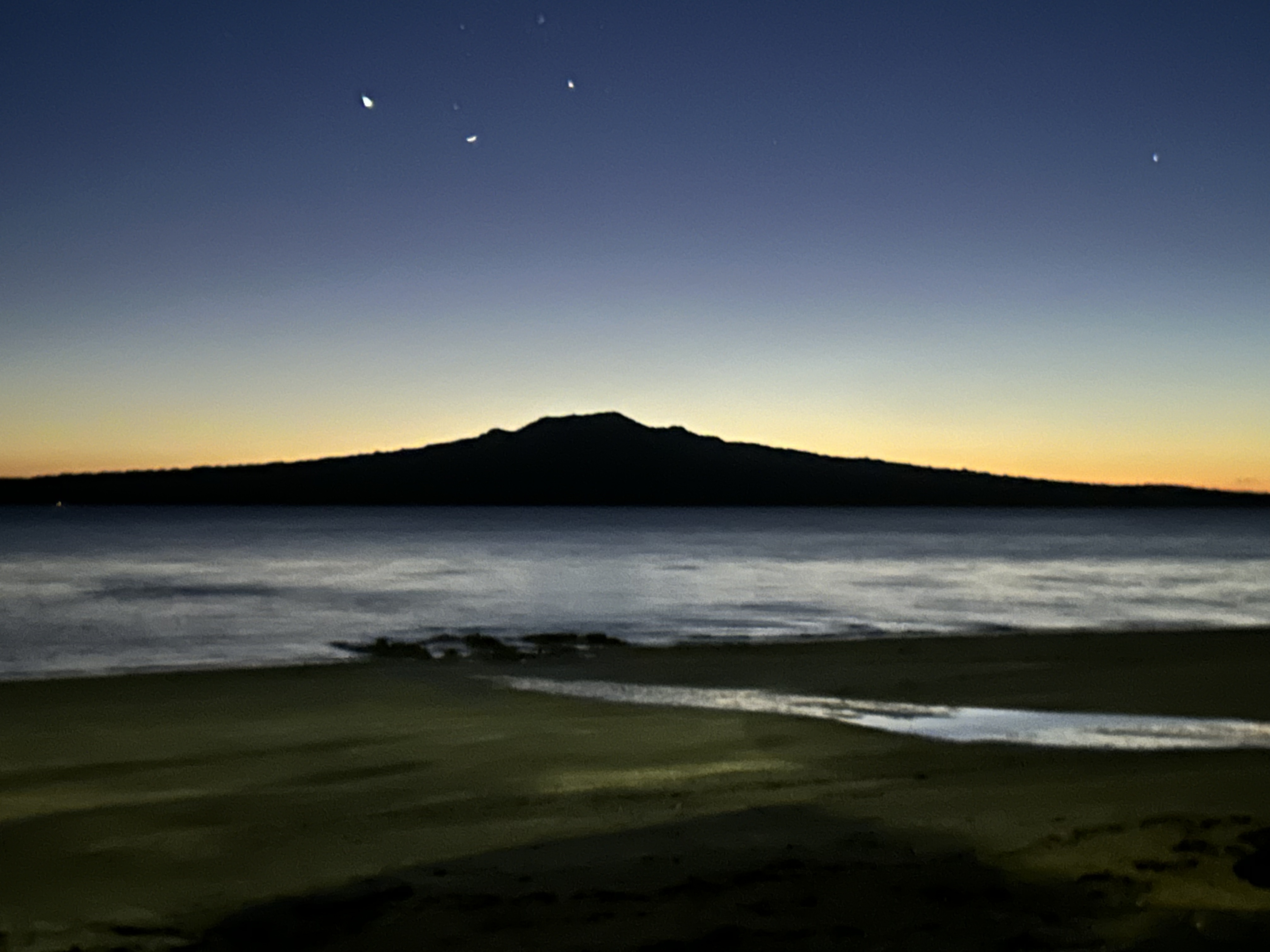
Living in a clearing in the bush out west, with expanse views of sky and the Waitākere Ranges, we get to appreciate the night sky, the glow of planets and salt and pepper stars. It’s beauty, it’s balm, it’s that sweet moment of contemplation. I often travel to city appointments before the sun comes up, and again the sky is a source of wonder.
I loved looking through my poetry shelves for poems with star glints – yes I fell upon beauty, a gleam here, a night glimmer there, but I was surprised how many of the poems I picked made me feel something. That moved me. Deeply.
Two more themes left in this series, but looks like I am creating a second group, it is such a satisfying thing to do and share. Thanks to all the poets who have contributed.
The poems
Dyslexic Child Makes Errors in the Night Sky
He’s leaning from the moon’s chin
and draws new stars
with a glow-in-the-dark
pastel. The colouring in
is messy sometimes.
He goes over the edges
but the moon doesn’t mind.
It lets him
scribble on the night
so he can try making new colours.
Higher in the dark
he uses glitter pen
and draws a brid a bored
a birrd by mistake.
He hugs the moon
and cries down its skinny
cheeks. ‘It’s all right,’
the moon tells him. ‘Everything
is written in the stars.
Jenny Powell
from Hats, HeadworX, 2000
What the stars say
I hear bird bones crack, splinter. I hear offal slosh in a bucket.
Matariki have seen it all before — my star companions remain silent. Have they gone mad?
Yes, mad as a meat axe.
I hear gunshots at the growing wall,
I hear laughter at cocktail hour
out of mouths as wide as mako shark.
The bleached face of Sirius gives no clue, all are catching a ferry to the Isle of the Blessed.
My ageless self trapped in a maimai — who knows how temporary?
It seems I am lasting forever, as long as stories repeat.
I blush and quiver to see myself
related to this pale imitation of the gods.
Reihana Robinson
from Aue Rona (Steele Roberts, 2012)
My Sister‘s Dead Perfection
You were up in the sky,
an absolute star.
You had the ear of God
they said — my God
nothing matched their love
for you dead
nothing on earth
was as pure;
you were the prototype
of girl making good
so I practised reaching
your infinite tall,
jumped from the roof
and the walnut tree
to be perfect too
I thought, I can
be as dead as you.
Rhian Gallagher
from Shift, Auckland University Press, 2011
Virgil at Bedtime
There are glow-in-the-dark stars
on the ceiling which probably
won’t peel off. And yes, there are
two gates of sleep, sweet heart,
it is not just in the morning
you have to be careful what side
of the bed you choose,
there are choices to make
day and night,
and for the rest of your life.
And the ivory gate is glittering
but not smiling at you,
it is just the way it is shaped
like the mouth of a crocodile
opening wide,
offering futures like vistas,
dream that will
eat you up.
No, the other gate is the gate
to choose, sweet heart,
and your dreams, if you dream,
will be safe as houses
and won’t bankrupt you at all –
you just have to be dead
to go through.
Anna Jackson
from Thicket, Auckland University Press, 2011
The Desert Road
Mount Ruapehu breaches clouds —
a whale arrested in a dive
fluke still planted in the earth.
Driving back through tussock
barnacles of shining white
and the high ice-creaking calls locate us.
Wet banks move, agitated, through slow day-lights
shunt time, whole eras, ahead and behind
carry small architecture on great backs.
We cut across this old wake, our father,
the suspension shakes and shakes
we can’t make the corners fast.
It gets dark and the languages come out
in constellations and even though we don’t know how
we follow them to familiar places.
Lynn Davidson
from Islander, Te Herenga Waka University Press, 2019
Old-fashioned Love
Nights are cold, hard as the stars.
I wonder whom you dazzle now.
Harry Ricketts
from Your Secret Life, HeadworX, 2005
Taking heart
for Ian Wedde at Gladstone Vineyard
A big one, by the sound of it
the sure beat of an old engine
reliable after all
the flash new models
have given up the ghost
lacking the guts to make it
over the big hill from Wellington
to where you now stand
and deliver, bare feet
on a Persian rug in fierce
sun, and somewhere
out of sight, the sly
asthmatic commentary
of magpies. True, it’s run down
round here, but the grapes
are driving a comeback.
You had a head start — hearing,
art, an elliptical star —
until, like the Georgians,
you ran out of steam.
The prescription? Well,
a glass of red a day
stops the arteries
hardening
they say, and in the end
old forms refuse corrosion.
Out here things are
as they seem — and so
it’s good to see you
taking heart, that glad
stone, something unfashionable
that suddenly we all
can’t get enough of.
Chris Price
from Husk, Auckland University Press, 2002
A star like no other
If a star—like a bare bone cleaned of everything pink—took his place,
then perhaps that would swing me. I would fail, once again, to be metal.
˜
‘That is sunlight peeking through your seams’, said the moon.
‘That is too much muscle for such a simple act of raising lanterns
and holding him close’.
So I dropped
my arms, resumed stasis. As it turns out, that
is too much sky for a single star to bear.
˜
Stars with sparrow tattoos. Stars with Russian memoirs.
The headlines fall off the pages, go swimming
in my morning coffee.
Stars in the arch of an eyebrow. Stars twitching under blankets.
˜
I see stars, and I have written him into mine.
I am still brushing his ashes from my sheets.
Chris Tse
from He’s So MASC, Auckland University Press, 2018
Twinkled to Sleep
Cerulean night-sky
Star-set;
Stygian-dark river-plain
East, north, west,
Dance-set;
Myriad amber-flashing
Lights dancing, rays flashing, all night.
Delight! delight! Inexpressible heart-dance
With these.
Strange heart-peace, in sparkling lights!
Blithe heart-ease, starry peace, dancing repose!
Star-charmed, dance-enchanted eyes close,
Appeased.
Dance in jet-dark depth, in star-set height,
Lights dancing, west, east,
Star-high, heart-deep,
All night.
Ursula Bethell
from Day and Night, Poems 1924 – 1935, Caxton Press, 1939
we see the stars
walk outside and look up
those pearls are a million miles away
you can touch them here
you can see them here
there’s nothing between you
and nothing
stand on the beach
the sea is chanting riddles
in the long night winds
a fishing boat way out there trawling
floats by the light
of stars like pearls
camp in the bush
by a bank of glow worms
kiwi fossick and slice the night
lie on your back and open the flap
in the tent of the sky
with its eyes wide open
your broken heart
a deserted city
your whitened bones
an empty street
your poor blind eyes
no stars to see
Jeffrey Paparoa Holman
from After Hours Trading & The Flying Squad, Carride Press, 2021
Matariki
June 2002
watching the flight
of a space shuttle
on a cold winter night
& marvelling again
that there are people
inside
this bright light
that comes silently
out of the southwest
& behind
in the northern sky,
the seven stars of Matariki,
who guided the canoes
of hope
across the Pacific
to celebrate endeavour
& the spirit of discovery
this celestial bridge
between rocketry
& the ancient belief
of stars.
Rangi Faith
from Conversation with a Moahunter, Steele Roberts, 2005
The poets
Anna Jackson, poet, anthologist, essayist, critic, fiction writer, grew up in Auckland and now lives in Island Bay, Wellington. She has a DPhil from Oxford and is an associate professor in English literature at Victoria University of Wellington. Anna made her poetry debut in AUP New Poets 1 before publishing six collections with Auckland University Press. Her most recent book, Pasture and Flock: New and Selected Poems, gathers work from her previous collections as well as twenty-five new poems. As a scholar, Anna Jackson is the author of Diary Poetics: Form and Style in Writers’ Diaries 1915–1962 (Routledge, 2010) and, with Charles Ferrall, Juvenile Literature and British Society, 1850–1950: The Age of Adolescence (Routledge, 2009). Her volume Actions & Travels: How Poetry Works (AUP, 2022) considers poetry through 100 poems.
Chris Price is based in Wellington, where she teaches the poetry MA at the International Institute of Modern Letters at Victoria University. Her first collection of poems, Husk (Auckland University Press, 2002), won the 2002 NZSA Jessie Mackay Award for Best First Book of Poetry and her next book, the genre-busting Brief Lives (Auckland University Press, 2006), was shortlisted in the biography category in the 2007 Montana New Zealand Book Awards. Her subsequent collections are: The Blind Singer (AUP, 2009) and Beside Herself (AUP, 2016).
Chris Tse is New Zealand’s Poet Laureate for 2022-25. He is the author of three poetry collections published by Auckland University Press: How to be Dead in a Year of Snakes, HE’S SO MASC, and Super Model Minority (the latter of which was a finalist for the 2023 Lambda Literary Award for Gay Poetry). He and Emma Barnes edited Out Here: An Anthology of Takatāpui and LGBTQIA+ Writers from Aotearoa. His poetry, short fiction, and non-fiction have been recorded for radio and widely published in numerous journals, magazines and anthologies, both in Aotearoa and overseas. He was the editor of The Spinoff’s Friday Poem and Ōrongohau | Best New Zealand Poems 2023. He is currently 2024 resident at the Iowa International Writing Programme.
Harry Ricketts is a poet and literary scholar and has
published around 30 books. He has lived in Wellington, Aotearoa New
Zealand, since 1981. Until his retirement in 2022, he was a professor in
the English Programme at Te Herenga Waka—Victoria University of
Wellington. His books include the internationally acclaimed The Unforgiving Minute: A Life of Rudyard Kipling (1999) and Strange Meetings: The Lives of the Poets of the Great War (2010). His recent poetry collections include Winter Eyes (2018) and Selected Poems (2021). With historian David Kynaston, he is the co-author of Richie Benaud’s Blue Suede Shoes: The Story of an Ashes Classic (Bloomsbury, 2024). His most recent book with Te Herenga Waka University Press is First Things, a memoir.
Jeffrey Paparoa Holman writes poetry, short fiction, history and memoir. He has published seven volumes of poetry; Best of Both Worlds (history, 2010); The Lost Pilot (memoir, 2013); Now When it Rains (memoir, 2017). As Big As A Father (Steele Roberts, 2002) was shortlisted in the Montana Book Awards, Poetry, 2003. Best of Both Worlds: the story of Elsdon Best and Tutakangahau (2010) was shortlisted in the Ernest Scott Prize, History (2011, Australia). His most recent work, an upcoming family history, Lily, Oh Lily – Searching for a Nazi ghost, is due in late September 2024, from Canterbury University Press. He journeys in time on the trail of of his grandmother’s sister, Lily Hasenburg, married into German society at the turn of the twentieth century; and space, where he travels to Germany in 2014 to research her fate, an Englishwoman living through two world wars, citizen now of an enemy country.
Jenny Powell has published six poetry collections, two chap books collections and two collaborative collections. She has been a finalist in the UK Plough Poetry Prize, two times finalist in the Aesthetica Creative Arts Award, finalist in the Lancaster one minute monologue competition, runner-up in the Plough Poetry Prize, runner-up in the Mslexia Poetry Competition, short listed in the Welsh Poetry Competition, shortlisted in the New Zealand Society of Authors Janet Frame Memorial Award and in the inaugural NZ Book Month ‘Six Pack’ Competition. In 2020 Powell was the RAK Mason Writing Fellow.
Lynn Jenner, a writer, teacher, and researcher, received the Adam Prize in Creative Writing for the manuscript of Dear Sweet Harry, which was then published by Auckland University Press and won the NZSA Jessie Mackay Award for Best First Book of Poetry. She has been widely published in the literary journals, here and overseas, including Carcanet’s Oxford Poets: An Anthology, 2013. A hybrid collection of writing, Lost & Gone Away (AUP, 2015), traverses the aftermath of the Christchurch earthquake. She writes poetry, memoir, essays and creative nonfiction.
Rangi Faith (Kai Tahu , Ngati Kahungunu, English, Scottish) was born in Timaru and brought up in South Canterbury. He is retired from teaching and is currently living in Rangiora. His work explores both European and Maori history and welcomes the resurgence of te reo and kotahitanga in Aotearoa. Published books include Spoonbill 101 (Puriri Press, 2014), Conversation with a Moahunter (Steele Roberts, 2005) and Rivers Without Eels (Huia Publishers, 2001). His poetry is included in ‘koe’ An Aotearoa ecopoetry anthology (Otago University Press, 2024), Te Awa O Kupu (Penguin, 2023), No Other Place to Stand (Auckland University Press, 2022), The Penguin Book of New Zealand War Writing (Penguin, 2015), When Anzac Day Comes Around (Forty South Publishing Pty Ltd, 2015), and other collections and anthologies.
Reihana Robinson is a writer, artist and organic farmer who lives on the Coromandel in Aotearoa/New Zealand, with part of the year in western Massachusetts. Her writing has appeared in various local and overseas journals. She debuted in AUP New Poets 3, Auckland University Press, 2008 and has two further collections: Aue Rona (Steele Roberts, 2012) and Her Limitless Her (Makaro Press, 2018). She has held artist residencies at the East West Center, Honolulu, Hawai’i and the Anderson Center, Red Wing, Minnesota, and was the inaugural recipient of the Te Atairangikaahu Award for Poetry.
Rhian Gallagher’s first poetry book, Salt Water Creek, was published in London (Enitharmon Press, 2003) and short-listed for the Forward Prize for First Collection. In 2007 Gallagher won a Canterbury History Foundation Award which led to the publication of her book, Feeling for Daylight: The Photographs of Jack Adamson. She also received the 2008 Janet Frame Literary Trust Award. Her second poetry collection Shift, (Auckland University Press 2011, Enitharmon Press, UK, 2012) won the 2012 New Zealand Post Book Award for Poetry. Freda: Freda Du Faur, Southern Alps, 1909-1913 was produced in collaboration with printer Sarah M. Smith and printmaker Lynn Taylor in 2016 (Otakou Press). Rhian was the Robert Burns Fellow in 2018. Her third poetry collection Far-Flung (AUP) appeared in 2020. Gallagher lives in Dunedin.
Ursula (Mary) Bethell (1874-1945) was born in England, raised in New Zealand, educated in England and moved back to Christchurch in the 1920s. Bethell published three poetry collections in her lifetime (From a Garden in the Antipodes, 1929; Time and Place, 1936; Day and Night, 1939). A Collected Poems appeared posthumously (Caxton Press, 1950). She did not begin writing until she was fifty, and was part of Christchurch’s active art and literary scene in the 1930s. Her productive decade of writing was at Rise Cottage in the Cashmere Hills, but after the death of her companion, Effie Pollen, she wrote very little. Vincent O’Sullivan edited a collection of her poetry in 1977 (Collected Poems, Oxford University Press,1985).
 NZ Poetry Shelf
What an inspiring set, like a christmas present on a rainy day.
LikeLike