
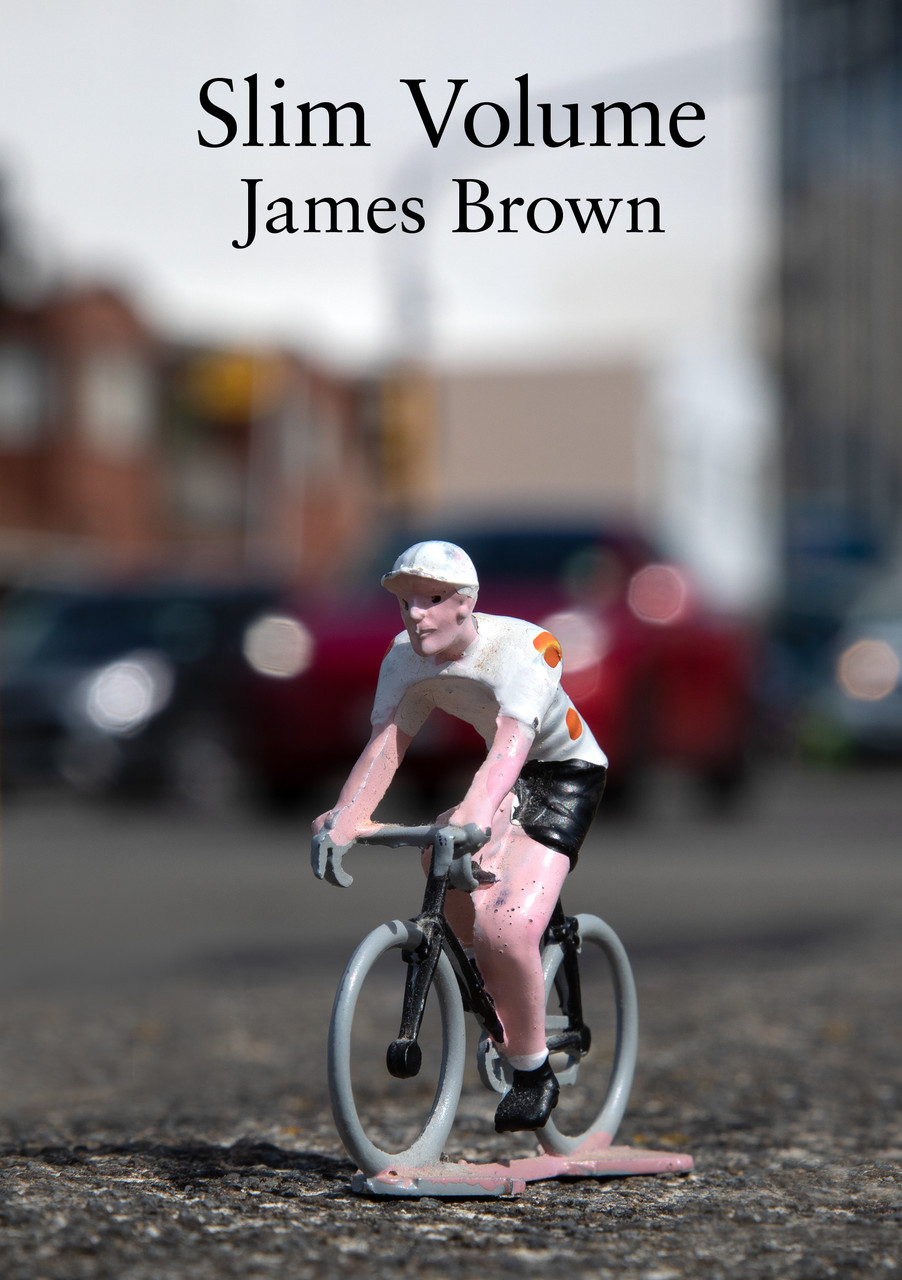
Slim Volume, James Brown, Te Herenga Waka University Press, 2024
A chair is a good place to sit.
You spend a week with a poem.
Then another week. Not your poem.
Somebody else’s.
from ‘Love Poem’
Ah. After a string of days watching the rain fall, Lake Fog slowly melt, the sour dough rise, what better delight than to open James Brown’s eighth poetry collection, Slim Volume. The blurb on the back provides a perfect invitation to enter the collection’s cycling trails, its widening itineraries: ‘A slim volume of verse, like a bicycle, offers us fresh and joyful and sometimes troubling ways of seeing the world.’ In a nutshell, it’s why I love turning to poetry in states of emergency or dillydally and seek the electric currents of words.
Begin with notions of travel, the ever-shifting multifaceted view from cycle saddle, train window or pedestrian stroll. Whether cycling or walking, things catch the eye and ear, thoughts compound and connect, disintegrate and startle, and you move with the hum and whizzing wheels of memory and anticipation. Similarly poetry, whether reading or writing, is an exhilarating form of travel. Especially reading James Brown, especially savouring the sweet whirr of the line, the turning back for a second look to see things afresh, the unmistakable accumulation of physical joy.
Slim Volume draws you into the intimacy of letting things slip, of layering and leavening a collection so that in one light it is a portrait of making poetry, in another light the paving stones of childhood. The presence of people that matter glint, and then again, in further arresting light, you spot traces of the physical world. Try reading this as a poetry handbook and the experience is gold. There is an invitation to see any subject matter as ‘worthy’ of poems (for example, cheese in pies), musing on who wants to read angry poetry or wayward words or making poems your own. And am I stretching the communal art of making sandcastles to consider poetry as a communal art (oodles of theory on this)? Perhaps the poem that stuck the firmest is ‘Love Poem’ (posted on Poetry Shelf, extract above). It’s the best ode to reading a poem I have read in ages.
And that is exactly why I love this book so much. I am sitting back in the chair of reading and taking things slow, and then whizzing in downhill glee, and then it’s back to travelling slow. Savouring the wit, the power of looking, listening. Take ‘Green and Orange’ for example, and track the loops and latches as a sideways glance becomes so much more. Sheez I love this poem. Just want you to read it for yourself. Here is the opening stanza:
The trees bend in the window frame.
Outside, I barely give them a glance,
but framed, each leaf has its own geometry,
anemone fingers in a green sea.
Or take a young lad on his milk run (‘it’s more of a milk walk’) in ‘One Thing Leads to Another or / My Part in the Dairy Industry’. And again I am sitting in the chair of poetry reading and it is description and it is wonder and it is different forms of loops and latches. Try these middle stanzas:
I get slower and slower
like the music box
in our kitchen.
People always startle.
A standing man
on the brink of his
water feature.
A hesitation in a
dressing gown.
The poem’s ending knocks me off my poetry chair and it is ‘Back home, a glass of cold milk / trickles into my account / from three or four hills / beyond my understanding.’
Like any satisfying form of travel, the collection offers diverse mood keys. There is a childhood anecdote of (slightly creepy) The Magic Show at a school fair, a defiant and much-missed Allegory hiding up a tree outside the classroom, and then ‘Bad Light’, an unsettling poem of uncertainty and impending disaster involving a boy on a red bicycle. Phew. Wow.
I keep coming back to two mother poems. ‘Evening’ frames a sharper-than-real scene at the kitchen table, mother with pen in hand, the son pulling the string of an odd musical instrument. The room fills: ‘The melancholy song / we think of as Russian // waltzes slower and slower / around the room.’ And then it fills and refills, these moments that have stuck and replayed. Yes, it’s the music box we meet in the milk-run poem.
The poet cyclist is mindful of pulling over on the edge of the road to absorb the view or take a break. To atone for seemingly no section breaks (think poem clusters), James inserts intermissions laced with witty invitations: ‘I like sections because they give you space to have a breather, to pause and think about things . . . like what brought you here and what you are doing with your life.‘ Don’t get me started James. But I will take this moment to make an espresso and heat a scone and ponder on potholes and war. The second-section break ‘marker’ invites me to take further time out:
So take some time out.
Look around the room.
Look out the window.
What do you focus on?
Is the view so familiar
you’ve stopped seeing it?
Again I am switching back to open-poem travel, to how we may become immune to the views and reading trails, as much as when we stroll down the road or gaze out the kitchen window. Ah, always the kitchen.
I thought I would try writing what I think of my latest poem travels on the back of a post card and sending it to a friend: Stunning scenery, sublime food, every mood under the sun, utterly refreshing, unforgettable.
I would like to gift this book to one reader. Let me know here or on my social media feed.
The first time I saw the sea,
I was completely enchanted.
I’d always known it existed, I’d just
never really noticed it before.
I hadn’t even gone to see it, I’d more
stumbled across it accidentally
between Foxton and Himatangi.
from ‘You Don’t Know What You’re Missing’
James Brown‘s previous poetry collections are The Tip Shop (2022), Selected Poems (2020), Floods Another Chamber (2017), Warm Auditorium (2012), The Year of the Bicycle (2006), which was a finalist in the Montana New Zealand Book Awards 2007, Favourite Monsters (2002), Lemon (1999), and Go Round Power Please (1996), which won the Best First Book Award for Poetry. James works as an editor and teaches the Poetry Workshop at the International Institute of Modern Letters at Te Herenga Waka—Victoria University of Wellington.
Te Herenga Waka University Press page
 NZ Poetry Shelf