Monthly Archives: June 2024

Poetry Shelf newsletter

Lost Summer

A late grasshopper
has strayed into another universe,
nothing he is programmed for
is here, the sun
is not where it should be,
the cooler air
is hard to breathe,
his flight is urgent but aimless,
he crash-lands everywhere.
He finally makes it to the open sky,
     a swarm of one
in search of the lost summer.

Leonard Lambert
from Slow Fires: New Poems, Cold Hub Press, 2024

“I’ve begun to think of short poems as being the literary equivalent of the small house movement. Small houses contain the same essential spaces as large houses do. Both have places in which to eat, sleep, bathe and sit; the difference being that small houses are, well, smaller. Like the question of bathrooms- does one need six stanzas or will one do? What short poems might lack in floor space they make up for in nifty storage. You might have to go outside to swing the cat, but you can still have the thought indoors.”

Jenny Bornholdt
from ‘Introduction’, Short Poems of New Zealand, Te Waka University Press, 2018

New books in my letterbox

Wild Wild Women, Janis Freegard, At the Bay, 2024
The End of the beginning, Jenna Heller, At the Bay, 2024
anthology (n.) a collection of flowers, Gail Ingram, Pūkeko Publications, 2024
The Mires, Tina Makereti, Ultimo Press, 2024

Weekly links

Monday Poem: ‘Disaster Escapism’ by Hebe Kearney

Tuesday: Fox Spirit on a Distant Cloud by Lee Murray feature

Wednesday: Ash by Louise Wallace review

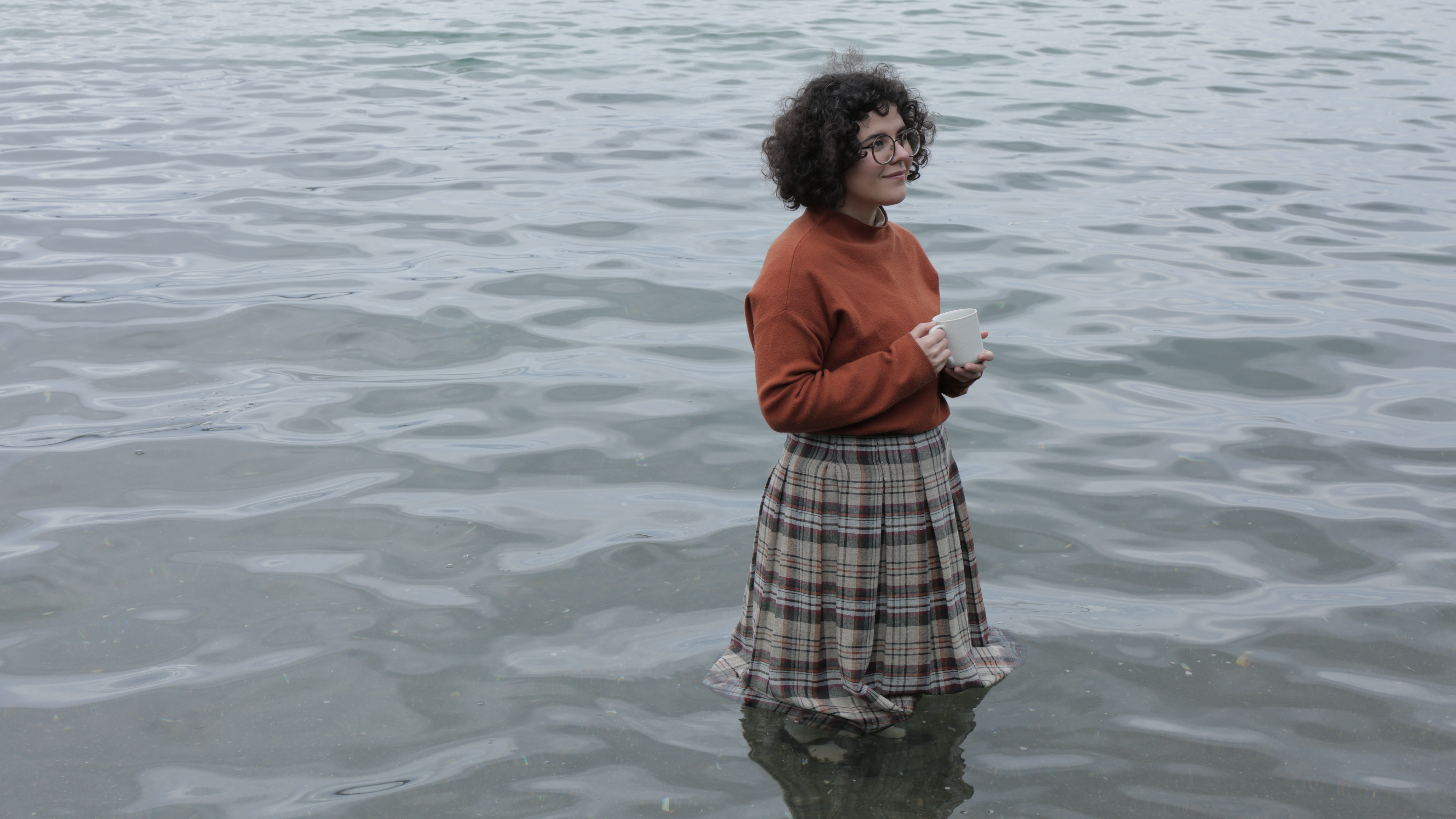
Friday: 5 Questions – Dani Yourukova

Poetry Box: Brown Bird by Jane Arthur feature

I am gifting a copy of Ash by Louise Wallace to Claire Louise

Poetry Shelf 5 Questions: Dani Yourukova

I have been thinking a lot about the place of poetry in global catastrophe and the incomprehensible leadership in Aotearoa. How do we write? Read? Do we need comfort or challenge or both? In an ongoing series, poets respond to five questions. Today Dani Yourukova.

Has the local and global situation affected what or how or when you write Poetry?

I’ve always thought that writing is as much about paying attention to the world as it is about stringing sense together. Like, sometimes you can write all day but then that work doesn’t matter at all if you haven’t walked to the shops, or reached the end of a thought, or had a biscuit.

So, as well as the regular at-the-desk writing practice, there’s a certain percentage of thought-space that needs to be dedicated to writing for it to work for me, and recently, I’ve found a lot of the thought-space normally labelled POEMS has been recategorised as WORRYING ABOUT EVERYTHING and RAGE. Which means protests instead of writing, and struggling to find employment instead of writing, and it means unspeakable grief, and shame, and petitions to ask our government to please refrain from whacking huge massive mining operations onto conservation land or supporting genocidal atrocities. 

Does place matter to you at the moment? An object, an attachment, a loss, an experience? A sense of home?

Oh I’m terrible at locating myself! I’ve always felt more like a brain sloshing around in a jar than a person, which I assume is because my personality is mildly defective. In practice, I think it just means that I have to work a little harder to understand what it means to be in a place, or to be “home”.

I think home is something I experience from being in community. I think it’s both brilliant and bewildering that we can move into and through each other’s lives, and fall into conversation, and take action together and piss each other off. It’s all very moving when you think about it. So I try to make sure I observe people and places sympathetically and honestly, and give parts of myself away sometimes. I listen, and work, and do my best to show up when someone needs me. I am not always good at it, but I do think it might be the most important thing I can do with my time.

Are there books or poems that have struck a chord in the past year? That you turn to for comfort or uplift, challenge or distraction.

I’ve been reading poems by Kapka Kassabova recently and finding a lot of uncertain comfort in them. I have quite an uneasy relationship with my heritage, but I couldn’t really resist reading a New Zealand Bulgarian immigrant poet once I realised we had one of those. Kassabova is about the same age as my mum, from the same end of the country, and they both went to language schools. I think I was curious if there was something, somehow, I’d recognise in her work. And I’m not sure if that happened, but I did find some of her work enormously resonant.

Preparation for the big emptiness


Smudges of moon in the morning —
fingerprints of the moon-eaters

A new core gathers for the evening
to be plucked and crumbled by other hands

Sometimes, there is blue in between
Sometimes, there is no one

You must prepare for the big 
emptiness to come

It has come

When it comes
you must spread yourself thinly,
transparently,
to fill what can’t be filled

It has come

Unlike the moon you must do it
without breaking


Kapka Kassabova
in Someone else’s life, Auckland University Press, 2003


Also, I found it sweet that we have the same publisher.
(Thanks AUP, you have this very specific niche totally covered)

What particularly matters to you in your poetry and in the poetry of others, whether using ear, eye, heart, mind – and/or anything ranging from the abstract and the absent to the physical and the present?

There’s that Audre Lord essay about poetry not being a luxury, and I’m sure everyone already knows the gist and follows the instagram account etc etc. But when I’m feeling a bit hopeless about writing, I come back to the metaphor that opens the essay:

The quality of light by which we scrutinize our lives has direct bearing upon the product which we live, and upon the changes which we hope to bring about through those lives. It is within this light that we form those ideas by which we pursue our magic and make it realized. This is poetry as illumination.

I sometimes think that, if I must write a poem instead of throwing bricks at politicians, well then that poem had better be beautiful and glorious and profound and timely and serious, and I’m not convinced I’m up to that almost-impossible task. But the other thought, and the thought which is more true I think, is that maybe it’s less about any individual thing we produce, and more about slowly changing the quality of the light. 

I wrote a very silly little poem for an exhibit a few months ago, and it’s really just a love poem to poetry and frivolity and shared jokes:

For Anaktoria
After Sappho, fragment 16


I am ordering bread for the table at a mid range chain restaurant
winking over broccoli soup

my heart a pepper grinder
my tongue a mistake

I want to take you to the waterfront market 
and purchase seasonal produce

string bags bursting with blackpurple eggplant
silverbeet spinach
fat sheaves of kale
bruise-coloured beetroots

tomato skins splitting with sweetness

and next thing you know we will be dressed as fatted calves
burning ourselves alive at the registry office

oh Anaktoria 

have you never lied
with violets in your lap?

the fiction too sweet to 
surrender easily


Dani Yourukova

Is there a word or idea, like a talisman, that you hold close at the moment. For me, it is the word connection.

“community”

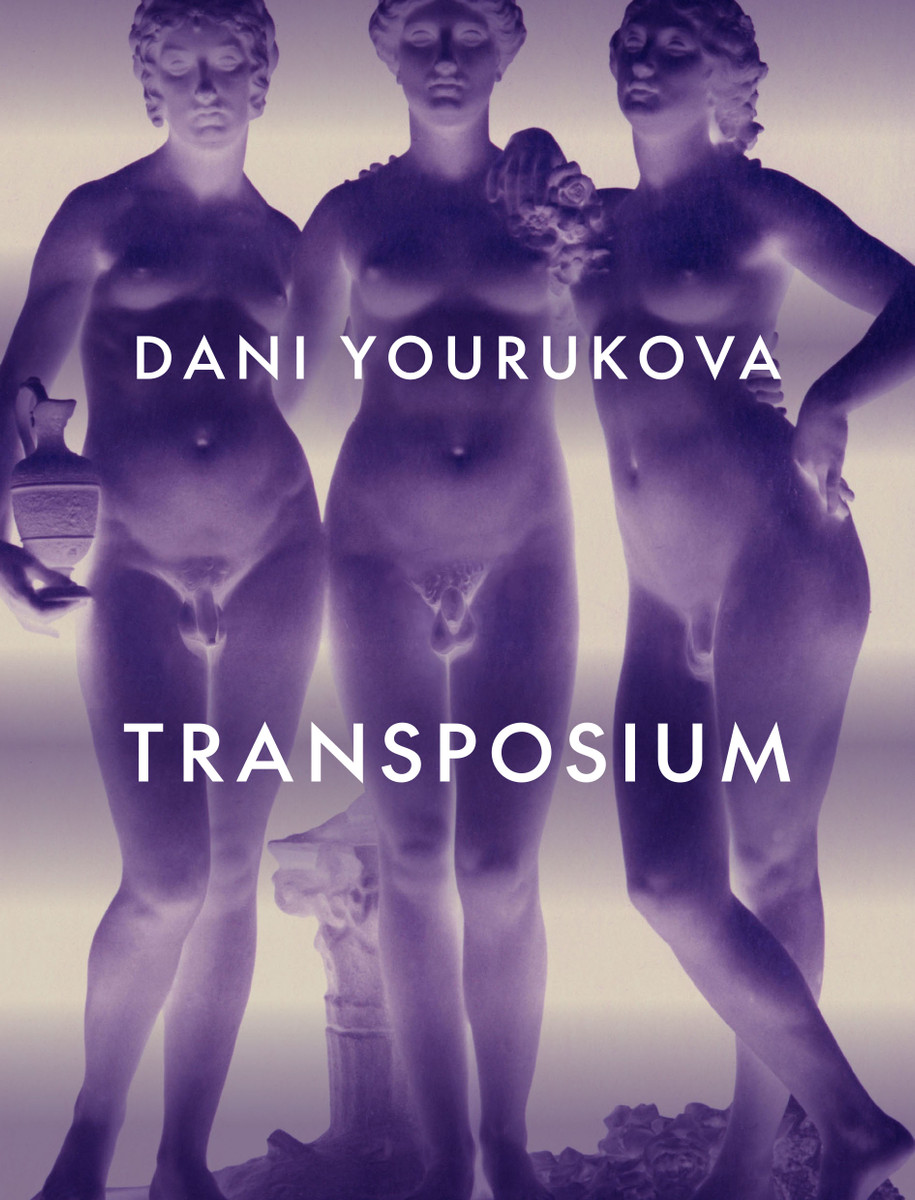
Dani Yourukova is a poet, researcher, and amateur occultist. Their poetry and essays have been published in places like Sweet Mammalian, The Spinoff, Bad Apple, and Turbine Kapohau. Their debut poetry collection Transposium was published by Auckland University Press late last year.

Poetry Shelf review: Ash by Louise Wallace

Ash, Louise Wallace, Te Herenga Waka University Press, 2024

                                  I have to learn

to live there.
But first I must dig

                                  myself out.

Louise Wallace, Ash

How to begin? How to share thoughts on Louise Wallace’s extraordinary novel without diluting the reading experience for you, without smashing the slowly accruing mood, the enigmatic mountain, and the maternal throb.

A woman lives in the shadow of a rural mountain, with her husband and two children. Mother wife vet woman body. Body belonging to child and child and husband, and even the stranger seated next to her in the dental surgery. I am reading this heartblasting evocation of woman on the coat tails of reading Lee Murray’s poetry-prose collection, Fox Spirit on a Distant Cloud. With the help of a nine-tailed fox spirit, Lee depicts nine Chinese women in the land of cloud. Upended, anchorless, despairing. A book that also moved me to the hilt.

How to be mother wife woman, working woman, dreamer, dreamcatcher, survivor – against and within a spectrum of visible and invisible degrees of subjugation? How to write a story driven by these vital questions? Begin with voice. Begin with a voice so real you are walking up the gravel hill alongside the woman as she heaves and grunts and pushes the pram. You are awake in the night with her as she searches for answers to her personal universe of questions.

Build a narrative and make it real familiar everyday, and then insert pieces that both enhance and disrupt the steady flow of the quotidian. Reclaim the art of storytelling, the practice of living, and make them your own. For example, Louise includes a sequence of ‘figures’ throughout the novel, as though we are holding a scientific treatise, but the word ‘figure’ rebounds as it signals body, proportions, considerations, adjuncts. For example, ‘Figure1. (The Figure)’ jam-repeats the phrase, ‘nothingissacrednothingissacred’ to form a hemmed-in box of text. Later ‘Figure 15 (The Figure)’ jams the phase ‘iamshellturningintoashelliamshellturningintoashell’ into a block text within the frame.

Keep the story moving moving and repeating. Now the woman is screaming at Nick and feeding the children and struggling to heal the limping bull. And it is real, devastatingly real, and it is splintering the mountain, and the story becomes myth and metaphor and fable. And it makes me ache and think hard. And it never stops being body-stomping real.

Along the bottom of the page we can follow a footnote thread of sentences, a footer fable, an underlay carpet that augments and stretches and weeps, as it traces other women wives mothers repetitions: ‘The wife had spilled the soup in bringing it to the table. Or had not put the butter out beside the bread.’

And I am sitting on the edge of the bed saying YES YES YES! We are following in the wordprints of all the writers who preceded us, all the mothers and sisters who wrote and lived, found voice, fierce or soft, groundbreaking or seed planting. Pioneers and Goddesses. In her ‘Acknowledgements’, Louise lists some of her sources of inspiration: Jenny Bornholdt’s The Rocky Shore, Zarah Butcher-McGunnigle’s Autobiography of a Marguerite, Arthur W. Frank’s The Wounded Storyteller: Body, Illness and Ethics, the ‘fables’ section of The Pedestrians by Rachel Zucker, Sara McIntyre’s Observations of a Rural Nurse, Danielle Hawkins’ Two Shakes of a Lamb’s Tail: The Diary of a Country Vet, and Anna Perry’s art.

Louise wrote and researched the book within the PhD programme at Ōtakou Whakaihu Waka University of Otago, with the support of numerous writing friends. I can hold this novel out to you like a prism and it will keep shifting in effect. In one light, the catastrophic ash, like Covid, is contaminating lives and places, rations are stockpiled, wellbeing is under threat. In another light, catastrophe becomes rage and is the unbearable weight of helpless and expectation, of the unsaid but the insistently thought. Hold the novel closer and you will spot the tipping point, the edge of eruption.

This is a novel to feel as much as it is a novel to think. It is a seething simmering boiling novel, every word pitch perfect, and I am holding it close because, yes, we need to keep writing from under and over and for the mountain, to step out of helplessness and expectation, role models and body paradigms, writing templates and restrictive definitions and hierarchical canons. Extraordinary.

I would like to gift a copy of this book to someone. Write a comment on my social media page or here and I will select one reader.

Louise Wallace is the author of four collections of poems, the latest of which is This Is a Story About Your Mother (2023). She is the founder and editor of Starling, an online journal publishing the work of young writers from Aotearoa, and the editor of Ōrongohau | Best New Zealand Poems 2022. She is a recipient of the Biggs Prize for Poetry and a Robert Burns fellow. She grew up in Gisborne and lives in Ōtepoti Dunedin. Ash is her first novel.

Te Herenga Waka University Press page

Poetry Shelf feature: Fox Spirit on a Distant Cloud by Lee Murray

Fox Spirit on a Distant Cloud, Lee Murray, The Cuba Press, 2024

Begin with a fox girl.
Begin with nine dutiful wives.
Begin with a departure from the land of jade to the land of cloud.
Move to you and you and you, the nine-tailed fox spirit, the húli jīng.
Continue with the new arrival woman, the new arrival adrift.
And it is she and she and she.
And it is the fox choosing, and it is the woman speaking.

And here we are in an evocation of Chinese women, women of the Chinese diaspora, women who are owned displaced muted with neither familiar ground nor kinship. Lee has used the figure of the nine-tailed fox to narrate nine women who are framed by the appearances of the fox. We listen to the mothers and daughters, girls and women, listen to them speaking out of struggle and despair, the hope flickering, the different versions piercingly similar. Listening, so very important, that we are listening.

This is the mother working her fingers to the bone: “only you will see the silent click of her tongue and the bitter taste of her unquiet”.
And it is the wife coiled in drudgery, the relentless routine, deferred and elusive dreamings, the social hubs existing elsewhere.
And it is sadness and subjugation and shapeshifting fox.

What a heart embracing collection this is. Such writing poise. Every line sings out with linguistic freshness, a feast of visual and aural conjunctions: “your heart shrivels to a rotting black walnut, the sweet sonata halts”. Every musical phrase leading to the jagged edge of living: “apples and flutes will always be parallel lines”. Every lyrical cadence twisting the blade: “the girl is a typhoon of want, a perfect symphony of longing”.

Lee draws upon: “the invisible Chinese fox women who came to make there home here in Aotearoa, who trod this cloud-land before me and who lived and died and suffered in these pages, though you are many and nameless, I want to thank you for allowing me to slip on your skulls, share in your lives and give voice to your stories.” from ‘Acknowledgements’

In her ‘Author note’, Lee admits the “poetry-prose work has been one of the most difficult pieces of writing I have ever completed, possibly because I was writing it during the global pandemic and was plagued with interruptions and anxiety, but also because as a New Zealand-born Chinese Pākehā, the tragedy of these narratives filled me with sadness and anger.”

Indeed. And out of this difficulty, out of this complicated and resonant stretch into the personal and the imagined, Lee has produced an extraordinary collection, a chorus of voices that will unsettle and unnerve and are utterly necessary to be heard. This is a book to be shared.

A reading

Photo credit: Maree Wilkinson

Lee reads from Fox Spirit on a Distant Cloud

A conversation

What are three or four key words for you when you write poetry?

Thank you for this illuminating question, which has had me thinking on process and purpose and the philosophy of poetry for a couple of hours now. For me, whether a poem focuses on a brief reflection or complex narrative, whether it is contemporary, historical or even speculative, formal or free, a single line or a novel-length epic, poems that resonate do so because they incite some feeling or deep emotion in the reader. There is an element of recognition and understanding, some shared insight into the human condition that is apparent even if the subject matter is foreign to us. So my four key words might be:

Truth.
Heart.
Connection.
Solace.

What gave you particular joy when you wrote this new collection? Or challenge?

The joy has been in the kind reaction from readers and reviewers. As writers, we’re rarely satisfied with our work, typically full of angst about its not-enoughness, and Fox Spirit on a Distant Cloud is such a strange little collection, one that is very hard to categorise, so I have been especially antsy! Is it fiction or non-fiction? Poetry or prose? As for the challenges (other than settling on a suitable classification for booksellers), Fox Spirit on a Distant Cloud has been the hardest thing I have ever written, which I admit in my author’s note:

While it seemed a simple enough objective when conceived, this prose-poetry work has been one of the most difficult pieces of writing I have ever completed, possibly because I was writing it during the global pandemic and was plagued with interruptions and anxiety, but also because as a New Zealand-born Pākehā-Chinese, the tragedy of these narratives filled me with sadness and anger. At times, I was stricken with writer’s block, something which has never happened to me before. My words were clumsy and insufficient, and I was overwhelmed with a strange responsibility for the women whose lives inspired these narratives. It struck me that it was only through a twist of time and fortune that I was not one of them. More than once, I was reminded to be grateful for the gifts of my grandmother, Wai-Fong, a Shanghai-born refugee, and my mother Pauline, a New Zealand-born Chinese—two incredible women who stepped carefully and also boldly, creating a path for me, so that I might thrive.

Have you read any poetry books in last year or so that have struck a chord? Or books that nourished you as you wrote the collection?

I read a lot of poetry books, so this is hard! However, two poetry books which spoke to me deeply while I was writing Fox Spirit on a Distant Cloud include Anxiety of Words: Contemporary Poetry by Korean Women (2006) by Ch’oe Sŭng-ja, Kim Hyesoon, and Yi Yŏn-ju (translated by Don Mee Choi), a groundbreaking collection of poems by three Korean poets who tell of lives shaped by tradition and expectation. Intimate and insightful. I also loved the truths, domestic and universal, revealed in Marge Piercy’s collection On the Way Out, Turn Off the Light (Alfred A. Knopf, 2020). Another book which nourished me that is not classified as poetry by its author, but which comprises prose so gorgeously lyrical that it may as well be, was L.E. Daniels’ novel Serpent’s Wake: A Tale for the Bitten (2018). It’s a kind of metaphorical fairytale for adults written as a means of processing trauma, a work that encapsulates that list of four words that epitomise poetry for me—truth, heart, connection, and solace—and which has become one of my favourite books of all time. Poetry books released in the last year which have struck a chord include Grace Yee’s powerful Ockham Award-winning collection Chinese Fish and Madeleine Slavick’s fabulous homage to small-town Aotearoa, Town. And for emerging writers looking for a way into poetry or established poets in need of a refresh, I highly recommend Writing Poetry in the Dark (2022), a collection of essays on writing into the wound edited by Bram Stoker Award-winning poet Stephanie M. Wytovich.

Lee Murray is a third-generation Chinese New Zealander and multi-award-winning author, poet and anthology editor. She has been awarded the Prime Minister’s Award for Literary Achievement for Fiction 2023 and been made an NZSA Honorary Literary Fellow. The manuscript of Fox Spirit on a Distant Cloud won Lee the Grimshaw–Sargeson Fellowship at the development stage and the NZSA Laura Solomon Cuba Press Prize when it was complete. She’s won five Bram Stoker Awards, awarded by the international Horror Writers Association. Lee lives in the Bay of Plenty with her husband and son.

The Cuba Press page

Poetry Shelf Monday Poem: ‘Disaster Escapism’ by Hebe Kearney

Disaster Escapism

I whimper as I wade into the Manukau –
autumn spread her cloak suddenly;
summer is a memory.

I call out:
‘Fucking hell, it’s like the North Atlantic on the 15th of April 1912 in here!’
it is April, but I don’t really mean it.
Anyway, my friends are getting sick of the Titanic references.

The sun is shining, though weak,
and all I have to deal with is gooseflesh.
I am not freezing politely to the tune of ‘Nearer, My God, To Thee
I am not watching from a half-empty lifeboat,
horrified at hypothermic chivalry.

Because that’s the thing – in negative 2 degree water
you’ll freeze before you drown. 
Your core temperature drops
and your organs go like dominos. Yes, 
exactly like Jack Dawson’s puppyface, 
dead already, slipping below
to join the majority of third class passengers
on the Atlantic seafloor.

But the band played on as the ship sank,
and the final song could have instead been ‘Autumn’,
a tepid tune with fiery streaks,
like the sky above me, as I swim,
I picture the musicians’ strings resonating in cold-thick air,
their breath fleeing in white puffs of terror.

More likely, it was the hymn –
coming from a band of religious men facing the end,
and many survivors recalled hearing it, or felt fear flash
when the familiar notes strained.

I watched some Mormons sing it on YouTube last night,
and fell asleep to an all male choir’s anonymous fleshy orb heads
floating above their tidy suits and hypocrisy.
But did Titanic’s band even sing, anyway?

Or was it just their lonely instruments
limping out over mirror-still water?
I know there were definitely voices
but they were probably screams.

I try to imagine it –
put myself in their bodies, sparking with panic,
and the generations of human fascination 
with them; their fate; that preposterous ship. 

It’s easy, really, it was long ago now,
and empathy never expires;
it has cold, historical curiosity as a preservative.

So it’s easy for me to dwell –
easier than having to remember other things, like that
this summer has ended; I am cold; this swim is over.
That I have to stop at the shop on the way home; or that 
we are currently living powerlessly 
through a genocide in Palestine.

Hebe Kearney

Hebe Kearney (they/them) is a poet and librarian who lives in Tāmaki Makaurau. Their work has appeared in publications including: Mantissa Poetry Review, Mayhem, Overcom, Poetry Aotearoa Yearbooks, samfiftyfour, Starling, Symposia, Tarot, The Spinoff, and Turbine. You can find them at @he__be on Instagram.

Poetry Shelf noticeboard

“Is a poem, which after all is only a literary construct within an imagined framework, a reasonable way to understand the world?”


Mary Oliver, Rules for the Dance, 1998

Highlights of the week

Following the posts and photos from the festival that Selina Tusitala Marsh, Karlo Mila and Daren Kamali are attending in Hawai’i. Wow! This is one amazing poet-rich event.

Bill Manhire asks where poems come from in the latest issue of North & South, and offers an eclectic response. He writes: “Several generations of school children have met Hughes’s [‘The Thought Fox’], and its assumptions have become commonplaces. Something magical happens when a poem is made. The poet is both powerful and powerless — shaman, summoner, inspired and chosen vehicle.” The most common question students of all ages ask me in schools is “where do you get your ideas from?” I don’t think my answer is ever exactly the same, but I riff on the idea that something drops in my head — like a feather, a snowflake, a leaf — and it might settle and grow into a bird or a snowball or a forest, or something altogether different. And it always surprises me. Both in its arrival and its growth.

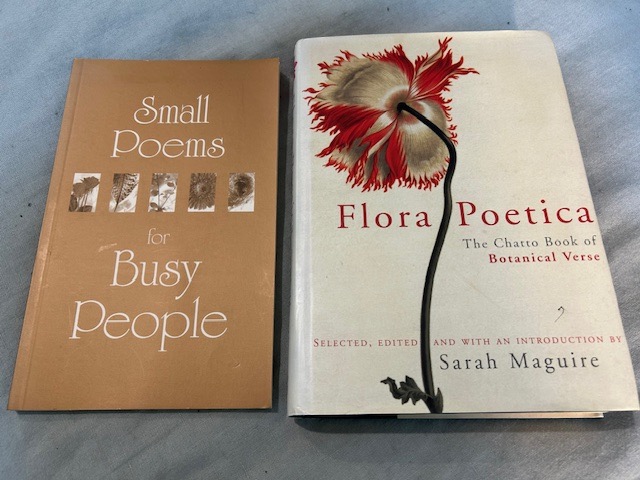
Discovering a book, Flora Poetica, in my box of Wild Honey copies! An accidental gift? It assembles over 250 poems about trees, plants and flowers from eight centuries of writing in English. The collection is organised botanically, so you might find Louise Glück alongside Ted Hughes writing irises, or Allen Ginsberg, Robin Hyde, William Blake, Rita Dove writing the daisy family. Floral arrangements transporting us across the globe.

This is how you live when you have a cold heart.
As I do: in shadows, trailing over cool rock,
under the great maple trees.

Louise Glück, from ‘Lamium’ 1992 (mint)


It looked like a clump of small dusty nettles
Growing wild at the gable of the house
Beyond where we dumped our refuse and old bottles:
Unverdant ever, almost beneath notice.

Seamus Heaney, from ‘mint’ 1996


Discovering Small Poems for Busy People in a box of books I hadn’t yet put on the poetry shelves.

Assembling a second suite of couplets because the first suite generated so much love. Will be posting near the end of the month.

Relaunching Poetry Box by deciding to review new children’s books that catch my attention, both local and international, any genre. At some point I want to get back to engaging children, teachers and librarians through various activities and challenges.

Rereading Tessa Keenan’s answers to ‘5 Questions’. Sublime.

Weekly posts

Monday: Monday poem – Frankie McMillan’s ‘Stripes’

Tuesday: review of A GOWN IS A GLACIER, RECEDING, Nina Mingya Powles

Wednesday: Winners of Given Words 2023 read their poems
New Writers Poetry Competition

Thursday: Rhian Gallagher on ‘Seeing You Asked’ by Vincent O’Sullivan
The House within – Fiona Kidman documentary

Friday: 5 Questions – Tessa Keenan

On Poetry Box

Review of The Grimmelings by Rachael King

A discovery

If I can Stop One Heart From Breaking

If I can stop one heart
from breaking
I shall not live in vain;

If I can ease one life the aching
Or cool one pain,

Or help one fainting robin
Unto his nest again

I shall not live in vain.


Emily Dickinson (c 1864)

Kim O’Keefe, the editor of Small Poems for Busy People (Cumulus, Whitcoulls, 2004) gathers a selection of smallish pieces to offer an oasis of calm, from across time and location, on love, friendship, sorrow, humour, family. Spotted a few old favourites: ‘Before You Go’ by Vincent O’Sullivan, ‘In Love’ by Jenny Bornholdt, ‘Whakapapa’ by Apirana Taylor, ‘Wild Daisies’ by Bub Bridger, ‘We Were Married’ by Gregory O’Brien, ‘For a Five-Year-Old’ by Fleur Adcock. I find this Emily Dickinson poem particularly resonant. Yet! The poem has appeared in multiple layouts, but curiously, for this small anthology, the editor omits the robin lines and adds in two unfamiliar to me. Strange. I got musing on how Vincent O’Sullivan kept faith with Ursula Bethell’s original versions when he edited her poetry. It feels like this is the time to be caring for our hearts, not just the hearts of others,but our own hearts. Today I am advocating self care. Poetry helps, as Tessa Keenan writes.

Poetry Shelf 5 Questions: Tessa Keenan

I have been thinking a lot about the place of poetry in global catastrophe and the incomprehensible leadership in Aotearoa. How do we write? Read? Do we need comfort or challenge or both? In an ongoing series, poets respond to five questions. Today Tessa Keenan.

A World of Perpetual Longing

It looks like they touch when the cloud comes in and coats the mountains,
I know. This is what Tāwh wants you to believe. It’s actually just a curtain.
Think: holding a friend’s towel up in front of them while they get dressed
after swimming.

Think further: a steeple doesn’t leave behind anything that would need
tweezing out. Some days the ground freezes over and it is the sun that
eventually warms it. New species get names, conservationists increase the
population of kākāpō, buildings are assembled then moved on the back of
trucks. There has to be space, something to stand on, and something to
reach for. As a consequence, this is a world of perpetual longing. Nothing
can be said without breathing in thousands of years of desire. When you
tell me how you are happy to be home, and how when you were a kid you
escaped to the beach, running over grass to dodge the prickles then running
over sand to shorten the burn, your words are born from the thoughts of
those who longed for that before you.

Think further again: the sky was bland at the bus station. I stood outside
and waited for you to find a seat, yelled ‘Bye!’ when you did.
On my way home, I thought about the night before: climbing over you as
you sweated, reaching along the walls with eyes unblinking, trying to find
the light switch, your hands drawing dreams of lakes, wheels, and winds
on my skin as you slept, the last thing you whispered before falling asleep.
By the time you got to Whanganui it was blue as summer and the trees
stretched as if it was morning. They were so close to touching. I sat there
breathing and breathing.

Tessa Keegan, from ‘Pukapuka mapi / Atlas’ chapbook
in AUP New Poets 10, Auckland University Press, 2024

Has the local and global situation affected what or how or when you write poetry?

Tessa: Yes. I have found it difficult to be inspired to write anything in the last year. But I don’t view this as a bad thing. If anything right now I think we can focus on being readers and listeners if that’s all we can do. Or speaking out, even in the least poetic way.

I see a huge necessity right now to listen to and uplift voices (whether that be non-fiction or poetry or whatever form) that are seriously under threat. Throughout the genocide in Gaza (and all of the colonial history of the world for that matter), we have seen attempts to silence voices – poets are being martyred. If we cannot find the energy to write, we can read and share the words of Refaat Alareer, Heba Abu Nada, Inas al-Saqa, and so many others whose words of resistance have outlived them. And back here at home, we can focus on spreading and uplifting the voices of those who are speak about the effects of certain (most) decisions being made right now.

Resting, eating, reading, talking, thinking, and spending time in my communities: these are the lifelines for me at the moment.

Does place matter to you at the moment? An object, an attachment, a loss, an experience? A sense of home?

Tessa: Home matters to me at all times and is at the heart of my writing. I am in a constant state of full-body longing for my ahi kā in Taranaki. I am very fortunate to have grown up next to my whenua and in a whānau with a strong sense of identity. It’s not that far away, and I’ve got lots of whānau in Te Whanganui-a-Tara, but being away from home makes me need to write about it to be there.  I feel like I write about home when I’m not there and then write about anything else when I’m there.

Are there books or poems that have struck a chord in the past year? That you turn to for comfort or uplift, challenge or distraction.

Tessa: Ngāhuia te Awekōtuku’s memoir Hine Toa came out a couple of weeks ago. I think I embraced my copy for about 5 minutes before I even opened it. How do I even write about what her work means to me? Beyond just a poetry and literary level, Ngāhuia’s life and work is like a guidebook for the kind of ancestor I want to be. Takatāpui excellence. Her memoir is already my book of 2024.

I’ve been enjoying a lot of new local poetry in the recent months. Notably the books Killer Rack by Sylvan Spring and Plastic by Stacey Teague. Both are very different in tone but strike different chords with me personally. I love the strong focuses on music and queerness in Sylvan’s book, and the honest and spiritual elements of Stacey’s.

For one of my classes at uni last year, I read DMZ Colony by Don Mee Choi. It has to be the best collection of poetry (if you can even call it that) I’ve read. It’s a puzzle, history thesis, and artistic masterpiece.

What particularly matters to you in your poetry and in the poetry of others, whether using ear, eye, heart, mind – and/or anything ranging from the abstract and the absent to the physical and the present?

Tessa: I love poetry that, on its face, talks to you straight up. Poetry that has the rhythm and fluctuation of an ordinary conversation, and the words to match. But then when you look closer the words that are coming out of the person’s mouth are jumbled a bit, or are too repetitive, or do not sound real. Still, the words get at something so real and otherwise untouchable. I feel like I’m doing a bad job of explaining this. Maybe it’s like a poem that anxiously laughs the whole way through. Until that one last line that stabs you in the heart.

Some of my favourite poems are ‘Gender Buttons’ by Hannah Mettner, ‘This Room’ by John Ashbery, and ‘Monologue’ by Hone Tuwhare.

Is there a word or idea, like a talisman, that you hold close at the moment? For me, it is the word connection.

Tessa: I have been thinking a lot about ‘utopia’. With full awareness of the inherent negativity of that word. I think you can still turn it into a talisman. The idea of a utopia helps me believe that there are worlds we can achieve where everyone is safe and peoples rights are respected as a bare minimum.

I’ve found myself look for mini utopias in real life. Like being on a marae and and blobbing out on a mattress while you listen to someone talk about its history. Or spaces where queerness is so common, accepted, and represented (yes I am thinking about women’s football). I don’t mean this as a distraction from the dystopias we see and experience on a day to day basis. But that idea gives me inspiration and hope at the moment. We need to protect our mini utopias!

Tessa Keenan (Te Ātiawa) is from Taranaki and is now based in Pōneke. You can find her writing in various Aoteroa publications including AUP New Poets 10Starling, and Pūhia. 

Poetry Shelf Poets on Poems: Rhian Gallagher on ‘Seeing You Asked’ by Vincent O’Sullivan

Seeing You Asked


There’s a dozen things I might tell you.
There’s a Chinese poem to begin with
of a woman folding curtains as she leaves
a man, forever. There is a Roman writing
from the edge of ice-fields, a vista
of dull silver beyond clicking reeds,
to a woman who watches a blue smoking
mountain in almost unbearable heat.
There are wartime movies with sad bridges
across morning rivers, the woman pressing
the two wings of her collar together
as a train draws out. There’s the story
as well of a woman driving north
towards a lake, a lake that was once fire,
a house by the lake, a life inside the house,
where today’s love becomes another fiction
you open when the room is empty,
put down when you hear voices, stand
up, smiling, at life where it happens . . .
There’s no end to certain stories,
as the plot has no desperate turns, the vase
on the bedside table burns with azaleas
whatever happens. But love, we say,
love, there are corners on the stairways,
there are fragments in each hour,
when the notes drift back, the ones
scarcely heard – just as the lake is always
beside you, spreading out, and out.
You say swim, you read, you fish.
There is something like the glint of a hook,
there is something, love, in that shimmering
vault, trolling too fast to speak of.


Vincent O’Sullivan
from Seeing You Asked, Te Herenga Waka University Press, 1998

‘Seeing You Asked’ by Vincent O’Sullivan is a big poem concerned with fiction. There are so many stories we can tell. But is there not also ‘something’ that eludes our telling. The poem is a homage to the unsayable. Saying the thing we can’t say is, of course, the work of poetry. There’s a certain playfulness here because the poem itself does attempt to get at the thing we can’t say.

The first line opens like an inviting door – ‘There’s a dozen things I might tell you’ – matter-of-fact and captivating: what are these things you might tell me?

The ‘tellings’ that follow are food that leave a reader hungry. I want to know more about the Roman ‘writing from the edge of ice fields’ and I definitely want to know more about ‘the woman pressing/ the two wings of her collar together/ as the train draws out’.

Vincent the poet is working in concert with Vincent the novelist. Each of the tellings are like synopsis, unpacked they could be novels. The desire to know more propels us through the poem while the accessible tone belies a heft and poignancy: The folding in of those ‘wings’ as the train leaves – they will not lift the woman from that ‘sad bridge’. It’s a war movie we are in the thick of yet all war could be described as a ‘sad bridge’ – the two sides that never meet.

A love of resonant detail is at the fore. Vincent is quietly mercurial as a poet: combining economy with the generosity of digression. The Roman writing from the edge of ice fields has a vista before him ‘of dull silver beyond clicking reeds.’ It’s not just that he writes to a woman but that he writes to a woman ‘who watches a blue smoking/mountain in almost unbearable heat’. They are seasons apart, the very temperature between the two of them is at odds.

The poem has relatively even line lengths, there are no stanza breaks. Within this seemingly seamless form there’s a rich modulation of pace. Opening slow until the midline break in the twelfth line. We then freewheel across eight lines, a freewheel that’s done with exquisite control:

                                   (…) There’s the story
as well of a woman driving north
towards a lake, a lake that was once fire,
a house by the lake, a life inside the house,
where today’s love becomes another fiction
you open when the room is empty,
put down when you hear voices, stand
up, smiling, at life where it happens . . .

This is one of the beating hearts of the poem. As readers we immerse in a story as if it were a here and now, we are in the thick of it, until someone else enters the room and we put down the book to greet ‘life where it happens …’

There’s a great deal in these eight lines – ‘a house by the lake, a life inside the house’ echoing for me that hand gesture rhyme played as a child ‘here is the church, here is the steeple …’.  The two lines that follow almost warrant an essay in themselves:

‘today’s love becomes another fiction
you open when the room is empty’

The way the lines are cast it’s not only that ‘you’ open the book that tells the love story from the past but that ‘you open when the room is empty’ as if it were safe/possible now for you to open up.

The conjuring of a present, a sleight of hand device, in turn enables a reflection on where fiction sits in our lives. The poem is an enactment. And, in this way, not only a reflection on fiction and story-telling but also a reflection on the nature of time itself.

Our confidence is gained through the calibrated detail and the rich patterning of feeling and thought. We know we are in safe hands. This carries us to the final turn in the poem more than willing to reach for the unreachable. It’s a beautiful flight:

                                 (…) But love, we say,
love, there are corners on the stairways,
there are fragments in each hour,
when the notes drift back, the ones
scarcely heard
(…)
There is something like the glint of a hook,
there is something, love, in that shimmering
vault, trolling too fast to speak of.

It’s almost as if this moment has had to earned. Yet what is given here is part and parcel of human experience: the experience of not being able to catch hold of our experience. The experience of love, thankfully, has never been nailed down.

Vincent’s sensibility honours the everyday, often the domestic; yet he is equally receptive to the illusive, what, in Seamus Heaney’s work, might be called ‘a marvel’.

‘Seeing You Asked’ echoes back to an earlier poem, ‘Look Sheila Seeing You’ve Asked Me’ (from the sequence The Butcher Papers, Oxford University Press, 1982). The question Sheila seems to have asked Butcher is: what is life? Butcher being Butcher, he approaches the question with a rollick: ‘Life is not a horse with a winner’s garland/ on it’s sweaty neck’ (…) ‘not quite a flushy sunset and its pouring ribbons/ from God’s theoretic bosom’. If only life could be pinned down but it keeps slipping Butcher’s grasp with what is not easily put into words: feelings of celebration or that ‘flushy sunset’ with its inexplicable beauty. Till Butcher himself has to own the unnameable: ‘Yet I don’t know what it is says Butcher (…) if not this as well –’.

                        which is light walking
the dreamy edge of steel
which is pulse where his wrist lies on complacent death
which is water pure as silence before speech is thought of
from the tap in the back room
                                   splashed on face, on boots,
as he stands with chin tingling,
with feet like jewels.

The experience of wonder (as with love) is something that we can’t quite pin down: ‘water pure as silence before speech is thought of’. To give such a moment to a character like raucous, blokey Butcher is an inspired act.

The lines above are some of my favourite from Vincent’s work, they enact an experience that evades all metrics. Wonder is like an endangered species. Yet it’s one of the qualities in our relationships with each other, and with the natural world, that opens our imagination and enhances feelings of kinship.

Thanks Paula, for the opportunity to celebrate two of Vincent’s poems. I’m going to miss him a great deal, many people are going to miss him a great deal. It feels like the conversation isn’t over.

Born in Auckland in 1937, Vincent O’Sullivan was one of New Zealand’s leading writers, acclaimed for his poetry, plays, short stories, and novels, which include Let the River Stand, Believers to the Bright Coast, and the Ockham-shortlisted All This By Chance. He was joint editor with Margaret Scott of the internationally acclaimed five-volume Letters of Katherine Mansfield, edited a number of major anthologies, and was the author of widely praised biographies of John Mulgan and Ralph Hotere. He taught at Waikato University and Te Herenga Waka—Victoria University of Wellington, and was the New Zealand Poet Laureate for 2013–2015. In 2000, Vincent was made a Distinguished Companion of the New Zealand Order of Merit, and in 2021 he was redesignated as a Knight Companion of the New Zealand Order of Merit. He died in April 2024.

Te Herenga Waka University Press page

Rhian Gallagher’s first poetry book, Salt Water Creek, was published in London (Enitharmon Press, 2003) and short-listed for the Forward Prize for First Collection. In 2007 Gallagher won a Canterbury History Foundation Award which led to the publication of her book, Feeling for Daylight: The Photographs of Jack Adamson. She also received the 2008 Janet Frame Literary Trust Award. Her second poetry collection Shift, (Auckland University Press 2011, Enitharmon Press, UK, 2012) won the 2012 New Zealand Post Book Award for Poetry. Freda: Freda Du Faur, Southern Alps, 1909-1913 was produced in collaboration with printer Sarah M. Smith and printmaker Lynn Taylor in 2016 (Otakou Press). Rhian was the Robert Burns Fellow in 2018. Her third poetry collection Far-Flung (AUP) appeared in 2020. Gallagher lives in Dunedin.

Poetry Shelf noticeboard: The House Within, Fiona Kidman documentary

A documentary on Fiona Kidman, directed by Joshua Prendeville, will screen at the NZ International Film Festival in July.

“At 84, Fiona Kidman has published more than 30 books of fiction, poetry, and memoir, and received a raft of the highest accolades here and abroad. In this gentle, meandering film, we’re shown a vocational life lived with conviction and courage, punctuated by loss. From precocious beginnings in rural Northland to her involvement with the New Zealand Women’s Liberation Movement, Fiona Kidman has always been propelled by her sense of the power of words to inspire change, and a nose for thinly veiled Kiwi conservatism.”

Details here

Poetry Shelf Celebrates: Winners of Given Words 2023 read their poems 

With the opening of competitions for the Phantom Billstickers National Poetry Day less than two months away, the director of Given Words, Charles Olsen, has invited the winners and special mention of the 2023 competition, Elliot Harley McKenzie, Boh Harris and Tim Saunders, to read their poems for NZ Poetry Shelf.  

All entries had to include the five words brokenreflectiondisappearpath, and paint, which were chosen by students at López de Arenas Secondary School, Marchena, Seville, Spain. The winners were selected by Mikaela Nyman, Sophia Wilson and Charles Olsen. Their comments on the poems along with a selection of the entries by both adults and under-16s can be read on Given Words.   

On 1st August 2024, Given Words will open for its ninth year, with some of the words chosen by pupils of Te Parito Kōwhai Russley School in Christchurch. Phantom Billstickers National Poetry Day will be held on Friday 23 August this year and all competitions will be available on the Competition Calendar.

The readings

The winner of ‘Best Poem’ was Elliot Harley McKenzie for their poem transmutations.  


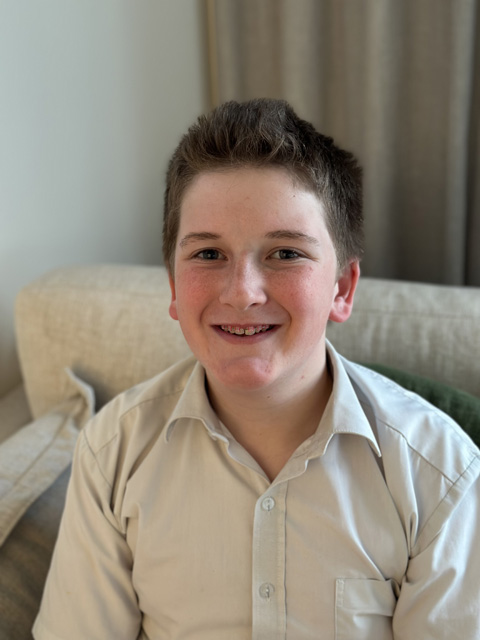
Winner of the ‘Best Poem by Under-16s’ was Boh Harris, then aged 12, for his poem The Broken School.  

And a Special Mention was awarded to Tim Saunders for his poem My Mother, Deciduous

The poets


Elliot Harley McKenzie
 (they/them) is a pākehā poet living in Tāmaki Makaurau Auckland. They have previously been published in Starling, Best New Zealand Poems, Tarot and Sweet Mammalian. Elliot enjoys listening to audiobooks, bouldering, ceramics and their job as a support worker for people with disabilities. Their poetry is inspired predominantly by love, heartbreak, queer identity, ecology and visual art. The poem transmutations looks back on a past relationship, exploring turbulent emotions and fragmented memories alongside the myth of Narcissus.  

Hi, I’m Boh Harris. I am 12 years old and I’ve been at Write On School for Young Writers for nearly 2 years. My top two interests are creative writing and drama. When I grow up I would like to be an actor and an author. Poetry isn’t my forte but I am happy with the outcome of this poem and will continue to do more poems in the future because I thoroughly enjoyed writing this piece.  

Tim Saunders farms sheep and beef in the Manawatu. He has had poetry and short stories published in Turbine|Kapohau, takahē, Landfall, Poetry NZ Yearbook, Headland, Flash Frontier, Broadsheet, Best Small Fictions, RNZ and he also won the 2018 Mindfood Magazine Short Story Competition. Tim placed third in the 2019 and 2020 National Flash Fiction Day Awards, and was shortlisted for the 2021 Commonwealth Short Story Prize. His first book, This Farming Life, was published by Allen & Unwin in August, 2020. His second book, Under a Big Sky, was published in August, 2022.