
I am inventing my weekly newsletter as I go. It will include links to the posts from the week, a particular musing (this week the NZ Poet Laureate role), and a poem that has struck me. This week it is a poem by Vaughan Rapatahana that I had missed when I was offline for four months. It haunted me this week, especially as I have been assembling the tribute gathering for John Allison. I am keen to post a poem from a new collection that catches me – but poetry charisma might surprise from anywhere. My recovery road is rocky and challenging at times, and my energy jar miniature, but doing the blog is nourishing. I cannot manage an open submission policy for poems, but I welcome books from publishers.
Posts this past week
Monday: Poem by Cadence Chung
Tuesday: Ockham NZ Book Award Feature: Bill Nelson
Wednesday: Review of Wok Hei – recipes in the year of the Wood Dragon
Thursday: Thoughts on Ursula Bethell’s ‘October Morning’
Friday: A tribute for John Allison with readings, poems, photographs, homages
Launch for Manuali’i by Rex Letoa Paget, Saufo’i Press
A poem
Now that I am dying
now that I am dying
it’s probably best
you learn
from me.
please do not credence
gossips, ghouls, gainsayers
& their inevitable
ostensions
about what I was,
what I felt.
now that I am dying,
it’s waaaay past
time
to avow
my aroha for you.
mahal kita.
please,
now
let me
pass
in
peace.
[mahal kita – I love you – Tagalog]
Vaughan Rapatahana
Vaughan Rapatahana (Te Ātiawa, Ngāti Te Whiti) is a poet, novelist, writer and anthologist. With David Eggleton, he has co-edited Katūīvei: Contemporary Pasifika poetry from Aotearoa New Zealand (Massey University Press, 2024). With Trevor M Landers and consultant editor, Ngauru Rawiri, Vaughan has co-edited Ngā Pūrehu Kapohau: A literary homage to Pātea, Waverley, and Waitōtara (Lasavia Publishing, 2024).
A weekly musing: The Poet Laureate
Song
For the first time in a long time
there is sun making sunshine,
the heart sings which was once sighing,
for the first time in a long time.
Now the world is the world without trying:
the line releases the next line
and the next line, the next line —
for the first time, for the first time,
Bill Manhire, from What to Call Your Child, Godwit Press, 1999
I have been musing on how vital the NZ Poet Laureate role has been over the past decades, and how with all the current cuts and losses, I hope the role continues.
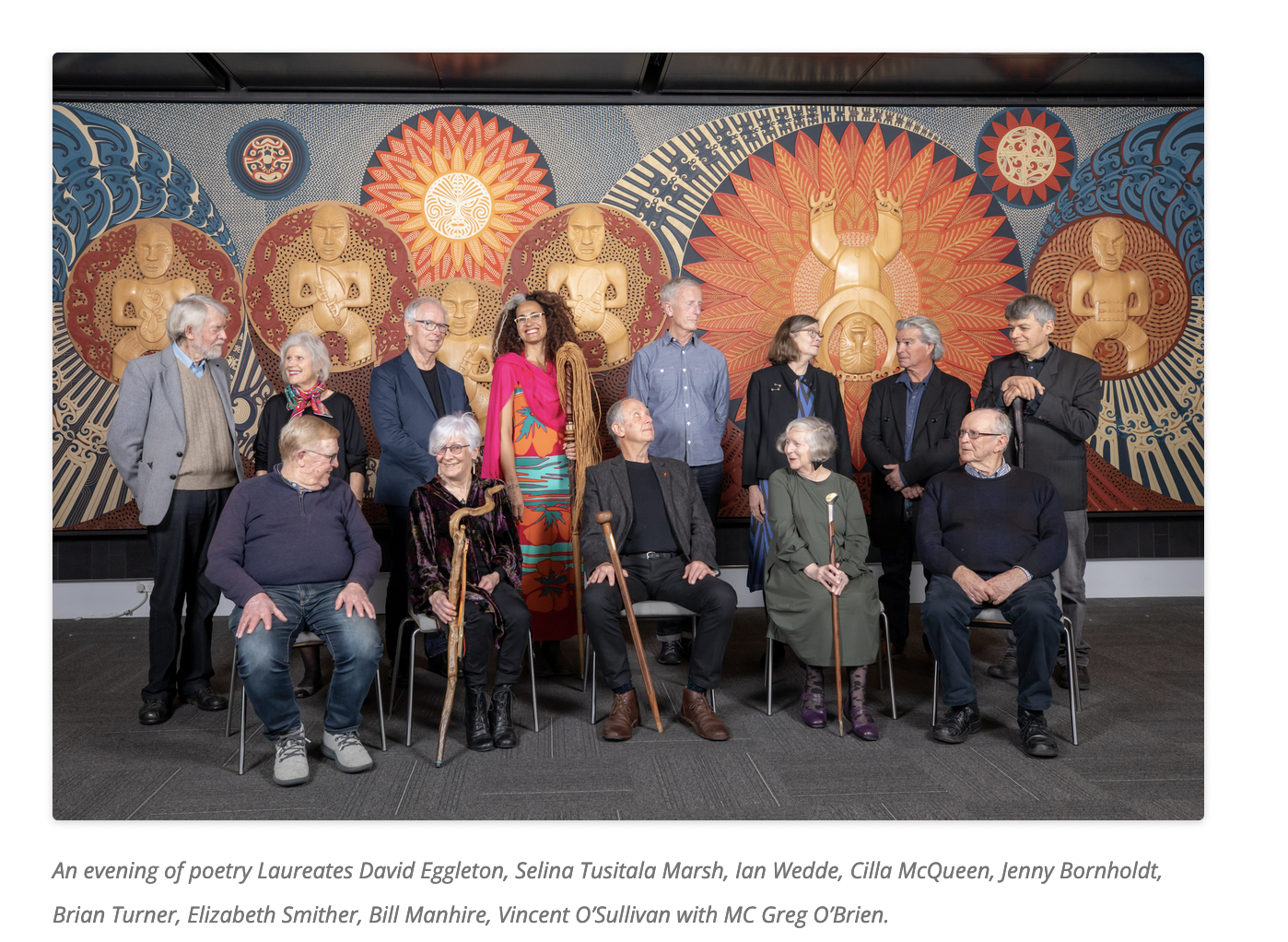
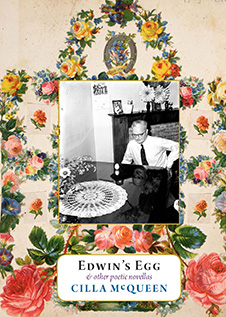
In June 2007, The National Library of New Zealand took over the administration and funding of the New Zealand Poet Laureate Award from Te Mata Estate Winery, with diligent nurturing from poetry enthusiast Peter Ireland. When I look back over the list of Poets Laureate I am reminded how each person has made the role their own, whether in a Laureate collection they penned, posts they have published on the National Library Laureate blog, events they have hosted, workshops they have run with both children and adults. Selina Tusitala Marsh,a charismatic performer on page and live, particularly inspired young writers across the motu, especially the Pasifika community. David Eggleton, also a charismatic performer, took to the road with infectious poetry energy and published a collected works. that catches his live charisma. Michele Leggott had us drawing poems on pavements, reciting reading and loving poetry in all nooks and corners, and also published a sublime collection (as did many others). Vincent O’Sullivan shared the blog space with other poets, Cilla McQueen used the blog to post Serial, a novella inspired by images in the National Library collection that was then published as a darling boxed set (see image below), Chris Tse, our current Laureate, is hosting events, carrying out workshops, promoting the pleasure of poetry widely. I sang his praises last week.
Each Laureate has received a generous stipend, some Te Mata wine, and a tokotoko especially carved for them by master carver Jacob Scott. The new Laureate is celebrated with the tokotoko, food, warm welcomes, invited friends and family, poetry readings over a weekend at Matahiwi marae near Clive in Hawkes Bay. NZ Poet Laureate blog.
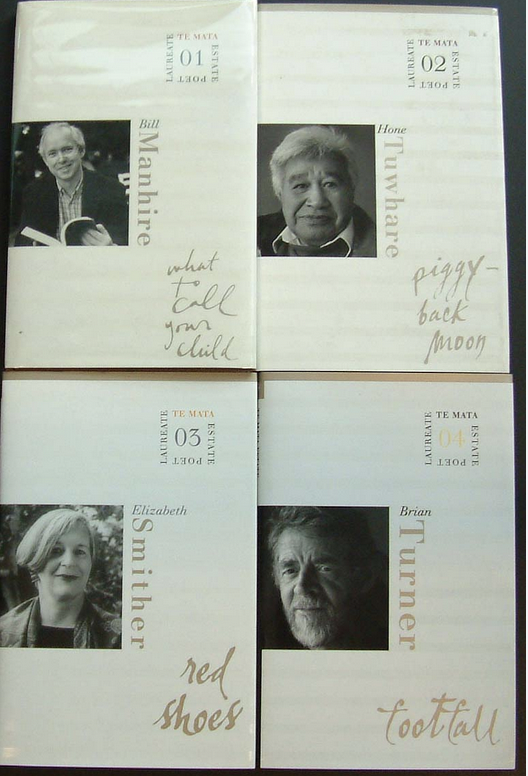
But I turn to the inaugural Poet Laureate, Bill Manhire, who accepted the role and continued his stellar advocacy for poetry written, published and performed in Aotearoa. And of course wrote terrific poems, some of which appeared in the inaugural Laureate collection (What to call Your Child, Godwit, Random House, 1999). I invited Bill to share some thoughts on the Poet Laureate role, and have also included a list of the Poets Laureate to date.
Today I toast our fabulous Poets Laureate.
Te Mata Estate Winery Poets Laureate:
- Bill Manhire
- Hone Tuwhare
- Elizabeth Smither
- Brian Turner
- Jenny Bornholdt
New Zealand Poets Laureate:
- Michele Leggott
- Cilla McQueen
- Ian Wedde
- Vincent O’Sullivan
- CK Stead
- Selina Tusitala Marsh
- David Eggleton
- Chris Tse
A Poet Laureate
It must have been some time in 1996 when Brian Phillips got in touch to ask if we could have a drink to discuss a project he had in mind. Brian was a well-known figure in the New Zealand book trade. At the time he was co-owner of Godwit Press, and would soon be managing drector of Random House NZ. Also at the pub, when I got there, was the wine writer Keith Stewart who – at that time, I think – had been advising Te Mata Estate on ways in which they could mark their approaching centenary. Brian and Keith wondered if I could give them some informal feedback on a proposal that Te Mata establish and fund a Poet Laureate position in New Zealand. I don’t recall the details of the discussion, but I know that at that time the plan was for a one-year appointment, and there was a notion that Godwit would publish a collection of the laureate’s work at the end of their term. Te Mata would supply a small honorarium and a crate of wine, a sort of equivalent of the English butt of sack. I was positive about the idea, and no doubt in some respects fairly opinionated. For example, I told them that it would be great to give New Zealand poetry a public dimension of this sort, but the silliest thing about the UK Laureate scheme was the expectation that poems be written to mark the births and deaths of the British Royal Family. I hoped that anything like that would be ruled out. Maybe it was at that point that they interrupted my flow and said that they had got me there under false pretences. The chief thing they wanted to know was whether I would be willing to accept the position if John Buck of Te Mata Estate were to ring me up about it.
I suspect they had had me in mind because I was fairly well known as someone who was good at talking poetry up in various ways. I had started doing regular conversations about poetry with Kim Hill on RNZ’s Nine to Noon show, and was contributing a monthly column to the bookstore magazine Quote Unquote. Among other things, I’d published a prizewinning anthology 100 New Zealand Poems with Godwit in 1993; and had helped bring Laura’s Poems into the world in 1995. There was also the creative writing course at Victoria. So I was a well published poet, but I was also known as a teacher and poetry advocate – and there was an expectation that writing and advocating would both be important elements in the laureate position. The thing was to be a kind of cultural ambassador, finding ways to make the wider public aware of just how good New Zealand poetry was. I don’t think anyone at any point saw the laureateship as a reward for long service.
Anyway – surprise, surprise – I said yes. Before I had even started, the appointment became a two-year one – partly because very few poets could produce a book good enough for publication in the space of twelve months. For me, the tokotoko, carved by Jacob Scott, was the most astonishing and distinctive thing – far more than the honorarium ($2,000?) or even the gift of wine. I took my tokotoko to America a couple of years later and showed it off to the then US laureate, Robert Pinsky. Jacob Scott is still carving them for each new laureate.
If there was a small element of marketing in the creation and publicity that surrounded the announcement of the laureate position, John Buck was much more personally caught up in its life. He developed genuine friendships with all five Te Mata laureates, and worked hard to make sure that laureate readings and events would take place throughout the motu. I even betrayed my own pronouncements and produced a poem for him, an adaptation of one by the Russian writer, Alexander Pushkin. It appeared in the book, What to Call Your Child, published by Godwit in 1999 after my term as laureate ended. In a nice piece of circularity Jacob Scott carved the words of the poem on a tokotoko that was presented to John by Te Mata when he retired last year.
GRAPES
after Pushkin, and for John Buck
But who can feel sadness
for the roses? The spring
goes, and they fade
just as the grapes I love
begin to ripen on the vine,
climbing across
the slopes above the house,
day after day
until at last they stand
in all the valleys and the golds
of autumn . . . where now
they are long and slender
and the light shines through them
as through the fingers
of a young girl’s hand . . .
After five of us – me, Hone Tuwhare, Elizabeth Smither, Brian Turner, Jenny Bornholdt – and with much more substantial funding initiated by the late Michael Cullen, the laureateship passed into the safe and often entrepreneurial hands of the National Library, where it has been very well cared for. As well as an advocacy position, it is now very much a literary fellowship. The connection with Te Mata remains. They manage the creation of each new tokotoko, and also – of course – continue the gift of wine.
 NZ Poetry Shelf