
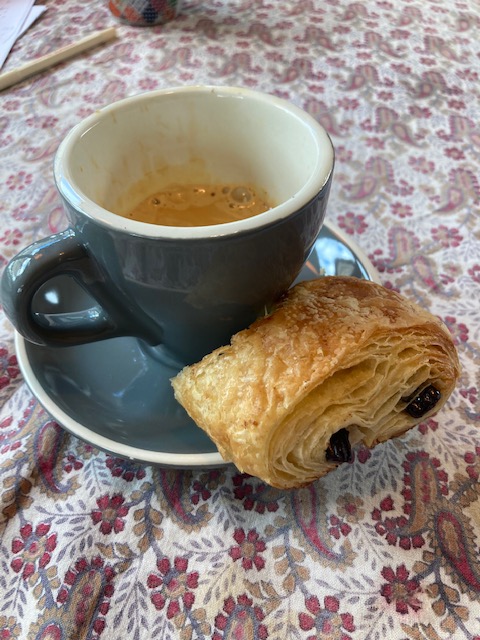
Poetry is like a stream. I woke in the middle of the night and had a thought flash in the dark that I get pulled along poetry currents, and that they might be fierce or gentle, rippled or calm, crisp cold or comfort warm, and sometimes I float and drift and dream, and sometimes I clamber onto a stream boulder and soak up melody and mystery, marvel and the mundane, word dance and human stretch, and it is skin tingle and heart embrace. And it is poetry.
Welcome to Poetry Shelf Cafe and a set of readings by 8 poets to celebrate National Poetry Day. Each poet reads a favourite poem of their own and one by someone else.
Happy National Poetry Day
Arielle Walker
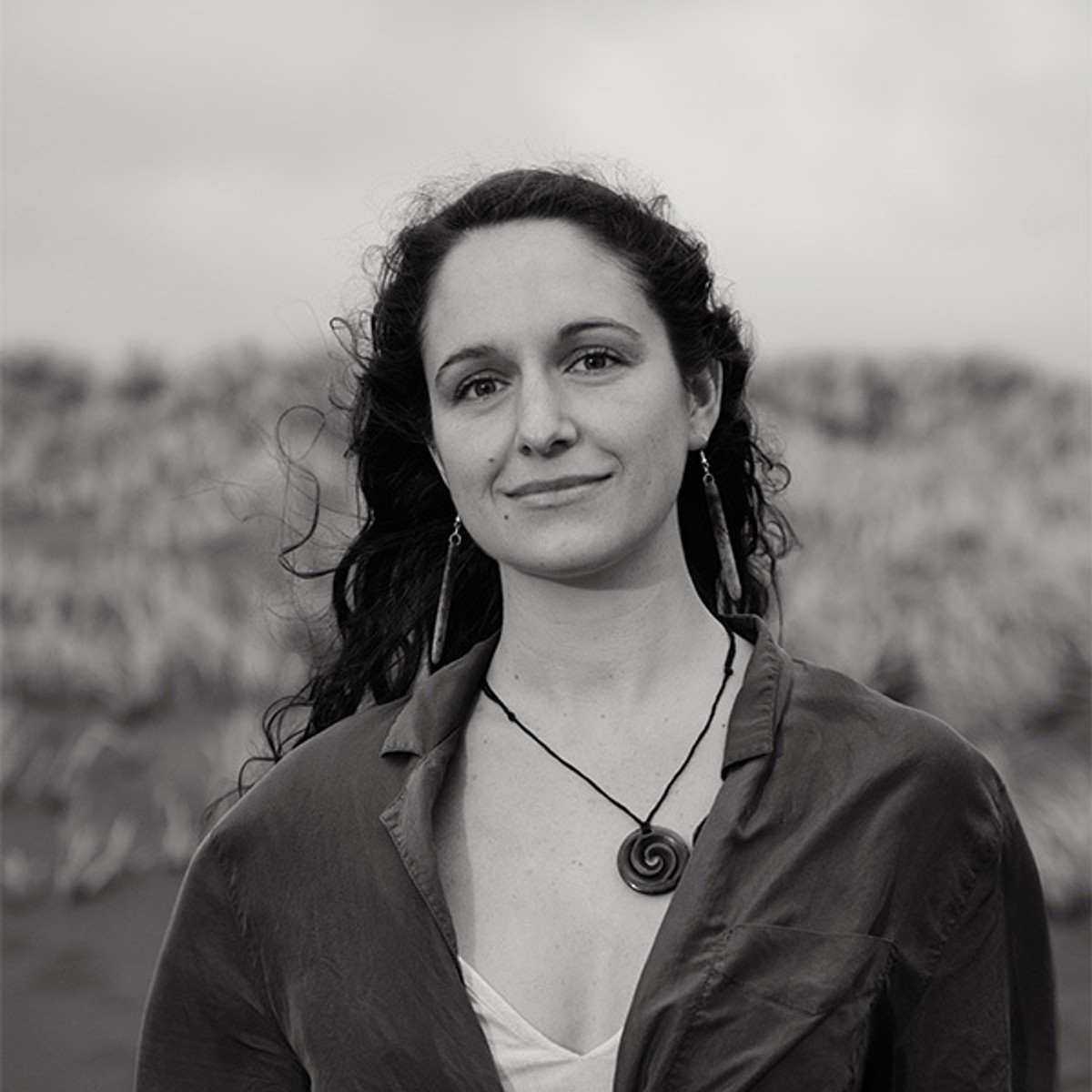
‘Gateway’ by Makyla Curtis from Apertures
hand-printed and hand-bound small print run through her MVA project Folding Time
‘dream futures from a plant beneath your tongue’ by Arielle Walker
from AUP New Poets 9 (Auckland University Press, 2023) and also No Other Place to Stand: An Anthology of Climate Change Poetry from Aotearoa New Zealand (Auckland University Press, 2022)
Each time I tried to write this line “on poetry,” it quickly threatened to become a very long cord instead, a thread, a whole weaving, possibly even a poem, unspooling quickly even though my other (non-poetic) writing has recently felt effortful – and I think that’s what I love most about it: as reader or writer, poetry has always offered me different ways and possibilities into language.
Arielle Walker
Arielle Walker (Taranaki, Ngāruahine, Ngāpuhi, Pākehā) is a Tāmaki Makaurau-based artist, writer, and maker. Her practice seeks pathways towards reciprocal belonging through tactile storytelling and ancestral narratives, weaving in the spaces between. Her first chapbook, river poems, can be found in AUP New Poets 9 (Auckland University Press, 2023), and her poetry can also be found in Stasis Journal, Turbine | Kapohau, Tupuranga Journal, Oscen: Myths, No Other Place to Stand: An Anthology of Climate Change Poetry fromAotearoa New Zealand (Auckland University Press, 2022), and the upcoming anthology Te Awa o Kupu (Penguin Random House, 2023).
Robert Sullivan

‘Tangaroa whariki kiokio’ by Robert Sullivan
from his new collection Hopurangi | Songcatcher (forthcoming from Auckland University Press in 2023).
‘The crash of living things’ by Arihia Latham
from Birdspeak (Anahera, 2023)
Kia ora. Poetry day is a celebration of our many traditions sheltering under the old trees of poetry. When Paula Green asked for a contribution I immediately thought of Arihia Latham’s wonderful new collection Birdspeak and its multiple emotional centres. Her poem “The Crash of Living Things” draws its decolonising energy from the colonisation of forests, spirit, and families. It makes gestures toward the traditions of both tangata whenua and western ideas of prayer, care and literature. I hope you each enjoy the eternally delightful energy of poetry on this great day helped along by Paula’s aroha for this artform. Ngā mihi mahana.
Robert Sullivan
Robert Sullivan (he/him/ia, Kāi Tahu and Ngāpuhi) has won awards for his poetry, editing, and writing for children, including the 2022 Lauris Edmond Memorial Award for a distinguished contribution to New Zealand poetry. Tunui Comet (Auckland University Press, 2022) is his eighth poetry collection. His widely acclaimed book Star Waka (AUP 1999) has been reprinted many times. Hopurangi / Songcatcher is forthcoming from Auckland University Press later this year. Robert’s an Associate Professor at Massey University and coordinates its Master of Creative Writing programme. He is a great fan of all kinds of decolonisation.
Hannah Mettner
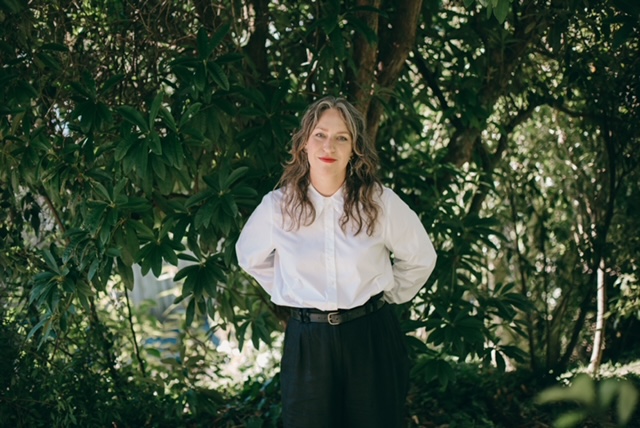
Photo credit: Ebony Lamb
‘after Sissinghurst’ by Morgan Bach
from Middle Youth (Te Herenga Waka University Press, 2023)
‘La bohème’ by Hannah Mettner
from Saga (Te Herenga Waka University Press, 2023)
Sissinghurst is the ‘castle garden’ in England created by Vita Sackville-West, poet and writer (and the inspiration for Virgina Woolf’s character Orlando), and her husband Harold Nicolson, author and diplomat, who were members of the famous ‘Bloomsbury Group’. The couple spent thirty years transforming a farmstead of “squalor and slovenly disorder” into one of the world’s most influential gardens. In her poem, Morgan visits the now heritage listed garden and imagines what that life must’ve been like; to “have hands all day in soil and sap / and all night in words and lovers, / that is the life we want, that we can / no longer pay for.” This stanza hits me in the chest every time I read it because it gets to the very heart of what makes poetry so seductive: the human need for beauty and love and good honest dirt, and the modern affliction of feeling so separated from those things. Of course, Vita and Harold had money; that’s how they were able to live that life. Morgan’s poem doesn’t dwell heavy-handedly on these problems, instead moving on to consider more sensual pleasures, but it leaves the reader questioning: what happens if only those who have money have the time/energy/resources to make art? Do only the well-off get to experience poetry? Are those things we so crave as humans, beauty and love and good honest dirt, the preserve of the rich? Surely that isn’t fair? With this in mind, the poem of my own that I’ve recorded is ‘La bohème’ which is coming at the same questions as Morgan’s in perhaps a less lovely way.
Hannah Mettner
Hannah Mettner is a Wellington-based poet from Gisborne. Her poems have appeared widely in literary journals, including Sport, Turbine and Cordite. With Morgan Bach and Sugar Magnolia Wilson, she is a founding editor of Sweet Mammalian, an online poetry journal launched in 2014. Her first collection, Fully Clothed and So Forgetful, won the 2018 Jessie Mackay Award for Best First Book of Poetry. Her second collection, Saga, was published by Te Herenga Waka University Press in August 2023.
Emma Neale
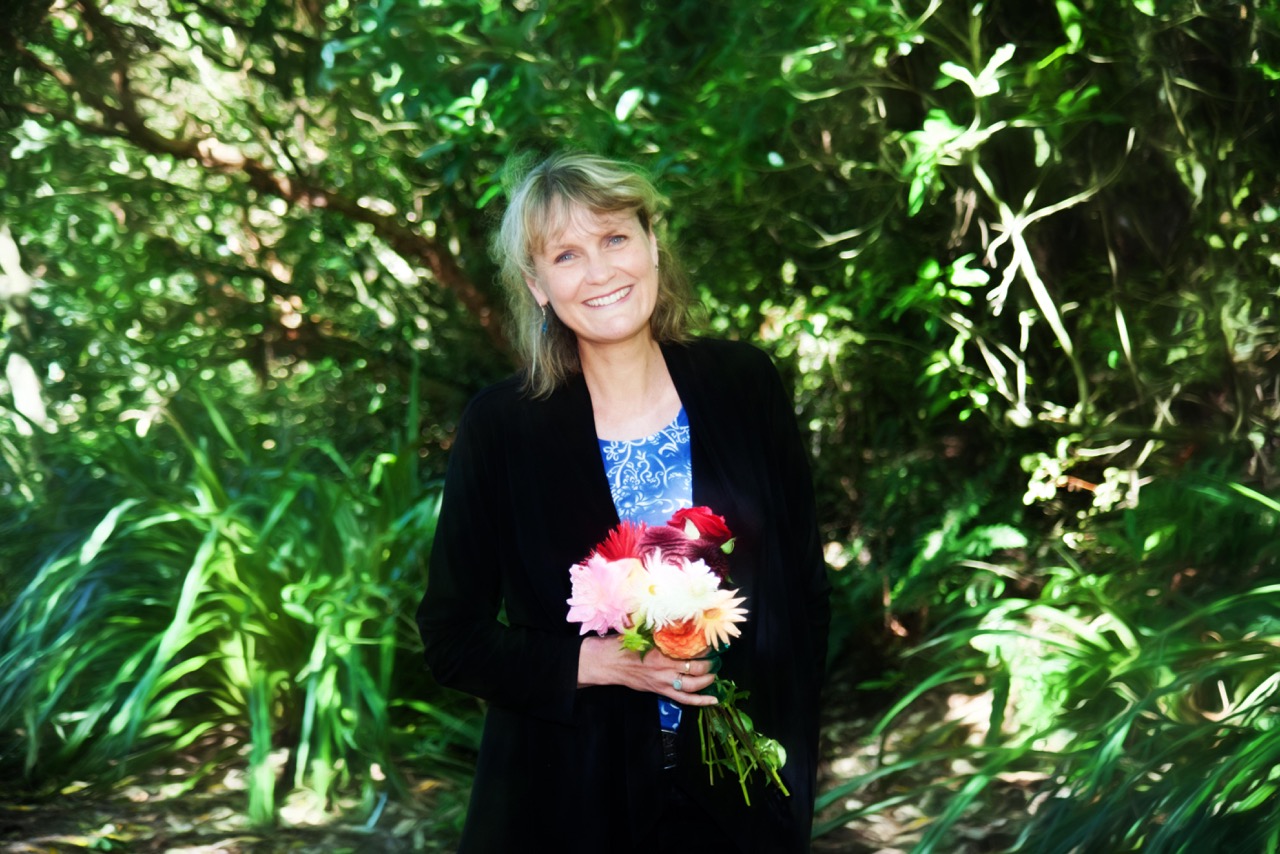
Photo credit: Caroline Davies
‘The Names’ by Lauris Edmond
first appeared in Salt From The North (Oxford University Press, 1980)
‘The Night Shift’ by Emma Neale
first appeared at Adda: Issue 2 : Remember to Rest (Commonwealth Foundation, 2023)
While poetry can be visually, typographically and sonically experimental, and can push the boundaries of language and meaning in multiple ways, I often return to it as a way to find a restorative comfort through the music of voice, and an untangling of complex emotions. Lauris Edmond’s poem ‘The Names’, for example, has a bittersweet seesaw between feelings of deep attachment and the distance that time and geography have wrought between a mother and her children: here there is wistfulness, poignancy, sharp recall and the sense of evolution in relationships, all placed alongside the sense of enduring bonds, despite those changes. My own poem revisits the liminal experience of resurfacing into consciousness after major abdominal surgery. I suppose what both poems might have in common is how they try to reassemble the speaker, or restore memory, after experiences of separation, fragmentation, disintegration of a kind.
Emma Neale
Emma Neale, the author of six collections of poetry and six novels, received the Lauris Edmond Memorial Award for a Distinguished Contribution to New Zealand Poetry in 2020. Her most recent novel, Billy Bird (2016) was short-listed for the Acorn Prize at the Ockham New Zealand Book Awards and long-listed for the Dublin International Literary Award. Her first collection of short stories, The Pink Jumpsuit (Quentin Wilson Publishing, 2021, was also long-listed for the Acorn Prize. She lives in Ōtepoti/Dunedin, New Zealand, where she works as a freelance editor.
Modi Deng

’The River’ by Mark Leidner
from Beauty Was the Case That They Gave Me (Factory Hollow Press, 2011)
‘Lessons’ by Modi Deng
from collection ‘安慰 (an wei)’ in AUP New Poets 8 (Auckland University Press, 2021)
Poetry is so close to me that it is difficult to write about it. As a form to read, it leaves something out, and yet is full and all-consuming. As a form to write in, it is incredibly concentrated and full of unexpected connections. It might reach behind itself and show you something broken when you were expecting an apple. At the heart of it, it is very beautiful and simple and true. It’s difficult to describe…
Modi Deng
Modi Deng is a pianist and writer from Aotearoa New Zealand. Her debut poetry collection was published in AUP New Poets 8. Currently based in Melbourne, her recent works have appeared in Cordite Poetry Review, Starling, Write Together, and on NZ Poetry Shelf. She cares deeply about literature (especially poetry, diaspora), music, psychology, and her family.
Joan Fleming
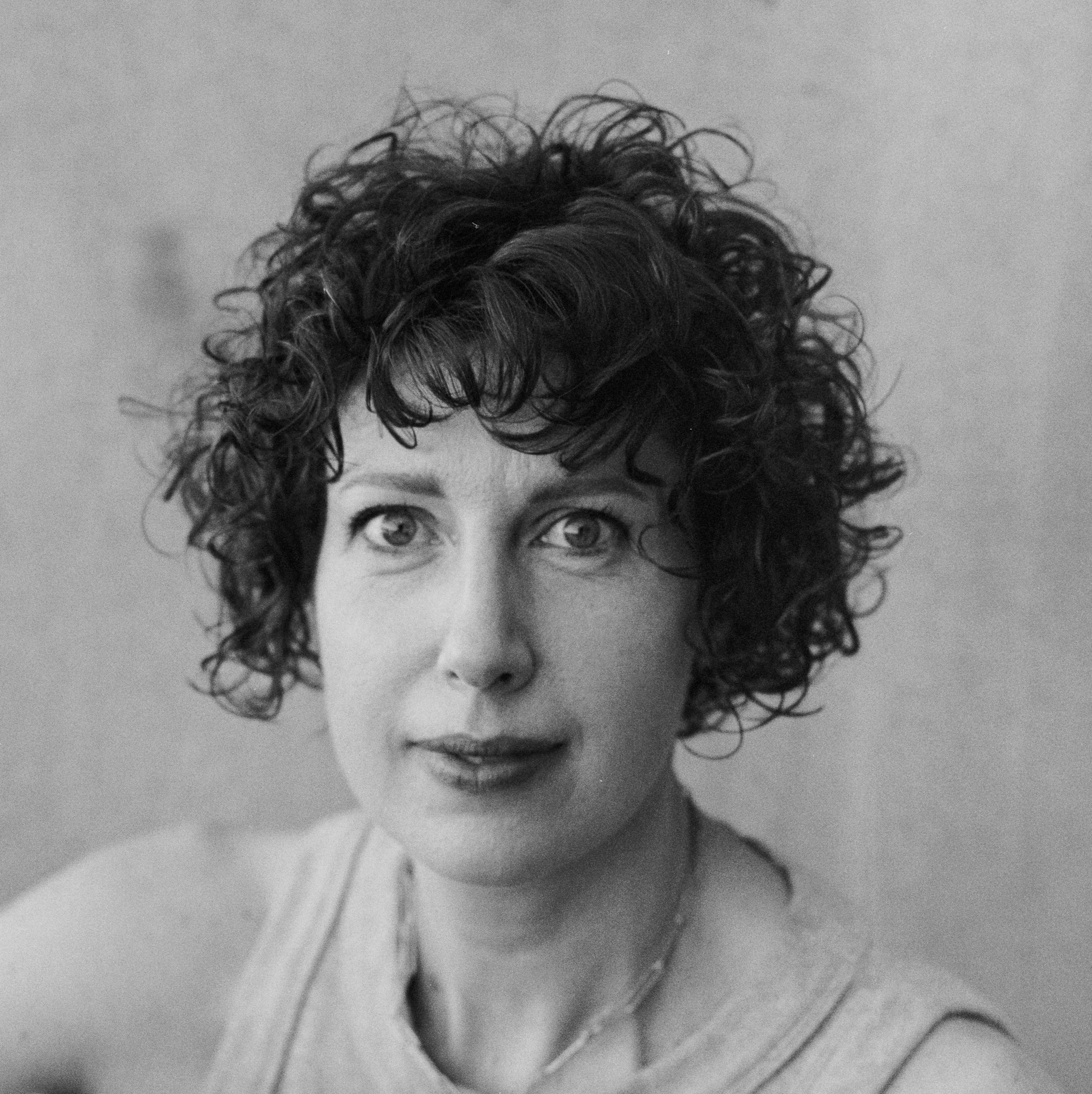
Photo credit: Gerard Starling
‘Glaciers’ by Sarah Jane Barnett
from WORK (Hue & Cry Press, 2015)
‘Coins, Glass, Nails, Pottery, Cinders’ by Joan Fleming
from Australian Book Review, May 2023
I think I still know what poetry is, but I might have forgotten how to do a ‘poem’. These days I’m stuck on the sequence, the hybrid, the poet’s novel. This is why I love Sarah Jane Barnett’s book Work, an undersung triumph of NZ letters. Her sequence work blows me away, as do her exquisite/devastating ecofeminist metaphors. Woman as glacier; woman as geological era. “She melted into deltas / and sinuous lakes” — of course she did.
Joan Fleming
Joan Fleming is the author of three books: The Same as Yes and Failed Love Poems (from THWUP) and the verse novel Song of Less (Cordite Books). Her honours include the Biggs Poetry Prize, the Verge Prize for Poetry, the Harri Jones Memorial Prize from the Hunter Writers’ Centre, a Creative New Zealand writing fellowship, and a residency with the Michael King Writers’ Centre. Her manuscript Dirt was shortlisted for Australia’s richest poetry prize, the Helen Anne Bell Poetry Bequest. She works as a lecturer in Creative Writing at Massey University, and writes about staying awake on the precipice of total ecological shitfuckery.
Vana Manasiádis
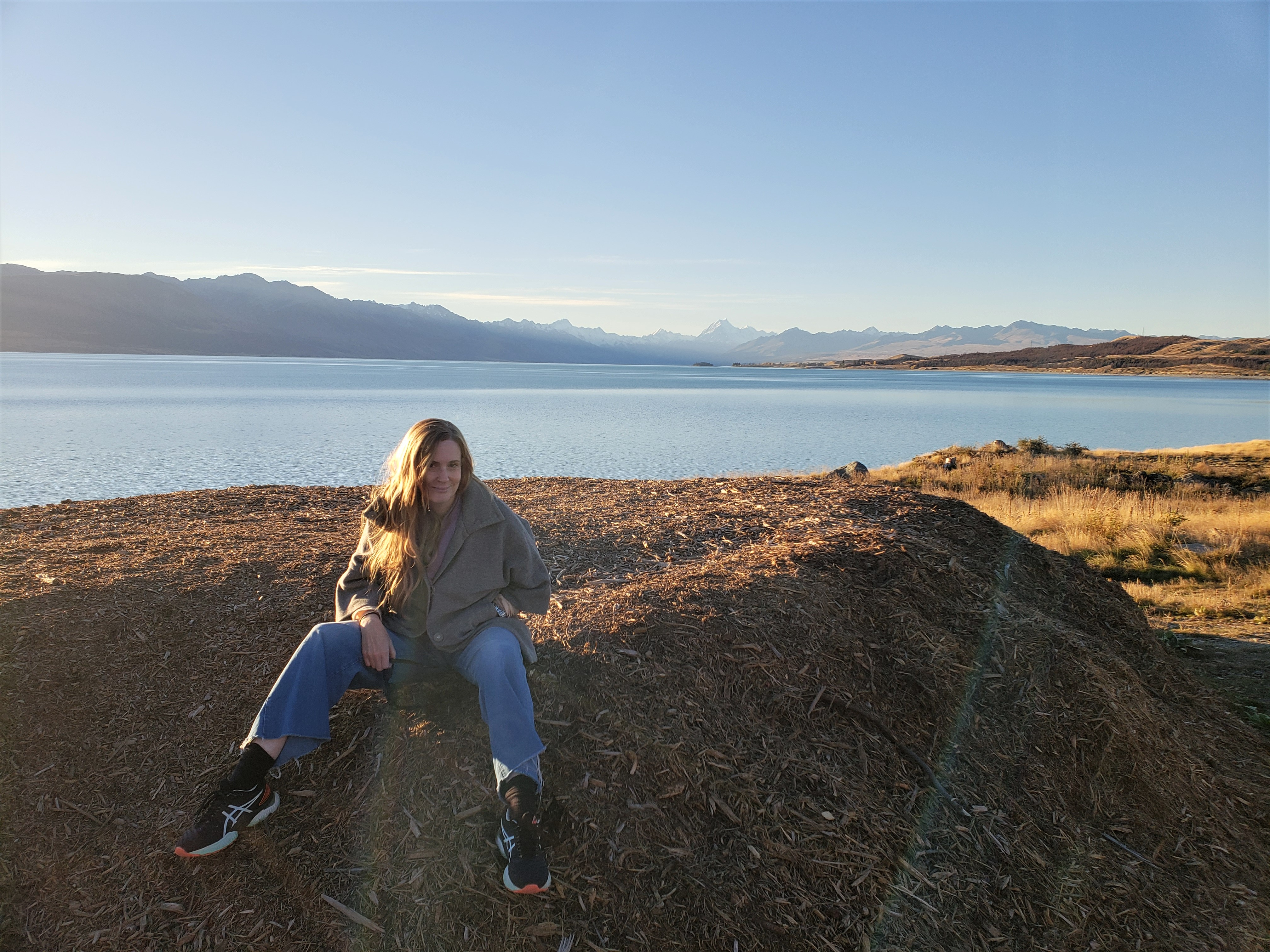
‘How do you keep a civil tongue’ by Vana Manasiádis (the poem is made up of English ‘translations’ of Greek proverbs, and the background reading is the Greek original)
‘Princess Alexandra Amalie of Bavaria (believed she swallowed a grand piano made of glass)’ by Rebecca Palmer
In his poem ‘Duplex’, Jericho Brown says ‘a poem is a gesture towards home’. I’ll say poetry is home. Is garden, body, heat and mess; the meal that someone you love makes you when you really need one.
Vana Manasiádis
Vana Manasiádis | Βάνα Μανασιάδη was raised in Pōneke and Ātene Greece and now lives in Ōtautahi. She is senior lecturer in creative writing at Te Whare Wānanga o Waitaha Canterbury University.
Chris Tse

‘Making a Salad’ by Sudha Rao
from On Elephant’s Shoulders (The Cuba Press, 2022)
‘Portrait of a life’ by Chris Tse
from Super Model Minority (Auckland University Press, 2022)
Last weekend I had the pleasure of being a judge at the second semi-final heat of the Word – The Front Line, a team slam competition in Auckland. Every single word and poem shared that day was imbued with emotion, from joy and rage, to sadness and longing. Something I found so inspiring was how the young poets used poetry to challenge how they are perceived by others (parents, teachers, society, the media) and to take back control of their own narratives. What a privilege it was to listen to their stories and experience first-hand the rapturous response from the audience. These young poets reminded us all that poetry can be a gift, a superpower, a provocation, and a balm – a way to crack upon every question or issue that troubles us to find a way towards light.
Chris Tse
Chris Tse is New Zealand’s Poet Laureate for 2022-24. He is the author of three poetry collections published by Auckland University Press: How to be Dead in a Year of Snakes, HE’S SO MASC, and Super Model Minority (a finalist for the 2023 Lambda Literary Award for Gay Poetry and longlisted for the 2023 Ockham New Zealand Book Awards). He and Emma Barnes edited Out Here: An Anthology of Takatāpui and LGBTQIA+ Writers from Aotearoa.
 NZ Poetry Shelf