Poetry Shelf has felt touch and go this week, as my energy jar slips to tablespoons, with a few early morning appointments, leaving in the pitch dark, watching the light lift in patches, catching sight of the early runners, dog walkers, paddle boarders, swimmers, the traffic at treacle crawl, the rhythm of slow a steady heartbeat. But Poetry Shelf is necessary travel, and it wouldn’t function without your glorious and thoughtful contributions. In the post this week, I was delighted to get Robert Sullivan’s new collection, Hopurangi -Songcatcher (AUP, AUP New Poets 10 ed Anne Kennedy (AUP), Mythos ed Cadence Chung (Wai-te-ata Press) and Madeleine’s Slavick’s Town (The Cuba Press). I was also delighted to see the number of poets appearing in AWF Streetside | Britomart events.
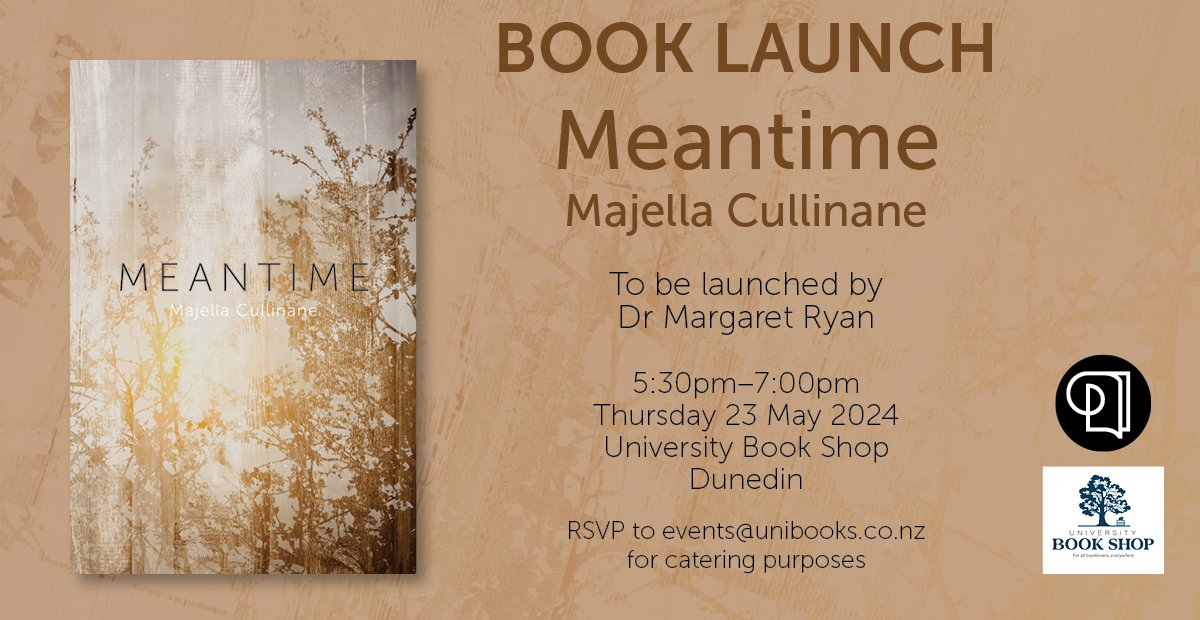
Friday: List poems and a homage to Frances Hodgkins Majella Cullinane book launch (May 23)
Saturday: AWF Streetside – Britomart events with poet poetry link
A poem
Some days I turn from the new books on my desk to the expanse of poetry on the wall shelves. I reach in a choose a book by an author I love, pick a single poem, and then linger between and beyond and within the lines; it is physical, it is elevation, it is the heart beating faster. This week it was Cilla McQueen’s ‘City Notes’ from poeta: selected and new poems (Otago University Press, 2018).
City Notes
How much does the city weigh? The earth beneath it shudders.
Thunderstorm kicking around. They go on making concrete.
Rain’s over – sun, cloud, wet air – magpies, sparrows, parrots: expats.
The land is under concrete, lest it rise. What lies beneath this leafy foreign park?
Inside the whispering fall of a Japanese maple, I spy an Australian lorikeet.
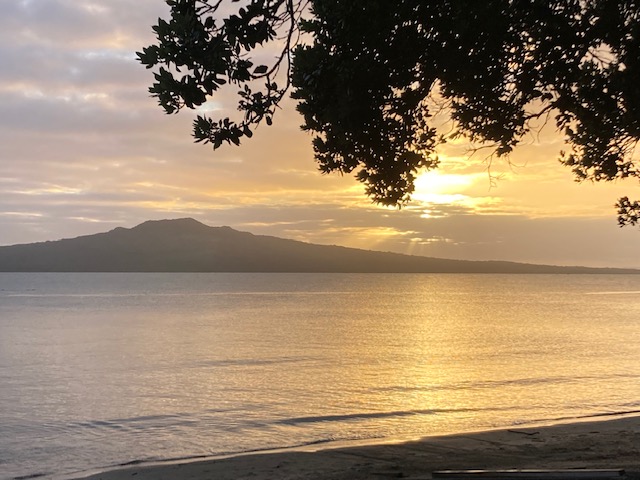
A baby runs full-tilt across the scene. Rangitoto appears remote.
Oh Lord, so remote, it seems of a different timescale.
Cilla McQueen
Poet, teacher and artist CILLA McQUEEN has published 15 collections, three of which have won the New Zealand Book Award for Poetry. Her most recent work is Poeta: selected and new poems (Otago University Press 2018). She has also published a poetic memoir, In a Slant Light (Otago UP, 2016). In 2008 Cilla received an Hon. Litt.D. from the University of Otago, and was the New Zealand National Library Poet Laureate 2009–11. In 2010 she received the Prime Minister’s Award for Literary Achievement in Poetry. Cilla lives and works in the southern port of Motupohue, Bluff.
A musing
I ponder the word ‘weight’ after my sojourn with Cilla’s ‘City Notes’. Musing, dreaming, puzzling. I am wondering how a poem bears weight, delivers weight, dodges weight, describes weight. I am wondering if, along with my current craving for light, weight can also be a source of reward rather than burden. Whether substance and seriousness are as alluring as space and luminosity. My drift-thoughts form a fascinating knot, light and weight become inseparable. A poem might hold a serious thought and then radiate light, a poem might privilege light, but embed weight deep within. Not either or, but a series of conjunctions. Ah. A poem might navigate the weight of the world and in doing so signpost vital rays of hope.
STREETSIDE is our surprising, hilarious, profound, and a little bit wild fringe evening! For one night only, writers, musicians and artists take to the streets of Britomart for an extravaganza of creative shenanigans. From intriguing performers to captivating conversations to enchanting activities, STREETSIDE is for everyone — whether you’re a reader, writer, both, or neither…
It’s fast, it’s fun, and it’s full of surprises. Expect the unexpected and get ready to experience a night of literary mayhem. No ticket or registration required — just turn up and join the ride.
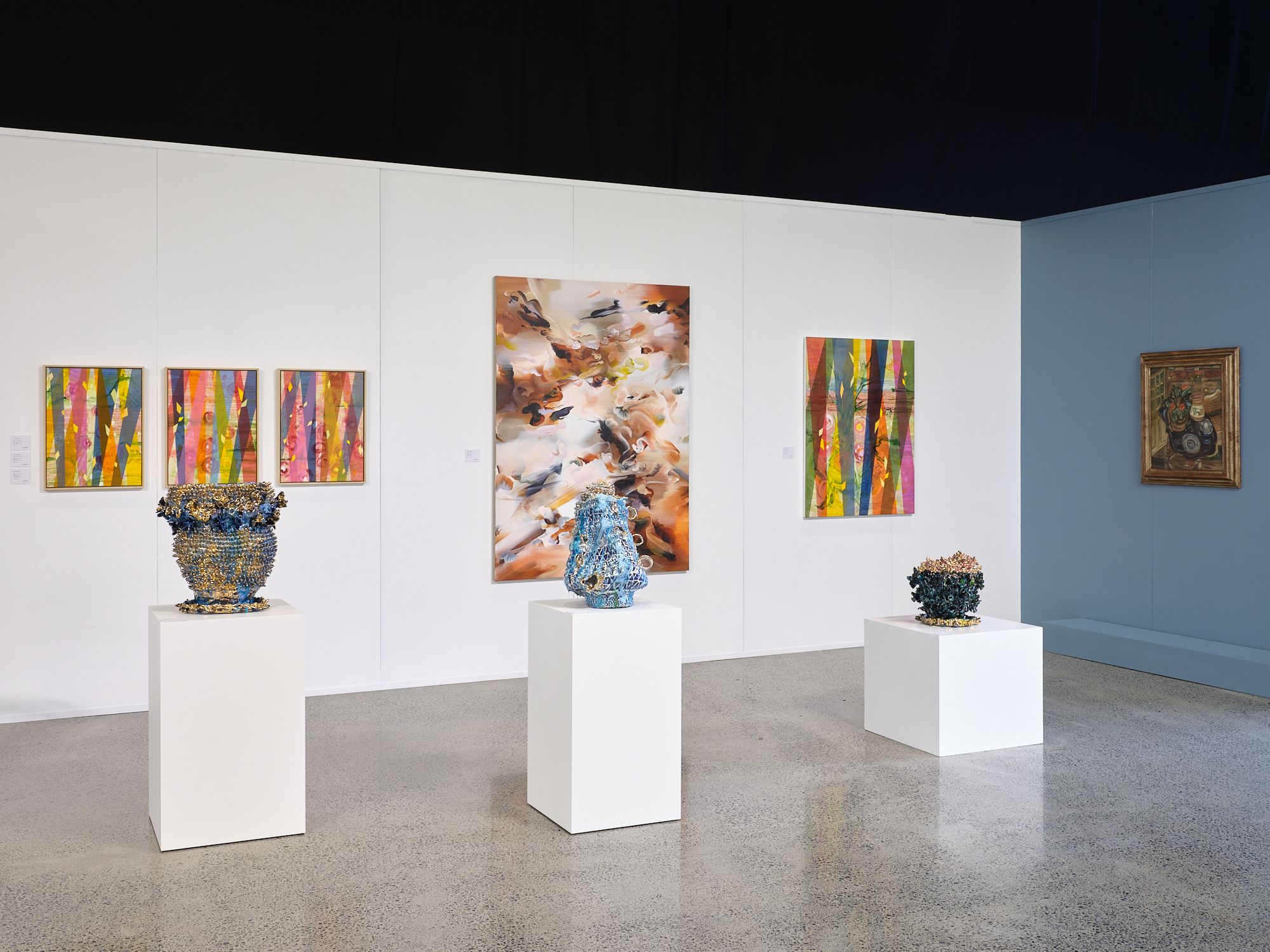
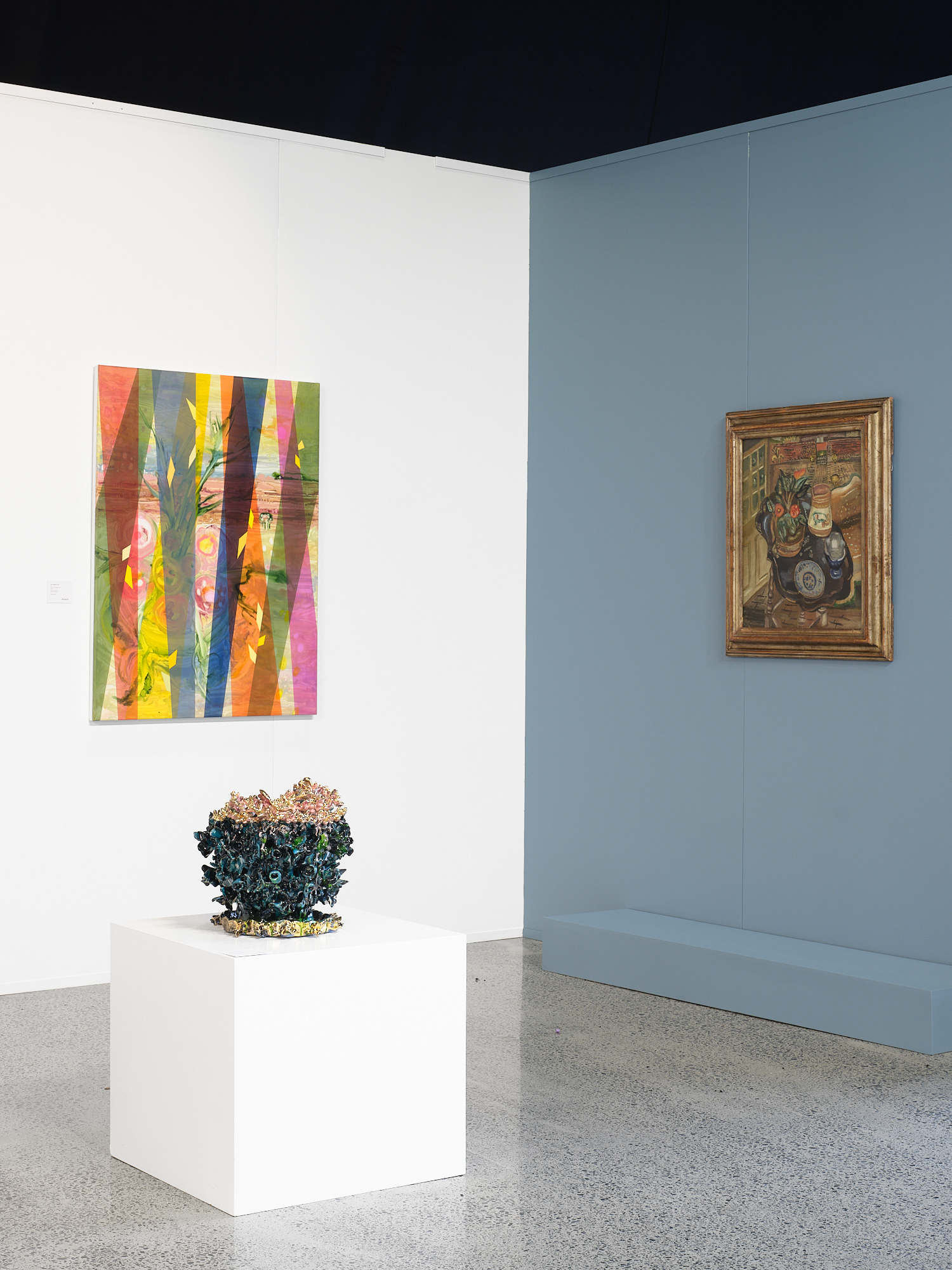
Gow Langsford Gallery booth at Auckland Art Fair 2024
Wings Over Water
Hold the shell to my ear and I hear the life of the hermit crab. Hold the bird to my ear and I hear the waterways and the windmills. Hold the drape to my ear and I hear the treachery of March. Hold the steps to my ears and I hear the blessings of Providence. Hold the vase to my ear and I hear the frugal life and the teeming rain. Hold the water to my ear and I hear the mist and the mud.
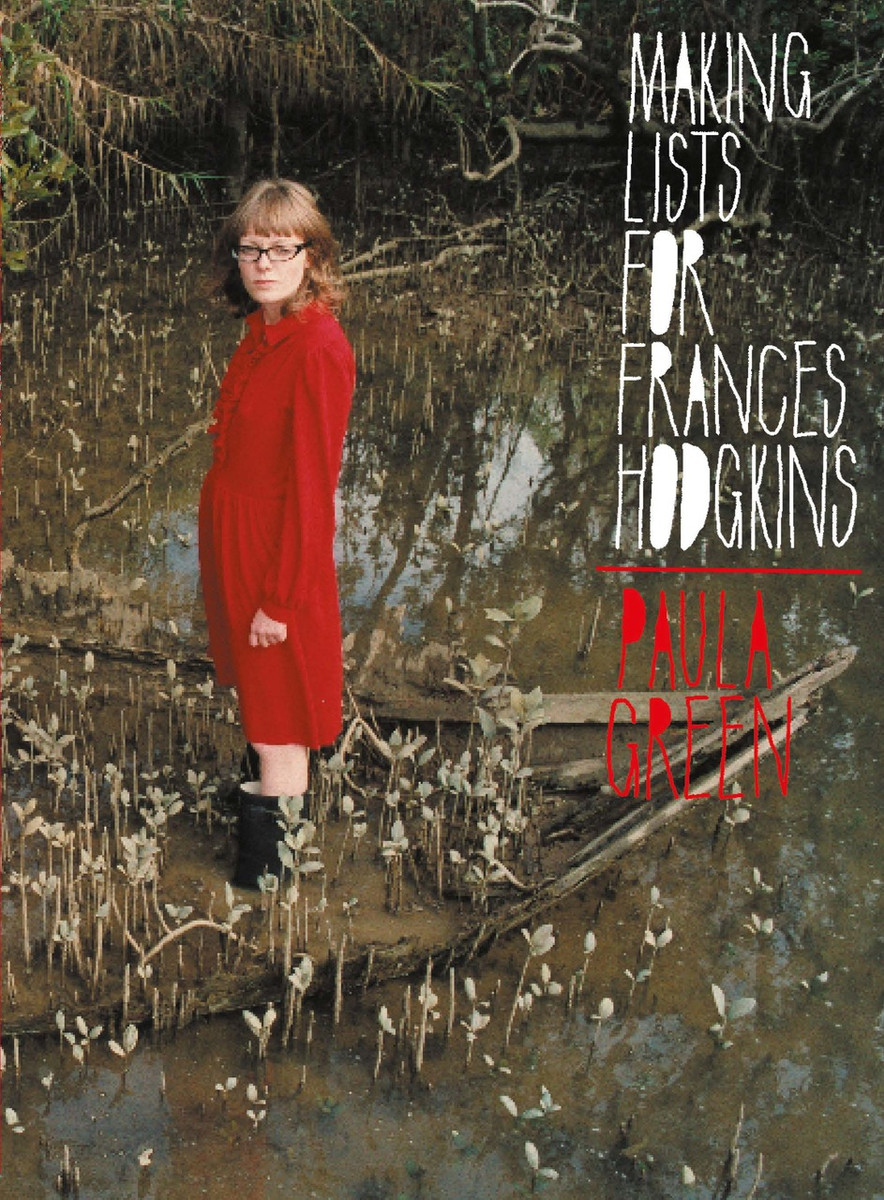
Paula Green from Making Lists for Frances Hodgkins, Auckland University Press, 2007
At the weekend, a Gow Langsford Gallery booth at the Auckland Art Fair featured a 1930s work by Frances Hodgkins, ‘Still Life in Front of Courtyard’. They invited three of their gallery artists – Sara Hughes, Grace Wright and Virginia Leonard – to produce a work in response. I have only seen the works on the gallery website but even on a distancing screen the effect is mesmerising. Three distinct and poignant homages to an extraordinary artist. I list three words in my notebook: vessel, colour, movement. But in the prolonged contemplation, I am moving beyond words to the way – perhaps a little like music – an artwork becomes elevator, suspension bridge, mental and body sway, absolute pleasure.
And then the words simmer and settle.
The still life of Frances Hodgkins, with its sensual curves and earthy colour, is like a charismatic poem that rhymes, pulses, holds the intangible within the physical, and resists any measure to be still. And here I am both transfixed and turning in the intimate moment of looking. Sara Hugh’s homages, equally charismatic, resemble the power of poetry to deliver the physical and the abstract. Overlapping bands of colour and motifs, where definitive meaning dissolves, as flower becomes swirl becomes vase becomes kiss, where the botanical becomes domestic and the domestic is a colour wash of recollection. Ah, the pleasure of looking.
Grace Wright also produces a sublime viewing experience. Again I look at these paintings as poems, with colour harmony and deft rhythms, and then find myself musing on artwork as music – such a vital ingredient of poetry. Is it an oxymoron to say that art triggers music, whether as melody, movement, chords, counterpoints, cadence? I don’t want to explain these sublime paintings, I just feel them, the enigma, the connections, the resonance. Grace’s paintings carry poetic titles: ‘Opening the Way’, ‘Cradle in the Moment’ and ‘Breath of Life’.
I had not seen the work of Virginia Wright before, and it is the perfect addition to this suite. The titles are apt: ‘Still Life with Plate’, ‘Still Life’ and ‘Crochet Legs’. The exquisite works summon the domestic, Frances’ ubiquitous vessels, with intricacy, with the pleasure of colour. They are like miniature poems on a ledge, with undulations of meaning and possibility, with harmonies and textures. Again feeling overrides thinking, feeling settling into drifting thought, the prismatic connections reminiscent of the white space on a poem’s page.
And then the looking shifts and startles.
This is a leap. I am fascinated by how each artwork prompts lists, simmering, shadowy lists, lists that step off from Frances’ still life, that might include lists of things on the table, what I see out my window, every vase in every poem (I begin with Ursula Bethell). Art that might hint or evoke or proclaim, that might reclaim or refresh the feminine, light-up the pioneering women, their painting and writing, their lexicons and grammars, whether literary or visual, without rules and regulations and limitations.
My life is full of lists. A daily list on the kitchen table, weekly lists for Poetry Shelf, shopping lists, dream lists, word lists. List poems. Ah, such a soft spot for reading and writing list poems. In 2006, I wrote a poetry collection called Making Lists for Frances Hodgkins, which I named an autobiography in the light of art. I wrote of the artists in my family tree, my youthful desire to paint, my ongoing pleasure in encountering art of all descriptions and my long and loving relationship with a painter.
Why list poems? I am drawn to the everyday and the ordinary, to the melody of repetition, the enchantment of pattern, the twang of surprise, the delight of humour, endings that swivel, a refrain of awe. Intricacy and economy. Whispers and shouts. The way the found might nestle alongside the imagined. The way myriad stepping stones might offer routes through a cracked maze of myriad things. The way a poem might signpost a shadow list, perhaps evoking memory, daydreams, objects, vistas, the ordinary.
I have selected five poems, gleaned from a solar system of list poems that I have particularly loved, with satisfyingly different approaches. Dinah Hawkens’ ‘Leaf’ is like an incantation, and is part of an awe-inspiring sequence of ‘page leaf stone’ poems. She draws me deep into prolonged contemplation, leaf reverie, poem drifts, to the way I might go full circle, to the way Frances’ vase might be the voice of my grandmother, the sunlight on the kitchen table, Sara’s vase motif, and back to the vase again.
‘Calabash Breakers’ by Selina Tusitala Marsh resonates in her voice as I read, both voice and poem charismatic, with the repeating pattern a form of insistence, a vital signal in these turbulent times, for yes, we need resistance to toeing the line, we need the storytellers, the singers, the artists, the poets. James Brown’s ‘The Time of Your Life’ is a list of adages, sayings so often repeated they can hollow out in meaning, but gathered here, linked by theme, assemble a witty portrait of time. And then, and then I am catapulted into thoughts of this life, this lifeline, this death, this silence . . . and whoosh, I am back at Frances’ vase, and it’s spiked with the uncanny, an emptiness, time passing.
Ashleigh Young, like the other four poets, has crafted lists into several of her poems. I have picked ‘Going rafting with my uncles’, because the list is the spine of her poem, a shadow list poem that is family. First the uncles, physically present, as though I’m holding a family snapshot. And then the poem viewfinder switches to include the mother, pulling her from outside the photo frame, an imagining. And at the acute heart of the poem, the lines that muse on love, the lines that pierce me, every time.
I find myself stalling on the artworks in the booth on numerous occasions, just as I find myself reading and rereading these five poems, refusing to limit them to tidy explanations, to close readings, to conforming to my expectations of what a list poem might do. Arielle Walker’s ‘a poem is a fluid thing all wrapped up in fish skin’ opens out what a poetry can be, how it might need liquid and mountain currents and salt water and fluidity. How it might be tangle and skeleton and swell. And here I go drifting again, musing on how an artwork might be tangle and skeleton and swell. How a poem gains momentum and wonder in the form of a list.
To finish, this sweet week of meander, I have included a second poem from Making Lists for Frances Hodgkins, a poem with a trace of list, a poem that is for me, both love poem and a miniature manifesto on absorbing art and poetry.
Poems
Leaf
Leaf as one of many. Leaf as incredible colour.
Leaf as silence, and silence as a cave and the wall of a cave.
Leaf as an invitation: as a screen to come leafing through.
Leaf as leafy machine. From water and light you have breathable air!
Leaf as a life partner, a moveable feast. Leaf, a soft whisper. Leaf as leaf.
Dinah Hawken from Ocean and Stone, Te Herenga Waka University Press, 2015
Calabash Breakers
we all know the calabash breakers the hinemoas the mauis the younger brother the only sister the orphan the bastard child with rebellious blood
we all know the hierarchies the tapu the boundaries always crossed by someone petulant
we all know the unsettled the trouble makers the calabash breakers they sail the notes of our songs stroke the lines of our stories and reign in the dark hour
we should know them we now need them to catch bigger suns
Selina Tusitala Marsh from fast talkin PI, Auckland University Press, 2009
The Time of Your Life
The turn of the century. The dawn of the decade. The year of the cockerel. The winter of our discontent. The summer of love. The age of Aquarius. The ides of March. The moment of truth. The nick of time. The knell of parting day. The twilight of the gods. The end of an era. The twinkling of an eye. The chance of a lifetime.
A night of it. A term of endearment. A momentary lapse of reason. A fraction of a second. A stitch in time. A minute of silence. An hour of darkness. A day of shame. A period of mourning. A month of Sundays. Oh season of mists . . . Two shakes of a lamb’s tail. Fifteen minutes of fame. One hundred years of solitude.
James Brown from Selected Poems, Te Herenga Waka University Press, 2020, originally published in The Year of the Bicycle, 2006
Going rafting with my uncles
No help comes, and night is closing in on me and my uncles. Some of us dangle our legs in the water –
all of our heels are shaped like mallets, see, or like they’ve been beaten with mallets. Uncle David sits apart, drafting a group email.
Uncle Neil has lost both our oars, and I find myself looking at his hands, his carpenter’s hands from the 70s. How good he was at everything, how tall,
how hungry we were for little cabinets and salad bowls. Uncle John bundles his swanndri around me, the one he goes eeling in. I once saw him kill an eel with a spade
while wearing it. We knew he was going to do it. It’s in how an uncle moves, it’s in how cosy he is, it’s in how you haven’t seen him for eighteen years and may not again,
and I wonder if I love these men – the sort of love that is said to be deep down, like sand that turns into a fish all of a sudden.
Oh someone save us, but do it without speaking. Oh, something happen, something happen – a house with lights on at the corner,
or moonlight, too beautiful to speak of, or rain, or, on a bank, the sound of my mother’s voice saying how glad she is to see us,
how she had to walk for hours through the swamp. Let us see her, holding a little dog in one arm and a video camera in the other.
Ashleigh Young originally published in Turbine | Kapohau 2022
a poem is a fluid thing all wrapped up in fish skin
How can I write a poem that isn’t first a body of water?
How can I write a poem unless its surface is formed from the borrowed skins of seals and salt and seaweed and its blood runs in the swell and roll of waves and moon-pull of tides and its bones are pieced together from the calcified skeletons of a million tiny fish?
I cannot write a poem in a drought
How can I write a poem unless it rolls (a ready-made river) out of the side of a mountain and runs gleefully forward in a rush of eddying currents towards the sea so that all I have to do is hold out a hand to unravel the slightest fraying edge of its fluidity, and spin a new yarn from its depths?
Arielle Walker from her ‘river poems‘ section in AUP New Poets 9, Auckland University Press, 2023
But What Do You See in It?
I see the sun humming or the yellowness of gold and if I could hold your hand we would lie in the gold meadow gilding with words to describe the mountains inside outside in the time you took to collect the hives.
During the Covid-19 pandemic, eighteen thousand uncrossable kilometres lay between poet Majella Cullinane in Aotearoa New Zealand and her mother in Ireland, a distance unbridgeable even by phone as Cullinane’s mother’s language was lost to dementia. Meantime calls and keens across this terrible distance. With attentiveness, tenderness and extraordinary vulnerability, these poems speak directly to personal experience while also addressing a wider world shadowed and altered by illness, where everything once familiar and coherent is disintegrating, in flux, uncertain and strange. These poems are works of vigil and devotion, breathed into existence by a daughter who could not be at the bedside of her beloved, dying parent. Personal and universal in its themes, the poems in Meantime possess a gravitas born of sorrow, steeped in love. A warm and loving conversation about memory and forgetting, and a celebration of the power of voice to connect and heal, this is a collection for our times.
The candle lit for peace flickers I can feel rain on my cheeks
Paula Green
How to mark ANZAC Day on Poetry Shelf when I want to stand on the street with a placard saying PEACE in one hand and a placard saying CEASEFIRE in the other. When I want to pause in this sweet haven in which I live, with its abundance of bush and birds, vegetables and water. When each day delivers small miracles of joy and delight.
And yet each day carries me to the inhumanity of Gaza, the infinite despair, brutality and violence of this godforsaken and utterly unnecessary war. Of all wars, past and present. Local and global. Today I am grateful for all the historians and journalists, fiction writers and poets, documentary and film makers who have exposed the travesty and horror of wars.
So today, I return to the haunting and insistent pain of Bill Manhire’s ‘My World War I Poem’, a poem I have returned to often, with its hope and its aching repetitions. I am reminded, with this poem haunting, of incalculable loss and suffering, of terror and agony and heartbreak. On each occasion of reading, a moment to mourn.
Bill directed me to Keith Sinclair’s ‘The Bomb is Made’, and it felt so very fitting, with its ominous over-and-undercurrents of threat, a finger pausing over the weapon, and the sweet startle of the final word with its semantic ripples. The poem is a repository of repetition, on this occasion both form and subject driven, where for me, the past is fingertapping the present. Again the reading triggers the mourning.
I have included the elegiac voice of Robert Sullivan. In his collection Cassino: City of Martys / Cittā Martire, Robert travels to Italy, to the place his grandfather and so many others battled during World War Two. He travels with a knotty braid of war memories, burial caves, cemeteries, family grief, drawing upon Hone Tuwhare, Dante, Ezra Pound, home soil, whānau. Again the poem, and indeed the entire collection, haunts. Again the reading becomes mourning.
Next Sue Wootton’s ‘War baby’. Again it clings to me long after I finish reading. The notion of concertina time squeezing in and out, the ripple implications and effects of war, it is like my heart is squeezing out melancholic music, a prolonged pain.
I finish with a poem I wrote for my dear sister in law, as we struggled to cope with the tragic news flooding in from Gaza, a poem that is still active in its motivation, an inhumane tragedy that I think of every day at dawn.
Let us work and write and record together for peace.
Five poems for ANZAC Day
MY WORLD WAR I POEM
Inside each trench, the sound of prayer. Inside each prayer, the sound of digging.
Bill Manhire, from Some things to Place inside a Coffin, Te Herenga Waka University Press, 2017
THE BOMB IS MADE
The bomb is made will drop on Rangitoto. Be kind to one another, kiss a little And let love-making imperceptibly Grow inwards from a kiss. I’ve done with soldiering, Though every day my leave-pass may expire.
The bomb is made will drop on Rangitoto. The cell of death is formed that multiplied Will occupy the lung, exclude the air Be kind to one another, kiss a little– The first goodbye might each day last forever.
The bomb is made will drop on Rangitoto. The hand is born that gropes to press the button. The prodigal grey generals conspire To dissipate the birth-right of the Asians. Be kind to one another, kiss a little.
The bomb is made will drop on Rangitoto. The plane that takes off persons in a hurry Is only metaphorically leaving town, So if we linger we will be on time. Be kind to one another, kiss a little.
The bomb is made will drop on Rangitoto. I do not want to see that sun-burned harbour, Islandless as moon, red-skied again, Its tide unblossomed, sifting wastes of ash. Be kind to one another, kiss a little, Our only weapon is this gentleness.
Keith Sinclair, from Moontalk: Poems New and Selected, Auckland University Press 1993
xxxviii. Songs
Singing through the flashes and tracer fire singing through the bombs and roaring propellers singing for the Shermans crossing the Bailey bridges singing the Māori Battalion song singing of the farms and the whānau singing out praise for their country singing like Orpheus so the rocks and trees followed them from home
Robert Sullivan, from Cassino: City of Martys / Cittā Martire, Huia Publishers, 2010
War baby
War’s rationing and war’s dread live on behind the fruit bowl and the hogget and the bread. Time’s a concertina with doodlebugs and sirens in its pleats, and when it’s squeezed it folds her in too tight: it requisitions happiness; carpet-bombs delights.
Sue Wootton, from By Birdlight, Steele Roberts, 2011
Speak the Mountain
for dear Banu
There is a mountain There is a river There is a lake
Hold the weeping child to heart Hold the thirsty and the wounded to heart Hold the dead and the fearful also to heart Hold the rubble home and the broken bones
We speak the despairing mountain We speak the blood river We speak the grief lake
Marching peace Marching heart Marching out
There is a mountain There is a river There is a lake
Plastic, Stacey Teague, Te Herenga Waka University Press, 2024
I count every maunga I can see: Mt Albert, Mt Eden, Mt Roskill, One Tree Hill. Growing up, we never learnt their Māori names: Ōwairaka, Maungawhau, Puketāpapa, Maungakiekie. There is erasure in the naming and not- naming.
I catch my foot on the nail on the deck, again. Hop downstairs to see my parents, and slump into their blue and yellow couch. When I left New Zealand in my early twenties, I couldn’t wait to disappear. I didn’t want to see my past in everything. Each time I came home I wanted to escape again.
This time, I have anchors.
from ‘ANCHORS’ in ‘Hoki’
Poetry is sustenance at the moment, for all kinds of reasons. I have been musing on how to review books, and don’t even think ‘review’ is the right word for what I do, unless it is a matter of re-seeing a book in new lights, personal lights, surprising lights.
I think of a poetry collection as a thicket – with clearings and growth, light streaks and shadows, memory provoking, sense activating, offering multiple reading pathways. I don’t want to carry a yardstick with me, or prattle on about what a poetry collection ought to do or does not do. I loathe reviews like that. I want to read a review that shines light on potential tracks of reading, on electric connections, whether leading to economy or rich complexity.
Stacey Teague’s new poetry collection, Plastic, with its beautiful cover by Sarah McNeil, is a compelling thicket to linger in, for so many reasons. It is personal, love-imbued, connecting. The poems have roots in family, place, navigations of home and, as Stacey contemplates who she is, her bones and her ancestors, she reaches out to te ao Māori.
I am mindful that for many of us who write poetry, we don’t write in a vacuum, we write within the captivating threads of the work of others, communities of poetic voices, styles, ideas, forms, choices. Stacey acknowledges this with poems that step off from the work of or are dedicated to: essa may ranapiri, Anahera Gildea, Talia Marshall, Kaveh Akbar, Jack Underwood, Mary Oliver, Sappho.
] ] I read Sappho ]she tells me to become a voice ] ] so I do ]I am
from ‘ode to Sappho’
The poems are prismatic in form – can I say this? You move from prose poem to concrete poem or couplets, from list poem to a poem with right-hand brackets hugging the left-hand margin, from slashes syncopating the flow to sweet stream currents. Six sections, along with an introductory poem, include three spell poem clusters, and an ongoing and deep attachment to women and Goddesses. I am thinking of Papatuanuku, Hine-nui-te-iwaiwa, Kurangaituku, her grandmother (Narn), her aunty, to the women in the photographs on the walls, the poet Sappho.
The poems are exquisitely present. How to be present in the world, intimately, vitally? This is what I feel as I read. How to be present in the poem, step by step, word by lovingly placed word, revelation by revelation? This is also what I feel as I read. When the poet returns home and stays in the spare room, she retrieves things from the memory box to make the space her own, to recognise herself. And yet linked to this, so very linked to this are the conjunctions of disappearance and appearance, whether overseas, in erasure or ‘the sound of nothing’.
The casting of spells, like forms of recipes, perhaps even mantras, heighten the effect of slow meditation. There are 19 spells, including ‘to divert love from one object another’, ‘to heal an unseen wound’, ‘to gain courage’, ‘to erase and replace’, ‘to carve out space’ and a spell ‘for self-compassion’. They establish little epiphanies as I read, as I seek space and courage and my own self-recognition.
I have jotted down so many lines I want to quote to you, in order to share the heart-rich rewards of this glorious book. This is a book to pack an overnight bag for, to sojourn within and beyond, to reflect upon and to re-emerge nourished. I am wondering if poetry can also be an amulet that protects ‘the hearts pulses’. I love it.
spell to gain courage
love wide-open against the natural framework / sinking always across phenomena / shift the form and work the despair until it is hollow / when you can’t see through the fear / you have to reclaim your structure / rearrange the text until / you can see yourself there in it /
Stacey Teague (Ngāti Maniapoto/Ngāpuhi) is a poet, publisher, editor and teacher. She is the author of the poetry collection takahē (Scrambler Books, 2014) and two chapbooks: not a casual solitude (Ghost City Press, 2016) and hoki mai (If a Leaf Falls Press, 2020). She is currently a publisher and editor at Tender Press. She is the former poetry editor for Scum Mag and Awa Wahine. In 2019 she completed an MA in Creative Writing at the International Institute of Modern Letters.
Miriam Sharland, Palmerston North City Library, Bruce McKenzie Booksellers and Otago University Press warmly invite you to the launch of Heart Stood Still by Miriam Sharland. To be launched by Ingrid Horrocks.
6:00pm–7:30pm Thursday 9 May 2024 Mezzanine Floor, Palmerston North City Library
All welcome! Please RSVP to publicity@otago.ac.nz for catering purposes
ABOUT THE BOOK: Miriam Sharland’s eco-memoir Heart Stood Still is the latest title in the Ka Haea Te Ata series from Otago University Press, a series dedicated to casting light on issues of importance in Aotearoa today.
In early 2020 Sharland was nearing the end of a 17-year adventure in Aotearoa. A desire to return to family and the familiar was pulling her back to her homeland, England. When Covid put an end to her travel plans, she found herself facing isolation in Manawatū instead.
Despite her initial unhappiness, Sharland came to see this strange and unexpected time as a gift – an opportunity to explore the natural beauty of the home she’d known for many years but had not fully seen or appreciated. Her explorations were grounding, and she began to examine what it means to truly ‘belong.’
Heart Stood Still is a record of Sharland’s journey towards finding healing in the world’s natural beauty, a beauty that we must fight to protect in the current climate crisis. It is both a memoir and a lyrical portrait of Manawatū. Through a series of personal essays that follow the pattern of the seasons, Sharland skilfully weaves reflections on her life and family history with observations on the native and introduced plants and animals about her; all tinged with her experience as ‘an unsettled settler’ in Aotearoa.
ABOUT THE AUTHOR: Miriam Sharland is a writer and editor focusing on creative non-fiction, travel, biography/memoir and natural history. Based in England and Aotearoa New Zealand, her essays, reviews and features have appeared in numerous books, journals, magazines and newspapers, and online. These include Reader’s Digest, The Dark Mountain Project, The Dominion Post, Headland and Adventure Travel. In 2021 she was awarded a writing grant from the Earle Creativity Trust and in 2022 she was runner-up in the New Zealand Society of Authors Central Districts summer essay competition. Heart Stood Still is her first book.
To celebrate the inclusion of At the Point of Seeing by Megan Kitching (Otago University Press, 2023) on the Ockham NZ Book Award Poetry short list, I am reposting a reading Megan did for Poetry Shelf from her collection and the review I wrote. Megan’s terrific collection is a book to be celebrated indeed. The awards will be announced at an Auckland Writers Festival Event on May 15th.
The reading
‘Headlands’
‘Crematorium’
‘Houseplants’
Megan Kitching, At the Point of Seeing, Otago University Press, 2023
The poem
The Inlet’s Shore flat and prosey — marginalia in a book of poems
Two chevroned feathers from a paradise duck’s breast caught on knitted turf so smooth they wafted into my fingers.
Their carpet was of water pimpernel beside the glasswort groves along the inlet’s shore woven with shells and mellow seagrass.
Flat, it was, manytoned drabs of sand, gleam and sun-shot emerald marching in low drones to the dunes and distant hills.
Under a milky light, pied birds went about stooped, gleaning the speckled field; others hung dark on the band of the sea.
In that wavering horizon, where the merest snag loomed I found a dull, sedate beauty, an abundance of swans.
Yes, despite the red fire flush tipping the succulent wort and a stilt’s elegant flight the marsh was flat, almost poetry.
Megan Kitching from At the Point of Seeing
The review
Once, when I asked a boy from Hong Kong what new things he’d seen here,
he answered, ‘the moon’.
from ‘Dark Skies’
Megan Kitching’s debut collection, At the Point of Seeing, as the title so aptly suggests, is a book of observation, a handbook on slowing down to see the world. Reading Megan’s poetry splinters immunity to the daily view, the window vista, the routine route. Looking becomes poetry and poetry becomes a source of fascination, nuances, wonder. It might be poetry as contemplation, whether reading or writing, and in that contemplation, in that slow and steady homage to the physical world we inhabit, we are returned to its beauty. In this time of unbearable inhumanity, planet selfishness, personal profit, ugly behaviour, At the Point of Seeing, is a reminder of hope.
In ‘Volcanic Harbour’, the speaker might “sit on a stone and let time work”. I become participant as I too find a “stone” to sit on, and let the poetry work along with time. I move from shells in a museum, to pūhā musings, to a rounded hill, the prevailing wind, horses in a paddock, an albatross curving, muslin rain, macrocarpa that “claw the sky”.
Megan is deft with words. I am trying to think of a poet who achieves such surprise and wonder on the line. Perhaps Emma Neale, perhaps Bill Manhire, Bernadette Hall. So often the next word is not the expected word, it takes me by surprise and that is reading delight. It might be adjective, verb, image evoked, trope. And that is in itself a performance of the awe of seeing through word selections. The way the albatross arc catches our breath, the crawling bee mesmerises.
A morning rain of muslin, hardly there except in the pinprick flicker, a thickening of the air.
from ‘Mornington
I also read this sumptuous collection as musical sound track, and again it produces wonder, delight, sonic surprise. It is a sweetly mixed playlist as we move from assonance, to rhyme, near rhyme, alliteration, aural dip and lift and slide. It is writing on the wire. It is scoring the world, it is intricate melody, it is open tuning.
Ah. I am pitching this book to you, when against all odds, poetry is a lifeline, the source of joy, the connecting force, the point of contemplation. We are at the point of seeing, we are at the point of speaking, sharing, hoping, and poetry such as this, poetry as good as this, makes all the difference.
Paula Green, originally posted November 2023
Megan Kitching was born in Tāmaki Makarau Auckland and now lives in Ōtepoti Dunedin. She holds a PhD in English Literature from Queen Mary University, London, looking at the influence of the natural sciences on eighteenth-century poetry. She has taught English and creative writing in the UK and at the University of Otago. Her poetry has appeared in The Frogmore Papers (UK), takahē, Poetry New Zealand, and Landfall. “The horses,” published in takahē 95, was nominated for Best Small Fictions 2020. In 2021, she was the inaugural Caselberg Trust Elizabeth Brooke-Carr Emerging Writer Resident. At the Point of Seeing is her debut collection.
His fiction is uncompromisingly experimental his book Ghost Stories
may well be his most accessible I was a bit disconcerted to find that
‘uncompromisingly experimental’ line in my publisher’s write-up on Facebook
tired of airport books? bored by Tom Clancy and Dan Brown? wearied by puerile web sites?
seeking a challenge? try a “novel” by Dr Jack Ross said Michael Morrissey
a few years further back à propos of The Imaginary Museum of Atlantis
it’s hard to remember why I felt it so necessary to print half the pages upside down
it certainly caused pain to the printers who had to redo the whole first run
I suppose it was just that the first time I picked up a book
with half its pages in Farsi hand-drawn dream maps
and diagrams of the compound where the ‘action’ was feigned to take place
it gave me a kick like I just can’t describe after that
texts within texts print windows surrounded by pictures
concrete poems imbedded like plums in Jack Horner’s pie
were all that attracted me but passion dies and the puritan fervour falls away
till you find yourself left-siding everything because you’re so much more interested
in what you’re saying than how to say it and the need for such scaffolding
seems lost like left luggage in an old train station where the ghosts of ambition
have gone to rest
Jack Ross
Jack Ross is the author of six poetry collections, four novels, and four books of short fiction. His latest book of short stories, Haunts, is due out from Lasavia Publishing later this year. He lives with his wife, crafter and art-writer Bronwyn Lloyd, on Auckland’s North Shore, and blogs here. https://mairangibay.blogspot.com/
I am inventing my weekly newsletter as I go. It will include links to the posts from the week, a particular musing (this week the NZ Poet Laureate role), and a poem that has struck me. This week it is a poem by Vaughan Rapatahana that I had missed when I was offline for four months. It haunted me this week, especially as I have been assembling the tribute gathering for John Allison. I am keen to post a poem from a new collection that catches me – but poetry charisma might surprise from anywhere. My recovery road is rocky and challenging at times, and my energy jar miniature, but doing the blog is nourishing. I cannot manage an open submission policy for poems, but I welcome books from publishers.
Tuesday: Ockham NZ Book Award Feature: Bill Nelson
Wednesday: Review of Wok Hei – recipes in the year of the Wood Dragon
Thursday: Thoughts on Ursula Bethell’s ‘October Morning’
Friday: A tribute for John Allison with readings, poems, photographs, homages Launch for Manuali’i by Rex Letoa Paget, Saufo’i Press
A poem
Now that I am dying
now that I am dying it’s probably best you learn from me.
please do not credence gossips, ghouls, gainsayers & their inevitable ostensions about what I was, what I felt.
now that I am dying, it’s waaaay past time to avow my aroha for you.
mahal kita.
please, now let me pass in peace.
[mahal kita – I love you – Tagalog]
Vaughan Rapatahana
Vaughan Rapatahana (Te Ātiawa, Ngāti Te Whiti) is a poet, novelist, writer and anthologist. With David Eggleton, he has co-edited Katūīvei: Contemporary Pasifika poetry from Aotearoa New Zealand (Massey University Press, 2024). With Trevor M Landers and consultant editor, Ngauru Rawiri, Vaughan has co-edited Ngā Pūrehu Kapohau: A literary homage to Pātea, Waverley, and Waitōtara (Lasavia Publishing, 2024).
A weekly musing: The Poet Laureate
Song
For the first time in a long time there is sun making sunshine, the heart sings which was once sighing, for the first time in a long time.
Now the world is the world without trying: the line releases the next line and the next line, the next line — for the first time, for the first time,
Bill Manhire, from What to Call Your Child, Godwit Press, 1999
I have been musing on how vital the NZ Poet Laureate role has been over the past decades, and how with all the current cuts and losses, I hope the role continues.
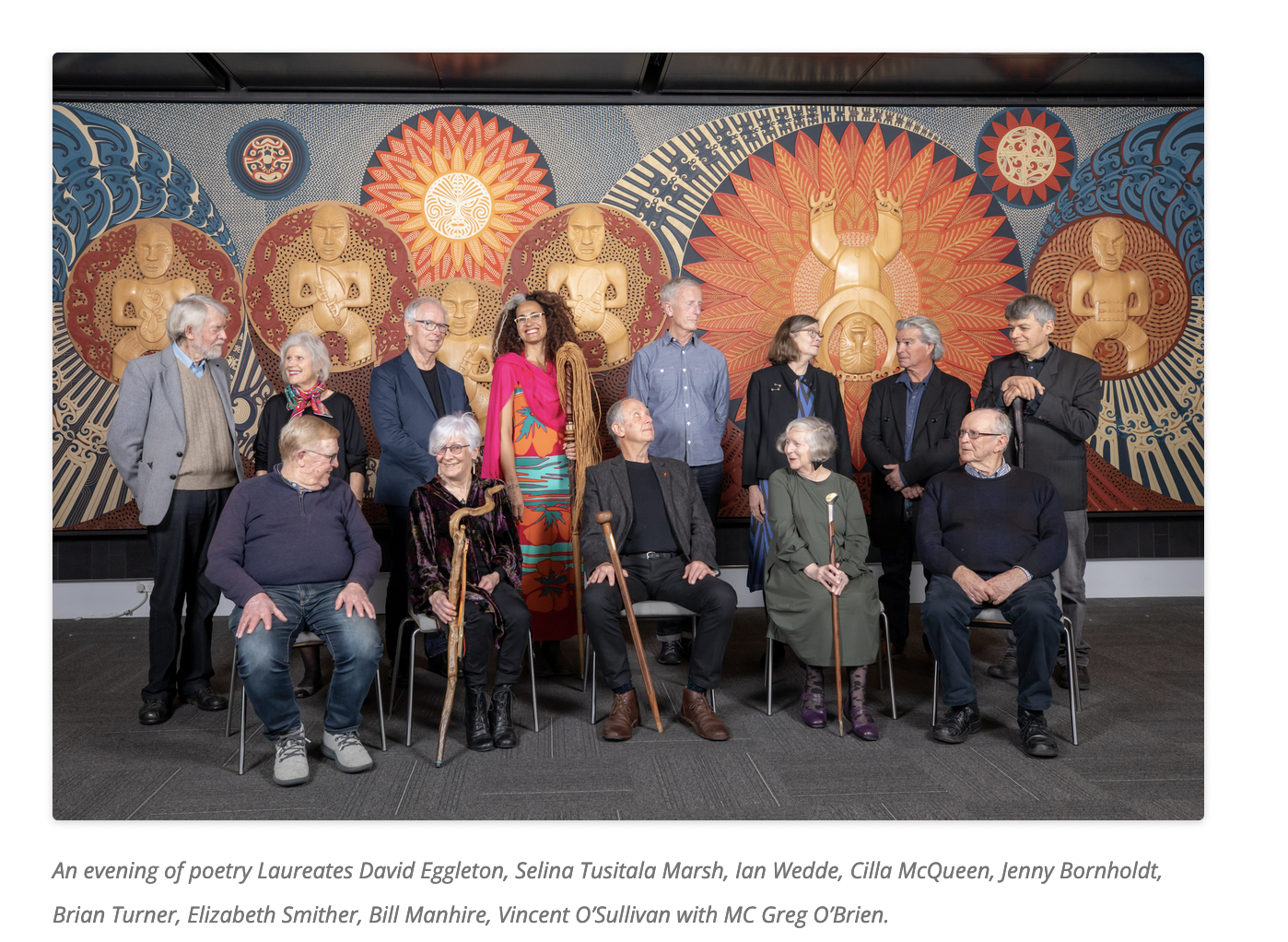
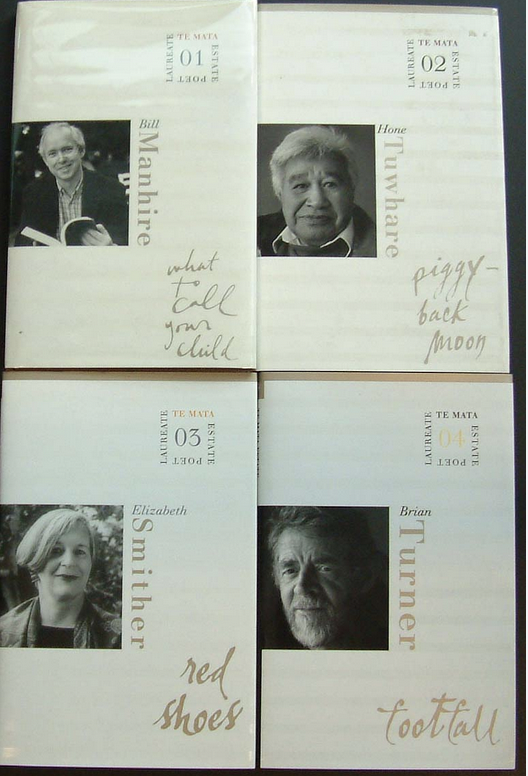
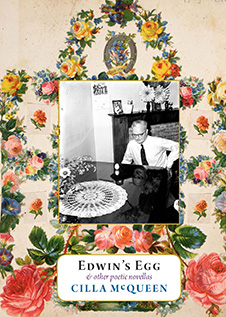
In June 2007, The National Library of New Zealand took over the administration and funding of the New Zealand Poet Laureate Award from Te Mata Estate Winery, with diligent nurturing from poetry enthusiast Peter Ireland. When I look back over the list of Poets Laureate I am reminded how each person has made the role their own, whether in a Laureate collection they penned, posts they have published on the National Library Laureate blog, events they have hosted, workshops they have run with both children and adults. Selina Tusitala Marsh,a charismatic performer on page and live, particularly inspired young writers across the motu, especially the Pasifika community. David Eggleton, also a charismatic performer, took to the road with infectious poetry energy and published a collected works. that catches his live charisma. Michele Leggott had us drawing poems on pavements, reciting reading and loving poetry in all nooks and corners, and also published a sublime collection (as did many others). Vincent O’Sullivan shared the blog space with other poets, Cilla McQueen used the blog to post Serial, a novella inspired by images in the National Library collection that was then published as a darling boxed set (see image below), Chris Tse, our current Laureate, is hosting events, carrying out workshops, promoting the pleasure of poetry widely. I sang his praises last week.
Each Laureate has received a generous stipend, some Te Mata wine, and a tokotoko especially carved for them by master carver Jacob Scott. The new Laureate is celebrated with the tokotoko, food, warm welcomes, invited friends and family, poetry readings over a weekend at Matahiwi marae near Clive in Hawkes Bay. NZ Poet Laureate blog.
But I turn to the inaugural Poet Laureate, Bill Manhire, who accepted the role and continued his stellar advocacy for poetry written, published and performed in Aotearoa. And of course wrote terrific poems, some of which appeared in the inaugural Laureate collection (What to call Your Child, Godwit, Random House, 1999). I invited Bill to share some thoughts on the Poet Laureate role, and have also included a list of the Poets Laureate to date.
Today I toast our fabulous Poets Laureate.
Te Mata Estate Winery Poets Laureate:
Bill Manhire
Hone Tuwhare
Elizabeth Smither
Brian Turner
Jenny Bornholdt
New Zealand Poets Laureate:
Michele Leggott
Cilla McQueen
Ian Wedde
Vincent O’Sullivan
CK Stead
Selina Tusitala Marsh
David Eggleton
Chris Tse
A Poet Laureate
It must have been some time in 1996 when Brian Phillips got in touch to ask if we could have a drink to discuss a project he had in mind. Brian was a well-known figure in the New Zealand book trade. At the time he was co-owner of Godwit Press, and would soon be managing drector of Random House NZ. Also at the pub, when I got there, was the wine writer Keith Stewart who – at that time, I think – had been advising Te Mata Estate on ways in which they could mark their approaching centenary. Brian and Keith wondered if I could give them some informal feedback on a proposal that Te Mata establish and fund a Poet Laureate position in New Zealand. I don’t recall the details of the discussion, but I know that at that time the plan was for a one-year appointment, and there was a notion that Godwit would publish a collection of the laureate’s work at the end of their term. Te Mata would supply a small honorarium and a crate of wine, a sort of equivalent of the English butt of sack. I was positive about the idea, and no doubt in some respects fairly opinionated. For example, I told them that it would be great to give New Zealand poetry a public dimension of this sort, but the silliest thing about the UK Laureate scheme was the expectation that poems be written to mark the births and deaths of the British Royal Family. I hoped that anything like that would be ruled out. Maybe it was at that point that they interrupted my flow and said that they had got me there under false pretences. The chief thing they wanted to know was whether I would be willing to accept the position if John Buck of Te Mata Estate were to ring me up about it.
I suspect they had had me in mind because I was fairly well known as someone who was good at talking poetry up in various ways. I had started doing regular conversations about poetry with Kim Hill on RNZ’s Nine to Noon show, and was contributing a monthly column to the bookstore magazine Quote Unquote. Among other things, I’d published a prizewinning anthology 100 New Zealand Poems with Godwit in 1993; and had helped bring Laura’s Poems into the world in 1995. There was also the creative writing course at Victoria. So I was a well published poet, but I was also known as a teacher and poetry advocate – and there was an expectation that writing and advocating would both be important elements in the laureate position. The thing was to be a kind of cultural ambassador, finding ways to make the wider public aware of just how good New Zealand poetry was. I don’t think anyone at any point saw the laureateship as a reward for long service.
Anyway – surprise, surprise – I said yes. Before I had even started, the appointment became a two-year one – partly because very few poets could produce a book good enough for publication in the space of twelve months. For me, the tokotoko, carved by Jacob Scott, was the most astonishing and distinctive thing – far more than the honorarium ($2,000?) or even the gift of wine. I took my tokotoko to America a couple of years later and showed it off to the then US laureate, Robert Pinsky. Jacob Scott is still carving them for each new laureate.
If there was a small element of marketing in the creation and publicity that surrounded the announcement of the laureate position, John Buck was much more personally caught up in its life. He developed genuine friendships with all five Te Mata laureates, and worked hard to make sure that laureate readings and events would take place throughout the motu. I even betrayed my own pronouncements and produced a poem for him, an adaptation of one by the Russian writer, Alexander Pushkin. It appeared in the book, What to Call Your Child, published by Godwit in 1999 after my term as laureate ended. In a nice piece of circularity Jacob Scott carved the words of the poem on a tokotoko that was presented to John by Te Mata when he retired last year.
GRAPES after Pushkin, and for John Buck
But who can feel sadness for the roses? The spring goes, and they fade
just as the grapes I love begin to ripen on the vine, climbing across
the slopes above the house, day after day until at last they stand
in all the valleys and the golds of autumn . . . where now they are long and slender
and the light shines through them as through the fingers of a young girl’s hand . . .
After five of us – me, Hone Tuwhare, Elizabeth Smither, Brian Turner, Jenny Bornholdt – and with much more substantial funding initiated by the late Michael Cullen, the laureateship passed into the safe and often entrepreneurial hands of the National Library, where it has been very well cared for. As well as an advocacy position, it is now very much a literary fellowship. The connection with Te Mata remains. They manage the creation of each new tokotoko, and also – of course – continue the gift of wine.







 NZ Poetry Shelf