daily each morning from the New Testament a few verses after cleaning teeth applying aftershave read silently from the little book with the cedar of Lebanon wooden bindings no man cometh unto the Father check for handkerchief RSA badge satchel down the stairs knees clicking like worry beads sufficient unto the day
Murray Edmond
Murray Edmond b.1949, Kirikiriroa. Lives in Glen Eden. Recent pubs: Back Before You Know (2019, Compound) two long narrative poems; Time to Make a Song and Dance: Cultural Revolt in Auckland in the 1960s (2021, Atuanui) cultural history; FARCE (2022, Compound) poems; Sandbank Sonnets (2022, Compound); Aucklanders (2023, Lasavia) 15 short stories.
Solitary, after all, were the gardener, But for the accompaniment of words.
Is this my matutinal seclusion Sights, sounds, and scents all, all agree to please. Comely the smile of all well mannered subjects, Goodly the smell of wholesome up-turned soil. Lovely above all is this silence – But the silence is vibrant with words.
They murmur in the distance like bees, They whisper in the rustle of trees, Then springs one, instant to be heard, Sings on my should like a bird.
Ursula Bethell from Garden in the Antipodes, Sidgwick & Jackson, 1929
Poetry Shelf is going on holiday for two weeks; time to replant, reseed, to daydream. Keep safe, keep well, savour the delights of poetry. See you all soon.
AUP New Poets 10, edited by Anne Kennedy Auckland University Press, 2024 Auckland University Press page
Anne Kennedy is the new editor of the AUP New Poets series. Anna Jackson edited the collections from issue 5 (2019) until issue 9 (2023), and captivated our attention with the work of poets such as Rebecca Hawkes, Claudia Jardine, Vanessa Crofskey, Ria Masae, Modi Deng, Sarah Lawrence, harold coutts, Arielle Walker. In her debut issue, Anne brings together three distinctive and engaging voices, poets who are unafraid of the personal or of ideas, of writing poems that represent the physical, signpost the felt, the withheld, the unsayable, that expose tough circumstances and difficult feelings, that offer diverse music and linguistic flair. Arresting voices indeed. AUP New Poets10 is a triumph that I have lingered with for weeks. I’m delighted to post an interview with Anne, along with a set of readings and my reviews.
The Editor
PG: There is no single recipe, but what do you find gives poetry charisma?
AK: Two things: message and voice. These are obviously very broad categories, but for me, when a poet has something to say that feels unstoppable, and they say it with conviction, that makes a poem fly. This has nothing to do with specific topics or style, it’s to do with the poet’s appeal to the reader – as Aristotle’s Rhetorical Triangle theorized back in the day.
PG: You use the words ‘freshness’ and ‘newness’ in your Foreword. What were some of the qualities in these three terrific debuts that prompted this response?
AK: Each poet shows their world and ideas in a distinct way, and that’s what invites us in as readers. What grabs me about these three writers is that they use language – turn of phrase, metaphor, image, all that lovely stuff – in ways that we’ve never seen quite like that before, even though they write within poetic conventions. It’s that quality of newness that makes us listen to what they have to say.
PG: I also loved your suggestion that this is ‘urgent work that allows us to perceive our contemporary world in ways that we would not have otherwise’. I have been thinking a lot about the place of poetry in global catastrophe and the incomprehensible leadership in Aotearoa. How do we write? What do we read? Do we need comfort or challenge or both? Thus my ‘5 Questions’ series’.
AK: It’s interesting that in these stark times, people turn to literature to analyse, lament and in some cases take comfort. Those famous dystopian novels are getting quite an airing these days, because they ring true like nothing else. They’re like touchstones, a kind of shorthand for how we organize ourselves, how we think. It’s worth remembering that the writers of those works were responding to their world.
In that way, new writing is essential to our times – it always has been, but especially when people are suffering. The New Poets 10 poets are writing into a volatile world that is unfolding before them, just as their writing forebears did. You can see that in the various ways each poet presents these strange times through their refined and special vision. It’s a brave thing to do, an uncertain thing to do. We can take comfort from that, because in the end, imaginative vision does influence how societies think.
Anne Kennedy is the author of three novels, a novella, four books of poetry, and many anthologised short stories. Her first book of poetry Sing-song was named Poetry Book of the Year at the 2004 Montana New Zealand Book Awards. The Darling North won the 2013 New Zealand Post Book Award for Poetry and Moth Hour was a poetry finalist at the 2020 Ockham New Zealand Book Awards. Anne has also won the BNZ Katherine Mansfield Short Story Award and has held fellowships at the University of Auckland, the IIML, and at the University of Hawai‘i at Mānoa. She has taught creative writing for a number of years in Hawai‘i and Auckland. Most recently she edited Remember Me: Poems to Learn by Heart from Aotearoa New Zealand.
The Poets
Tessa Keenan
Tessa: I love poetry that, on its face, talks to you straight up. Poetry that has the rhythm and fluctuation of an ordinary conversation, and the words to match. But then when you look closer the words that are coming out of the person’s mouth are jumbled a bit, or are too repetitive, or do not sound real. Still, the words get at something so real and otherwise untouchable. I feel like I’m doing a bad job of explaining this. Maybe it’s like a poem that anxiously laughs the whole way through. Until that one last line that stabs you in the heart.
Tessa Keenan’s chapbook is entitled ‘Pukapuka mapi / Atlas’, a fitting title for a suite of poems that generate lyrical poetic mappings. I am immediately drawn into the steady and surefooted rhythm of writing, the sweet carwheel hum of travel. Poetry can do this. Poetry can render the rhythm of ideas and heart so necessary, so refreshing, your skin tingles. In focusing upon an object or place or person, Tessa produces a series of foldings and unfoldings, the physical world at hand and an ethereal world captivating.
Take the breathtaking poem, ‘Ōākura Beach’, for example. Think of it as an occasion. Think of it as an occasion of startle wonder delight. I adore how the opening lines hook and hold my attention: ‘That space asks for something to enter it. / I imagine people walking with clean washing / towards the sea.’ This poem replays the pulse of both presence and absence, drawing us across bridges between place, mood, space. The lure of possibilities. If I adored the opening stanza, I adored the closing one even more:
The wind tucks its fingers into the space between an ocean and a home. I see it slide through the people I’ve imagined. It whispers an imperative.
Tessa’s poetic mappings are also a form of self anchor, the poem as surrogate grounding. At the core: whanau, the tupuna, the pā, the urupā. Every poem lyrically deft, with a refreshing turn of phrase, the shift of searching eye. One poem begins: ‘These days we are a photograph’. Another begins: ‘I’ve been told to map myself.’ I find myself anchored and then soaring within the folds and unfoldings of writing.
This is eclectic travel, and that adds to the delight and wonder of reading. In a self portrait, ‘Permission to Hate’, the speaker admits they hate ownership, money and colonisation, as they list things they were obliged but hated to do when young. Or take ‘Scurvy Girls’ – another list poem – that begins in a lecture on climate change and then side splinters to humorous pocket anecdotes on the attendees and other characters. The poem again epitomises Tessa’s genius skill with opening lines: ‘in the middle of a lecture about climate change and the Suez Canal, / Sophie realised she must be a pirate.’ The impetus to keep reading is strong. Here’s one of the character’s anecdotes:
‘When Janhavi is embarrassed about spending money she orders a filter coffee. There is a small person inside her that enjoys watery things.’
Tessa’s poetry underlines the strength of words to map internal movement and conversation, as much as they might ground the reader in a vital and resonant sense of place. I feel physically located, enriched by her voice, her sensitivity, her awareness, embraced by her writing, by the inherent aroha, by the way writing is a matter of relationships (I have tucked this away as a fertile topic to muse upon further). When Tessa participated in my ‘5 Questions’ series, her responses resonated deeply, her poetry now equally so. Here are the final three stanzas from ‘Ōākura Beach’ because this is a poem to have on replay:
This is the first day of my lonely spell. Seagulls are locked above like cut-outs.
There is nobody around, really. Extinction is the only thing on the beach.
The wind tucks its fingers into the space between an ocean and a home. I see it slide through the people I’ve imagined. It whispers an imperative.
Tessa Keenan (Te Ātiawa) is from Taranaki and is now based in Pōneke. You can find her writing in various Aoteroa publications including AUP New Poets 10, Starling, and Pūhia.
romesh dissanayake
a reading
‘Walnuts’
‘Still cheers’
‘Eating a peach in the sun i wonder’
a review
romesh dissanyake has titled his chapbook ‘favourite flavour house,’ and it is a flavoursome house of poetry. At the collection’s hub, a restaurant embeds the physical presence of food: the sizzling caramel, the diced kūmara, the parsnip stock sieved, the truffle ravioli awaiting the simmer pot. But the food latticework radiates across the poems to include fenugreek stew with green mangoes, the plums and walnuts that hui brings the poet from the orchard, the succulent summer peach brought to breakfast lips.
Yet the delight of savouring food infused in the poems, extends beyond taste buds. The broken walnut shells in ‘Walnuts’, prompt a moving riff on brokenness, with the line on liberating identities striking a particular chord:
i expect my body to break like they break i expect power structures to crumble upon my return i expect to set free all the guilt i thought i had made i expect to set free babula’s pelmini so that she knows she didn’t die in vain i expect to set free all those identities living within me
The voice of the poet pulls you in, pulls you into the revelations, intimacy, rifts. The way, for example, writing a poem is as necessary as letting ‘the garlic sizzle’ or the ‘tumeric leave stains’ in the airbnb, and that writing is not a matter of pleasing the ‘house-lords upstairs’, but a matter of writing in and from your own skin:
we can do what we damn please because this is our poem about being on holiday just try and catch us and like free roaming stray dogs we’ll duck out stage right whenever we like
from ‘Natasha says we shouldn’t heat our curries too high in the microwave’
For me, the sequence has multiple hearts; food yes, the favourite flavoursome workplace yes, but there is also the pulsating heart of family, especially in the memory rich ‘Six a.m. in Colombo / Cinnamon Gardens’. The poem arcs from childhood to adolescence, from complicated, prismatic, signals of what’s important and what’s not, to the sublime ending, the utterly poignant, squeeze-the-heart ending.
I keep drawing upon the idea of heart, as romesh’s poems are in debt to heart, to the vulnerable, generous steady life blood of writing. Not a poetry exercise, not ‘cute little poems to please white people’, but a glorious liberation of both words and self. On each occasion of reading, I find different pulls, always the food yes, but the self recognitions, the yearnings, the fallibilties, the attention to what writing poetry might mean to the poet, build an inspirational tempo of insistence:
think of every line you’ve ever sat on every time you’ve sat to shit every tyre-kicking foreign ending stanky, roachy, chuckling
romesh dissanayake is a Sri Lankan and Koryo Saram writer, poet and chef from Te Whanganui-a-Tara Wellington. His poetry, fiction and essays have appeared in various print and online publications. His first novel, When I open the shop, was the winner of the 2022 Modern Letters Fiction Prize and is published by Te Herenga Waka University Press. His chapbook poetry collection, ‘Favourite Flavour House’, is featured in AUP New Poets 10 published by Auckland University Press.
Sadie Lawrence
a reading
Sadie reads ‘Puppy’, ‘Ode to the Autism Diagnosis Report’ and ‘heartbreak (living next to the kindergarten)’
Sadie Lawrence’s poetry is both overlap and underlay, an extraordinary evocation of wound and repair, of teenage girls and childhood scrapes, of nightmare hauntings and internal demons. Like the other chapbooks in AUP New Poets 10, the writing pulls me back in, again and again, to explore the nooks and crevices afresh. Her chapbook is entitled, ‘Like Human Girls / all we have is noise’.
The first attraction is aural because Sadie writes with linguistic flair and agility. She weaves shifting tones and melodies, sweet repetitions, and elastic syntax. Nouns and verbs resettle on the line to kindle an image, an idea, a moment, to deliver an arresting voice:
‘We barefoot the grass.’ ‘Summer fizzled / against the canine bite in the air.’
The second attraction is the way individual lines delight and stockpile in my imaginary room of reading wonder.
‘I discovered myself in the elbow of the tree.’ ‘I am epiphany bathing.’ ‘(…) and the egg yolk of the night slipped / down the back of our necks with a chill’. ‘Love took me in its jaws like a weary dog.’
Move in deeper, still carrying the joy of poetic music and individual lines, and I reach the rippling arrival of wound, whether scraped knees, nose bleeds, broken heart, autism, slit throats, violent dreams, the elusiveness of normalcy. Here is the overlap and the underlay, the way skeletal references cut sharp as I read, and the echoes and missing bits are both poignant and vital. And how, embedded within this poetic ripple of difficulty and suffering, is the possibility and the signs of self repair, the girl friendships, the stitchings.
Individual poems, as is the case with romesh and Tessa, are like constellations: sparking and sparkling with possibilites. This is a book to take to a cafe poetry club and talk through the recognitions and pleasures you gain as you read. How you want to weep and laugh and grimace. How you feel the love, you most definitely feel the love of writing. How you want to celebrate the power of words to reveal myriad versions of who we are and who we can be. Sadie’s poetry does exactly this, and I am all the better for having lingered in and loved its exposures, within and beyond the poem frames. I am leaving you with the second stanza of ‘Leaving home’:
If there is an absence, it is a tangible thing that lives, like cockroaches, in the depths of the pantry – in food arranged by inexperienced lovers. If there is independence, it is a stray feeding on the plum carcasses that stop the shed door shut. If these are hands, then praying is second nature; if they are not, the dusk feeds on my cold body, jaws snapping like an impatient hound. This is not growing up. there must be an alien thing deep in the chasms of me that I am growing around.
Sadie Lawrence is an undergraduate university student of creative writing and media studies. Her collection in AUP New Poets 10, ‘Like Human Girls / all we have is noise’, was written from ages seventeen to nineteen. Her autism screening was inconclusive.
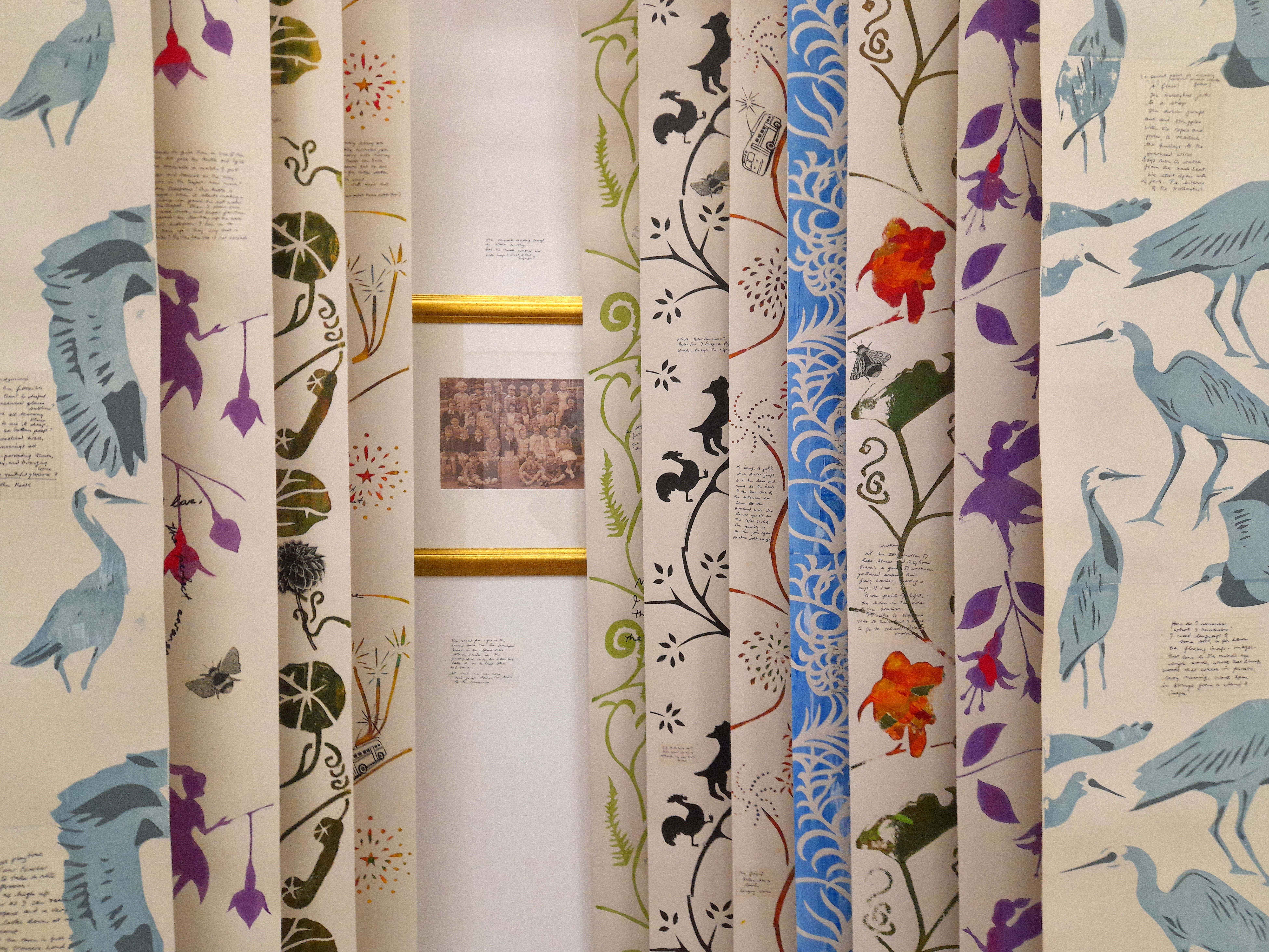
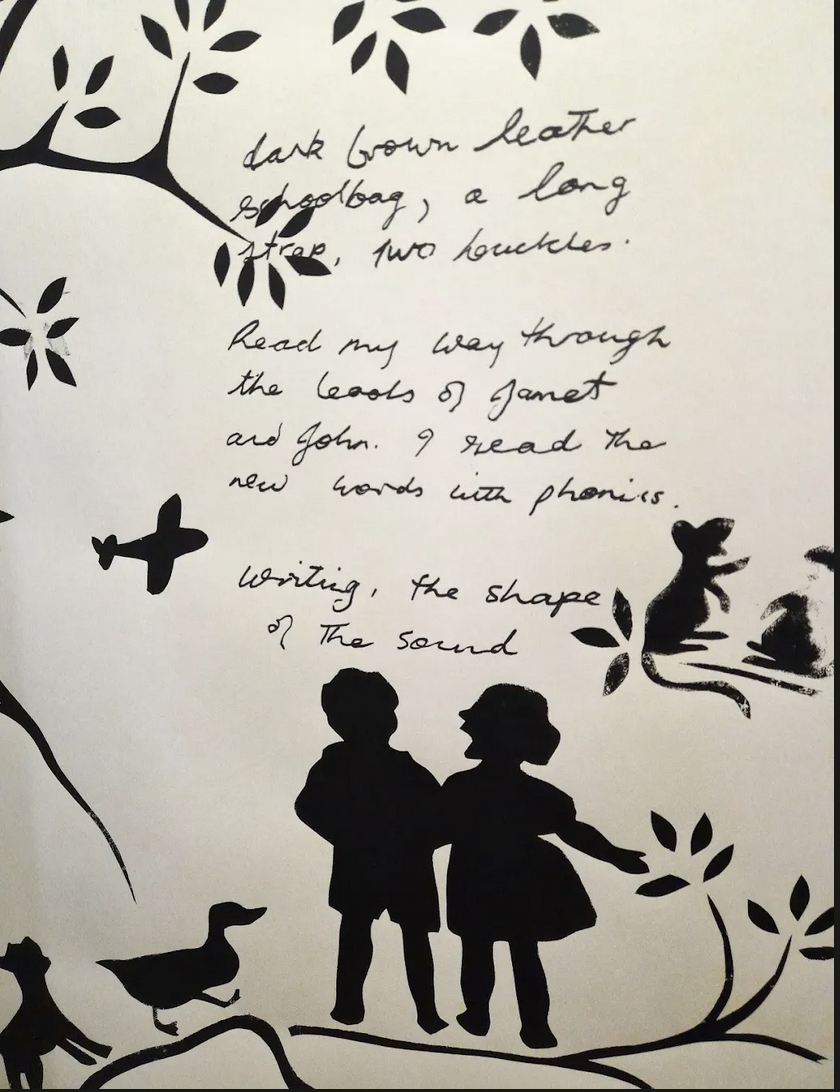
The Arts + Science exhibition is taking place over the next two weeks in Ōtepoti Dunedin. It features extraordinary collaborations between artists and scientists — most work visual art but some includes poetry.
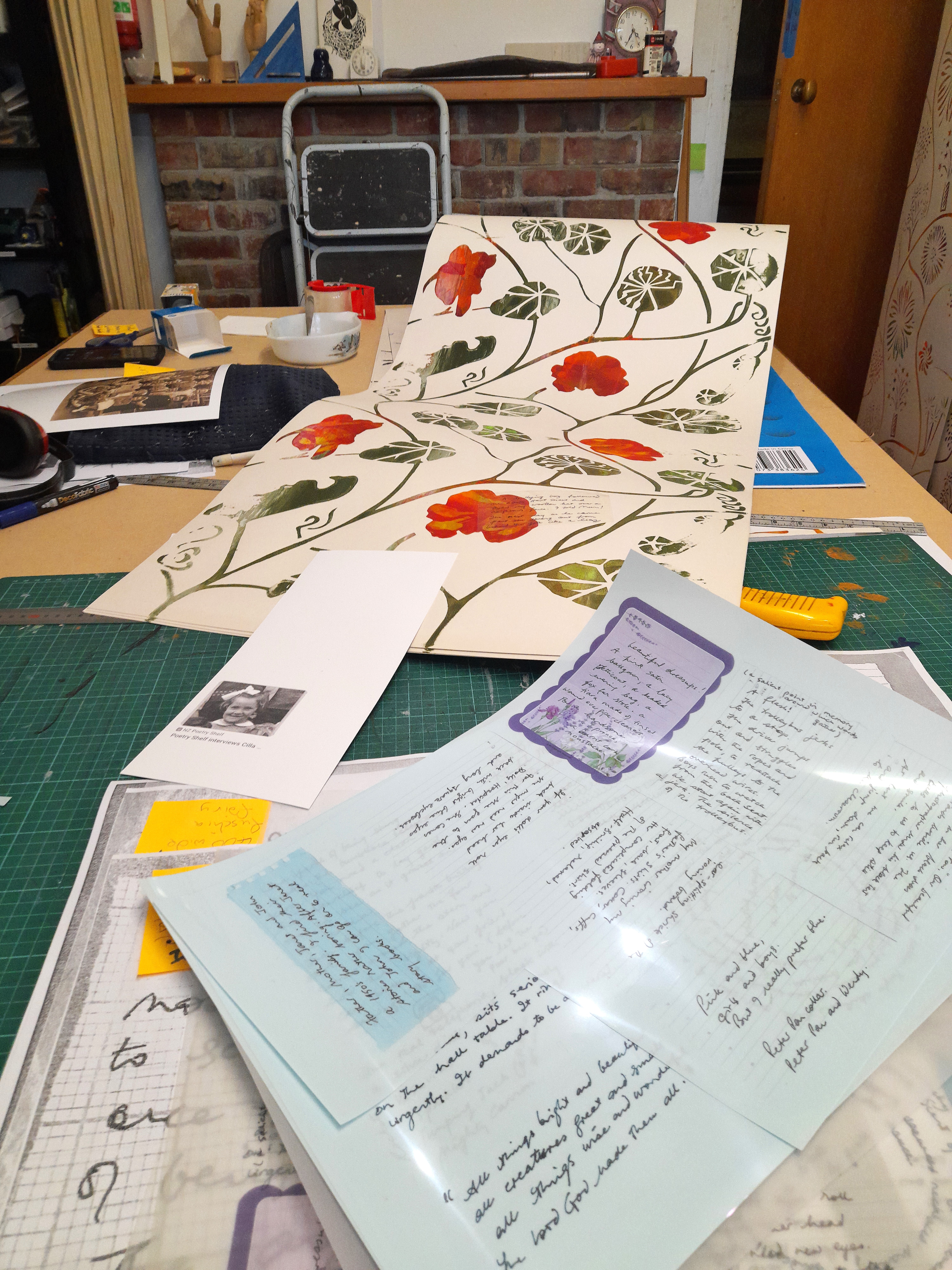
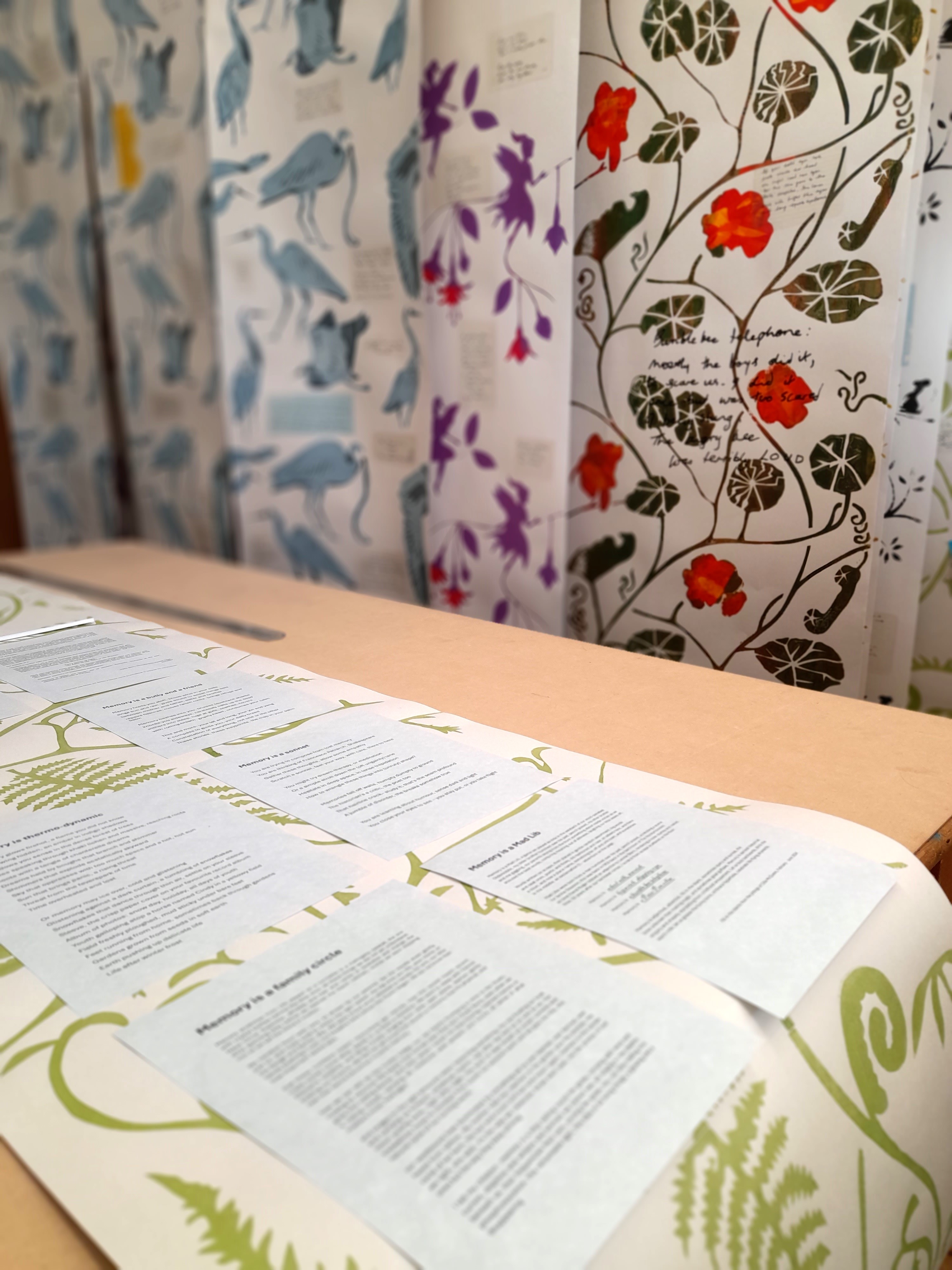
The theme this year is exploring memory, and Michelle Elvy‘s role was as historian/ poet, working with printmaker Manu Berry and psychologist Rachel Zajac. They made a series of layered wallpapers with the memories of Cilla McQueen, who also agreed to participate. Michelle has written a series of poems to accompany the hangings. They’ve been working on it since February.
Memory is a collect call
the moment you ring up and hear the faint connection, the click of contact, distant but familiar the moment before you speak, when there is only breath, when there is nothing but space
the hello?
the moment you will ask something of yourself that question hanging between all the yous the moment you hesitate, then wonder: do you accept the charges, or hang up?
I have been thinking a lot about the place of poetry in global catastrophe and the incomprehensible leadership in Aotearoa. How do we write? Read? Do we need comfort or challenge or both? This week Tate Fountain.
Has the local and global situation affected what or how or when you write poetry?
It has. I haven’t written much poetry at all, not for a while, beyond the usual cataloguing of images and thoughts. Mostly I’ve been wanting to read and listen and get out into the world, and within that, other things have felt more pressing, especially as a result of the ongoing genocidal campaign in Palestine and the political landscape here in Aotearoa.
Part of writing, for me (and for other poets, I think, some of whom have mentioned a similar thing in their own answers), is connecting with the world around me, with the people and environments therein—understanding the relationships we all have to each other, and how we’re informed by those bonds. These past months, there have been other vehicles for connection: rallies; petitions; boycotting companies aligned with widespread and well-documented harm; showing up for friends and the communities most impacted. Writing may well come to join that line-up, but for a while my focus has been on other things, and more drawn to other voices.
Does place matter to you at the moment? An object, an attachment, a loss, an experience? A sense of home?
Place sits, as both concept and reality, at the heart of everything—it’s intertwined with the idea of home, and all those ideas you’ve described, Paula: where your memories are anchored, where you feel least obliged to perform, where you can anticipate the movements of the sun and which plants are likely to be scorched through any given window without even having to check; the place where the people who love you live. That’s what makes all of the extreme colonial violence we’re seeing across the globe, and agendas here in Aotearoa seeking to impinge on the rights of Māori and disrespect this land, so devastating—and so vital to stand up against. Because it’s homes, and histories, and futures, all under threat. And it does matter. Place matters a lot.
I’m also conscious within this question that a lot of my work to date has focused on distance, the gap between rather than the current place/situation. (I mean, not massively surprising—that’s the musical theatre ‘I Want’ song, that’s the actor’s objective, that’s the dramatic impetus for plot, isn’t it?) Right now, though, on a personal level, the laundry list of differences between where I am and where I want to be is the shortest it’s ever been, and the discrepancy is manageable. I’m trying to make the most of being in this place, alongside people and restaurants and beachfront walks and galleries I love. It can, and often does, all change so quickly.
Are there books or poems that have struck a chord in the past year? That you turn to for comfort or uplift, challenge or distraction.
This past summer—seemingly distant now—was defined book-wise for me by all about love by bell hooks and Just Kids by Patti Smith. I feel like I was doing a lot of catching up on foundational texts. The former ended up covered in underlines and annotations and the latter was absolutely the kind of thing I’d have pastiched with heart-swelling, earnest naïveté had I read it as a young teenager (hello, The Bell Jar).
In terms of poetry, though, I’ve been reading a lot of Hala Alyan’s work; her poetry is so stunning, full of sensory detail and beautiful cadences. There’s a rhythm and colour to it that just hits me every time. We’ve also published two issues of Starling in the past year, plus finishing up the reading period and selection for Issue 18, which has meant proximity to lots of work that I’m very excited, touched, and inspired by. A great perk of editing!
What particularly matters to you in your poetry and in the poetry of others, whether using ear, eye, heart, mind – and/or anything ranging from the abstract and the absent to the physical and the present?
I want something that feels truthful. Something that feels free from affect and posture; something with a real, solid core. This can be in the voice of the poem, in the tone, in the subject, the formatting, all of it. You can be as verbose as you want, as eclectic—you can make a point of that—so long as it feels, to read it, like what you’ve written matters to you.
On a technical level, I love an adroit call back, and the circularity of that; I think it’s very clean and evidence of craft. I’m also really compelled by a closing line that takes you out at the knees. Sometimes that’s a matter of sticking the landing, but sometimes it can be about the jolt of—oh. That’s not what I was expecting. And yet of course that’s where we’ve ended up. Almost being left hanging on the last step, or with the rug pulled underfoot, the intention indisputable.
I’m also a sucker for a visual swing, provided that it heightens the work. Again, it’s that intent, that sense that both what you’re expressing and how you’re expressing it are important to you. And, apparently, based on some recent curatorial conversations, I do quite like a good swear word! I think that’s to do with getting to the point.
Is there a word or idea, like a talisman, that you hold close at the moment? For me, it is the word connection.
For me, it genuinely is always ‘love’.
Tate Fountain (she/her) is a writer, producer, performer, and literary editor based in Tāmaki Makaurau. She has worked for various arts and cultural festivals in Aotearoa, is the current Editorial Committee Lead for Starling, and in 2022 published her poetry collection, Short Films, with Tender Press.
There’s a passage toward the past, toward where I know we’re all headed, and it grows like a ladder
thru my heart, and those visions when I slept said, The other way is death. In the dark, I can’t see myself
leaving you. Stars covet the rigid land, your body, your short rabbit breaths that pattern the air. Who was I
that saw you there, on the platform, arm outstretched, waiting for the last train home. When I turned
to the sight of you, alone. When I turned and lost myself to the blue. Who was I before I met you.
Jackson McCarthy
Jackson McCarthy is a poet and musician from Auckland currently studying in Wellington. He is of mixed Māori and Lebanese descent. He was a finalist for the Schools Poetry Award 2021, and was one of the Starling Micro-Residents at the New Zealand Young Writers Festival 2023. You can read more of his work here.
I want to stay forever at my mother’s table describing the parts of the world that aren’t immediate. Remind her of the porchlight, like an ugly moon, pooling over the balcony of the childhood home.
How the silhouettes of dead moths ached like craters against the LED and the egg yolk of the night slipped down the back of our necks with a chill. She held her arms up to the night sky like a chalice to be filled.
I will make her recall the rosebud fist of the happiest baby in the hospital, orange robes like a mandarin rind and underneath tiny, pale and pink. Hong Kong humidity flushed her ripe and took her home, already having learned to smile.
I will say the memory of beautiful things is just as important as the image. This is hypocrisy: I will not say I’m so glad my mind has eyes I’m so glad to have you forever.
Sadie Lawrence in AUP New Poets 10, AUP,2024
The last few weeks I have been lingering over and loving AUP New Poets 10, edited by Anne Kennedy, and featuring the poetry of Tessa Keenan, romesh dissanayake and Sadie Lawrence.
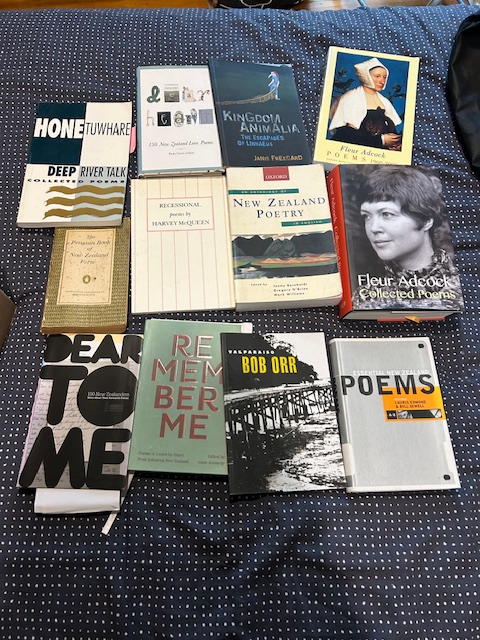
And I have been transforming our spare room into my poetry room! Such discoveries, such richness, old friends and new friends. It’s like a poetry refresher course, and I’m ready to dive back into blogging, reading and new writing. Photograph above is one cluster of books on the poetry-room bed waiting to be shelved!
Listener Books Editor, Mark Broach, has dedicated this week’s issue to books (that said the magazine always features an excellent range of reviews). Mark surveys some of the best books of the year so far, local and global (I have circled a few for my next online spree). There is a feature on genre writers, another on Māori writers surfing an international demand for their work, Kirsty Gunn writes a brilliant piece on ‘dangerous’ fiction, there’s a new poem by James Brown, plus the usual gift of reviews (including Vincent O’Sullivan‘s posthumous volume, and new books by CK Stead, Majella Cullinane, Jake Arthur).
Several things this week prompted me to worry that I don’t pay people who contribute to my blogs, especially in such tough, challenging times. I’m in a privileged position at the moment where I can write and blog without grants but I don’t have the energy to apply for funding to pay contributors. My energy jar is still small, and my recovery road still bumpy, my blogs hanging on by skinny threads, so I carefully choose how I use my storage jar. I know from your emails how important self care is these days, and I always welcome your ‘no’ as much much as I appreciate your ‘yes’. When I posted my payment concerns on my social media page, your replies not only supported Poetry Shelf, but our reading and writing communities. Thank you.
I was delighted to read the programme for WORD Christchurch Festival. Programme director, Kiran Dass, has curated a festival that is a sublime celebration of our books and authors. Love it so much! Media release.
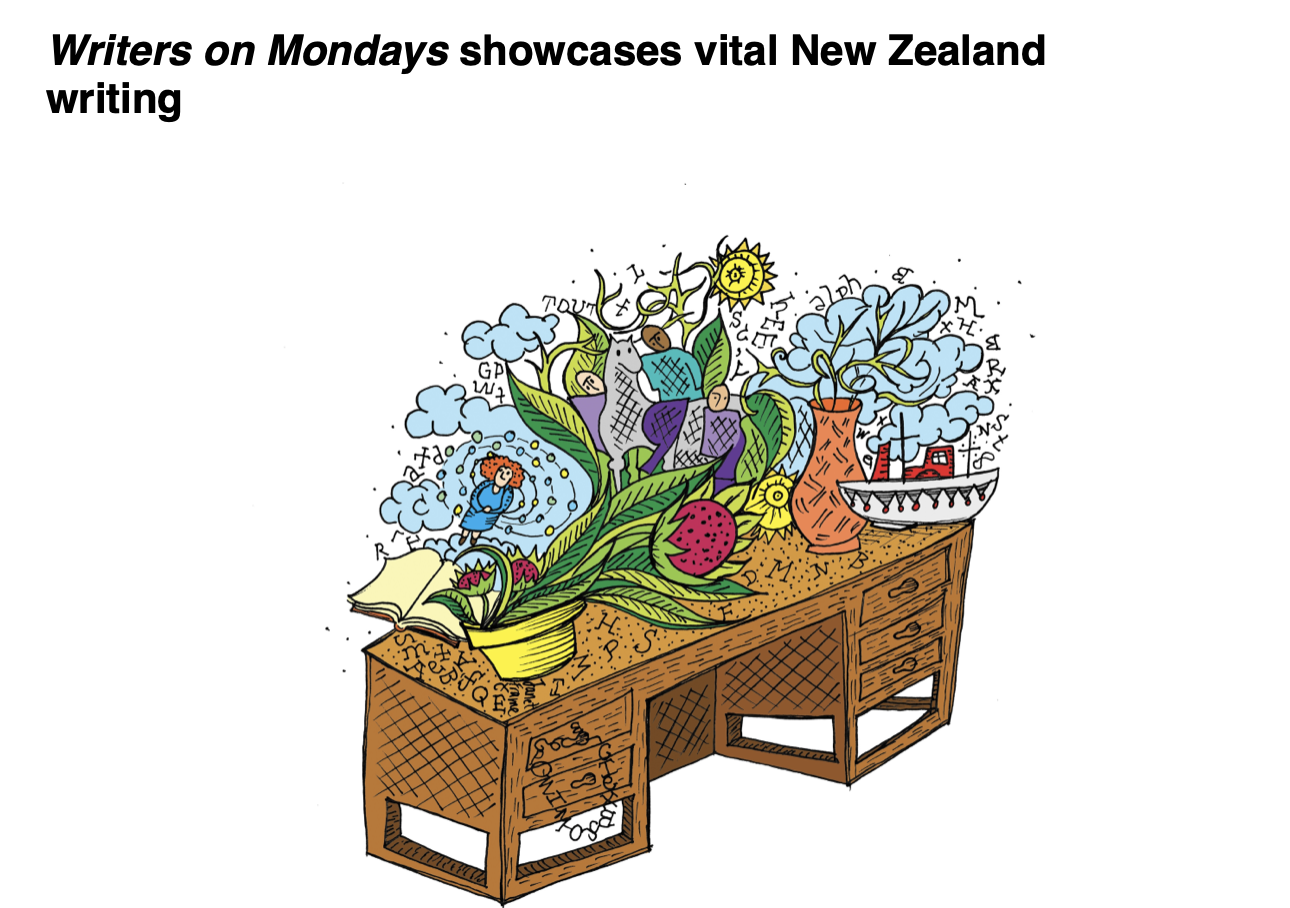
Writers on Mondays resumes this coming week. The series, curated by IIML Senior Lecturer Chris Price, is bigger than ever. Seventy-six poets, novelists, playwrights, and nonfiction writers will take part in 14 events across four venues between 8 July and 30 September. Full programme here. It’s a beauty!
An invite: Last year I had to park my Road Trip poetry series, clusters of poems attached to various towns and cities in Aotearoa, but am hoping to reboot that soon. I only managed two stops! Poetry Shelf does not accept submissions for the Monday Poem spot but I am inviting you to send poems for consideration for any of these places on my Towns and Cities road trip:
Deadline: 14th July Email: paulajoygreen@gmail.com Places yet to do: Ōtautahi Christchurch Papaioea Palmerston North Tāmaki Makaurau Auckland Ngāmotu Palmerston North Te Tai Tokerau Northland towns and cities Maniototo Central Otago towns Te Ika-a-Māui North Island towns Te Waipounamu South Island towns
New books in my letter box:
Vultures, Jenny Rockwell, Te Herenga Waka University Press, 2024 Undressing in slow motion, Michael Giacon, GTM Press, 2024 Departures, Dunstan Ward, Cold Hub Press, 2024 Guiding Lights: The extraordinary lives of lighthouse women, Shona Riddell, EXISLE, 2024
A compelling line-up of established writers and fresh literary talent will be showcased in Wellington this winter as Writers on Mondays returns. This free lunchtime series highlighting new books and writers is run by the International Institute of Modern Letters (IIML), the creative writing powerhouse of Te Herenga Waka—Victoria University of Wellington, in conjunction with Te Papa Tongarewa and Circa Theatre.
This year’s series is bigger than ever. Seventy-six poets, novelists, playwrights, and nonfiction writers will take part in 14 events across four venues between 8 July and 30 September.
“We’re blown away by the depth and breadth of New Zealand writing in this programme,” says IIML Senior Lecturer Chris Price. “In challenging times, these writers are giving us some of their best work.”
The 2024 series includes literary couple Anna Smaill (Bird Life) and Carl Shuker (The Royal Free) in conversation with Emily Perkins about their new novels, Christine Jeffs’ film of Shuker’s A Mistake, and their writing lives. Hinemoana Baker returns from Germany to join award-winning poets James Brown and Tracey Slaughter in sharing their latest work and pondering how poetry talks back to its time. Tina Makereti talks about her new novel The Mires, described by Shankari Chandran as a book about “the monsters we’ve created and the power we have to stop them”.
The rising popularity of creative nonfiction is under the spotlight. Acorn Prize winner Airini Beautrais (The Beautiful Afternoon) and Flora Feltham (Bad Archive) will appear in conversation about their new essay collections, and Emeritus Professor Harry Ricketts (First Things) and Talia Marshall (Whaea Blue) discuss their keenly anticipated memoirs. Other highlights include Te Herenga Waka/Creative New Zealand Writer in Residence Ingrid Horrocks on her shift from nonfiction to fiction, and poets selected and introduced by Poet Laureate Chris Tse from his edition of Ōrongohau | Best New Zealand Poems.
Te Papa will be home to most of the series, with events in both Rongomaraeroa and Te Huinga Conference Centre. In a glimpse of future work emerging from the IIML’s MA workshops, scriptwriting students will have their work brought to life in lunchtime performances at Circa Theatre, while the next wave of novelists, poets, and creative nonfiction writers will read their work in special evening events at Meow. The series is supported by the Letteri family.
Writers on Mondays will run from 12.15—1.15 pm each Monday from 8 July to 30 September 2024 at Te Papa Tongarewa and Circa Theatre, with two special evening sessions at Meow. Admission is free and all are welcome. The full programme can be viewed here.
On the lake, a circle of verbs On the sheet, a bed of roses
Paula Green
There was so much love for the first suite of couplets I have assembled a second one. I am often drawn to a single couplet on the page in a poetry collection, to how it can lead you deeper within the poem or carry you beyond its borders, on wings made of fire or clover honey or garden path. Couplets can rhyme or not rhyme, they might cluster together in suites, hide secrets, get personal, enigmatic, visually descriptive, opt for tongue-in-cheek or serious edge. Couplets are open-poem zones, and I love that. I love how they drop into my head in the middle of the night and send me into sweet miniature wordfalls.
Thank you to all the poets who contributed to Couplets 2.
Couplets 2
Cilla McQueen
Turtles
Consider, poet, Whose backs you’re standing on.
Megan Kitching
Irrepressible
Look: in the crack at the turn of this verse, a dandelion.
Sirens
Each morning, the plangent sounds of shorebirds make harder demands.
Always greater than
The questions if only I’d asked > The years we coincided.
Anuja Mitra
Incision
When memory strikes, it slices clean through: sharp, then hot, in the way of a wound.
Joshua Toumu’a
small funeral / carbon zero
the day we lowered my mother into the earth, the countryside rejected her body and swelled up with frost.
A Pearl
Spitting sand into the kitchen sink! Alas, we have not yet found a pearl made of our grief.
Making Sense
What’s to a year but another ring? What’s to a cat but to look at a king?
Vincent O’Sullivan
Chrysalis
A train enters a tunnel. Comes out as sky.
in Blame Vermeer, Te Herenga Waka University Press, 2007
Os
My initials are bone to the end, life gone flat out.
in Blame Vermeer, Te Herenga Waka University Press, 2007
Watching the Hawkduns
Look, let your eye track them, eastward and back, Rucking their curtains along winter’s rack.
in Further Convictions Pending: Poems 1998 – 2008, THWUP, 2009
Murray Edmond
Once, a tick and tock of mechanical clocks. Now, digital silence, like walking in socks.
Le coeur dans le coeur, la larme dans la larme, Pour cette chanteuse et sa voix et son charme.
Ēnei ngā rā o te wā Matariki, E iwa ngā whetu ki runga piki.
When it comes to literary crime, The worst of all: couplets that don’t rhyme!
Elizabeth Smither
The trampoline instructor’s wake sends her adoring pupils into space
Kay McKenzie Cooke
light fight
A candle in the sun. What cancels out the other? Neither one.
out of time
Funny how when talking to someone with dementia time turns to jelly
she liked him
She liked him and when in the middle of an animated discussion his glasses slipped off his nose, she liked him even more
Fiona Kidman
My sinuses are a saxophone, the music of the face singing to me, my face pressed against the pillow .
Sitting beneath a feijoa tree eating green grey flesh in greedy gulps without a spoon.
Majella Cullinane
Morning Prayer After Tchaikovsky
Half-way through your journey you are called out. From the dimmed room of your making, we watch
you moving like a corridor across a sea, or the cool fingers of autumn stroking a tree.
Your small hand flexes and tightens, your spine curves against me like a horseshoe, a strung bow.
The brazen scarlet of gum tree fades on the hill and like the season, it is still early days for you and me;
for my bones to soften, my body to swell. Wait for me in the undertow of waves. It is there
I will catch you my little boy, and when you emerge we can explore the novelties of light.
from Guarding the Flame, Salmon Poetry, 2012
Reihana Robinson
wild, wild turkey sauntering by leave a feather to haunt my eye
as evidence of your dusky stroll past fence and field, you rock and roll
a sing-song gait by any standards interrupted by evening bandits
from ‘Crow‘
James Norcliffe
After the forthcoming plague
Long after the humans left, the rehearsal room was empty. Still, each morning in the canopy, the birds sang Colonel Bogey.
Footnoteto Sodom
Sulphur made the camels sick, but Mrs Lot was good to lick
Claire Orchard
Dog park reflection
Zeus would be well-suited to a leadership role. Even, I dare say, a ministerial portfolio.
Prop
Now I’m using a crutch, people stop and talk to me a lot.
Whenever I encounter men on crutches they always suggest we race.
Wow, men on crutches have grandiose ideas of their own abilities.
Washing line
A sky full of soft, pale sheets flapping away away away.
If the wind ceased maybe the silence would be unbearable.
Summer is ending and it always goes like this, in just a minute.
Next to water I think I most appreciate sunlight.
I had a thought then about sunlight but it faded.
On the path, a song of winter On the tongue, an urgent whisper
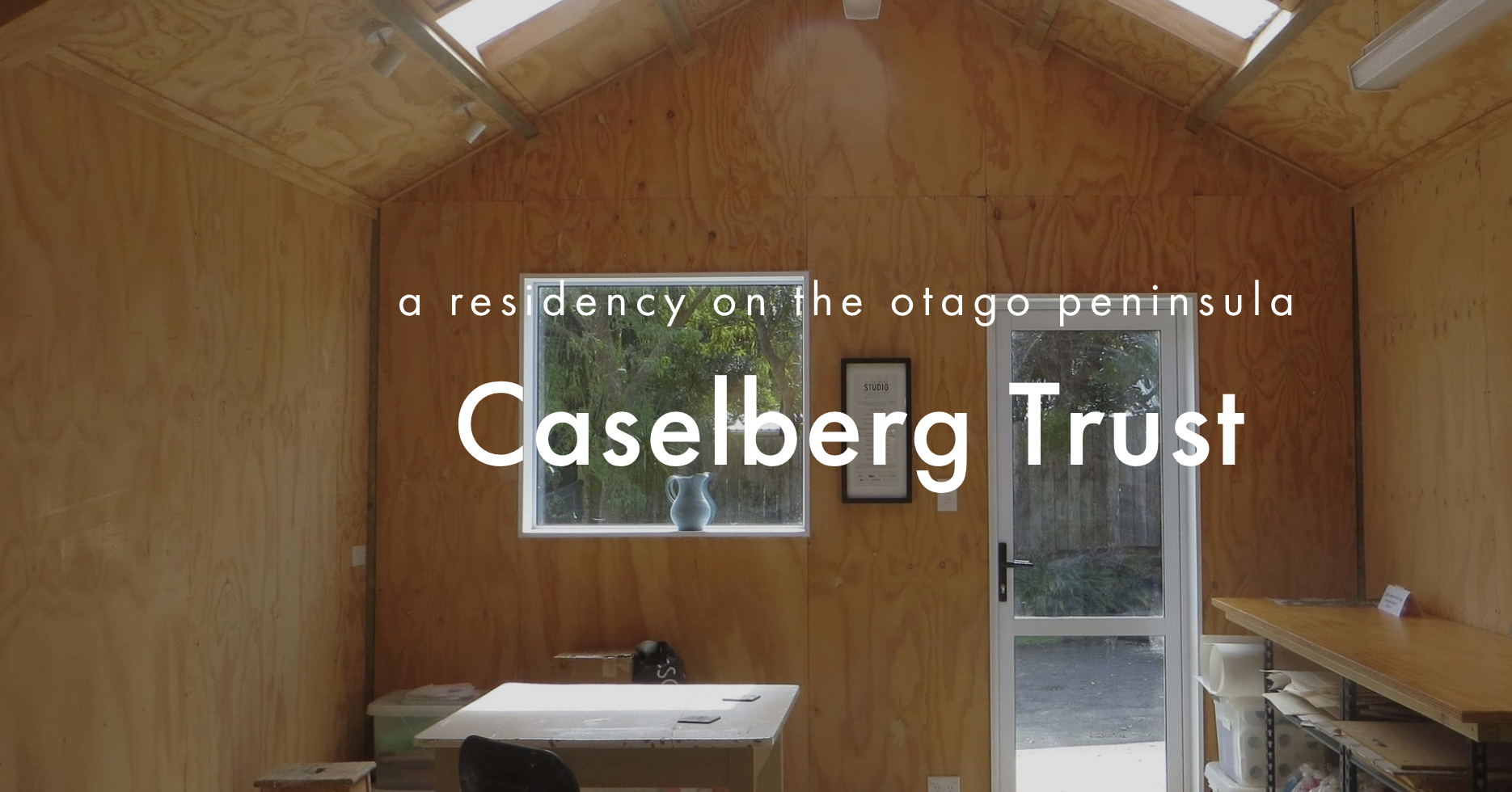
The Caselberg Trust International Poetry Prize is open for submissions until 5pm on 31 July 2024.
Entries will be judged blind by judge, Alan Roddick. First Prize is $500 (plus one-week stay at the Caselberg house at Broad Bay, Dunedin). Second Prize is $250; and there are up to 5 Highly-Commended awards (no monetary prizes).
The first- and second-placed poems will be published in the November issue of Landfall, and all winning and highly-commended entries will appear on the Caselberg Trust website (copyright remaining with the authors).




 NZ Poetry Shelf